

Search engine optimization (SEO) is essential for online visibility. To build a strong SEO foundation, it’s important to understand how meta tags and HTML elements work together to help search engines interpret, index, and rank your content effectively—while also improving user experience.
This explains the 10 most important meta tags and HTML elements for SEO success, complete with best practices, examples, and optimization tips. Whether you’re a digital marketer, SEO professional, developer, blogger, or business owner, mastering these on-page SEO elements is critical for long-term search performance.
Search engines rely on meta tags and HTML structure to understand how content should be indexed, displayed, and ranked. When these elements are implemented correctly, they improve crawlability, accessibility, and user experience—creating a strong foundation for both traditional SEO and AI-driven search results.
The sections below break down the most important meta tags and HTML elements every website should optimize, along with practical best practices and real-world examples.
1. Meta Title Tag (<title>)
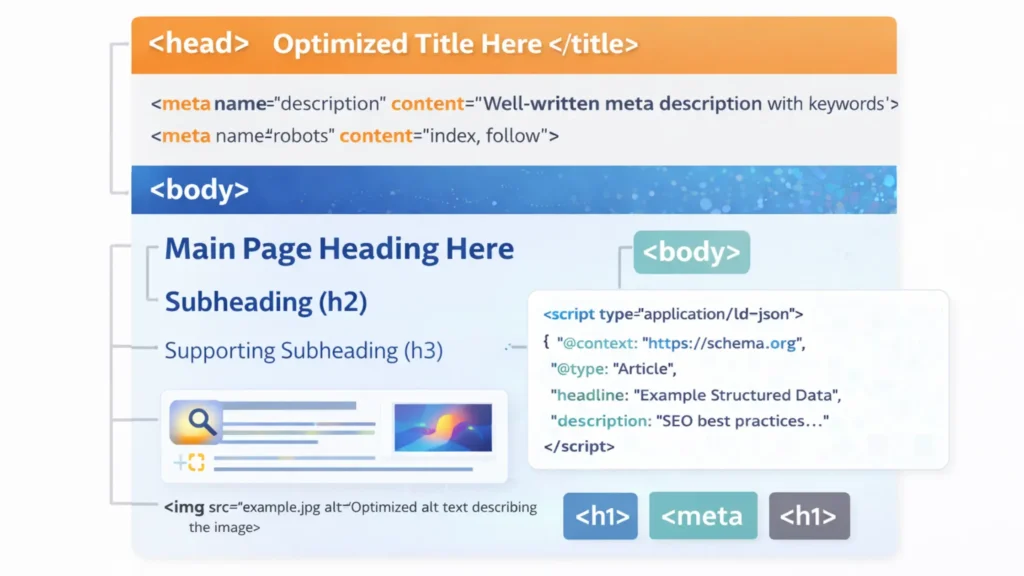
What It Is
The <title> tag defines the title of a web page. It appears as:
- The clickable headline in search engine results (SERPs)
- The browser tab title
- The default title when shared on social media (if Open Graph tags aren’t set)
<title>Your SEO-Optimized Page Title Here</title>
Why It Matters
The title tag is one of the strongest on-page SEO ranking factors. It:
- Influences search rankings
- Impacts the click-through rate (CTR)
- Signals topic relevance to search engines
Best Practices
- Keep titles between 50–60 characters
- Place primary keywords near the beginning
- Write compelling, human-friendly headlines
- Avoid keyword stuffing
- Use unique titles for every page
- Add brand names when appropriate (usually at the end)
Examples
<title>10 Proven SEO Tags to Boost Your Rankings</title>
<title>Noise-Canceling Headphones | 30-Hour Battery | SoundMax</title>
2. Header Tags (<h1>–<h6>)
What They Are
Header tags structure your content hierarchically:
- <h1>: Main page topic
- <h2>–<h6>: Subsections and supporting content
Why Header Tags Matter
- Help search engines understand content structure
- Improve readability and accessibility
- Support keyword relevance and voice search optimization
Best Practices
- Use only one <h1> per page
- Follow a logical hierarchy (h1 → h2 → h3)
- Include keywords naturally
- Avoid using headers for styling alone
- Keep headings clear, descriptive, and concise
Example
<h1>Top 10 HTML Tags and Meta Elements for SEO</h1>
<h2>Meta Title Tag</h2>
<h3>Best Practices</h3>
3. Image Alt Text (alt Attribute)
What It Is
Alt text describes images for:
- Search engines
- Screen readers (accessibility)
- Browsers when images fail to load
<img src=”seo-checklist.jpg” alt=”Checklist of top HTML tags for SEO optimization” />
Why It Matters
- Improves image SEO
- Enhances accessibility (WCAG compliance)
- Adds contextual relevance to pages
Best Practices
- Describe the image accurately
- Keep alt text under 125 characters
- Include keywords only when relevant
- Avoid “image of” or “picture of.”
- Use empty alt (alt=””) for decorative images
4. Canonical Tag (<link rel=”canonical”>)
What It Is
The canonical tag tells search engines which URL is the preferred version when duplicate or similar pages exist.
<link rel=”canonical” href=”https://www.example.com/preferred-url” />
Why It Matters
- Prevents duplicate content issues
- Consolidates ranking signals
- Improves crawl efficiency
Best Practices
- Use absolute URLs
- Set self-referencing canonicals
- Ensure canonicals match indexed URLs
5. Robots Meta Tag (<meta name=”robots”>)
What It Is
Controls indexing and link-following behavior.
<meta name=”robots” content=”noindex, nofollow” />
Best Practices
- Use index, follow for important pages
- Apply noindex to low-value pages (thank-you, login)
- Avoid conflicting directives
- Place inside the <head> section
6. Open Graph Tags (og:)
What They Are
Open Graph tags control how pages appear when shared on social media platforms.
<meta property=”og:title” content=”10 Must-Use HTML Tags for SEO Optimization” />
<meta property=”og:description” content=”Learn which HTML and meta tags improve SEO visibility.” />
<meta property=”og:image” content=”https://www.example.com/seo-cover.jpg” />
<meta property=”og:url” content=”https://www.example.com/seo-guide” />
Best Practices
- Always include title, description, image, and URL
- Use high-quality images (1200×630 px)
- Match the OG content with the page content
7. Schema Markup (Structured Data)
What It Is
Schema markup helps search engines understand content context and enables rich results.
<script type=”application/ld+json”>
{
“@context”: “https://schema.org”,
“@type”: “Article”,
“headline”: “Top 10 Meta Tags and HTML Elements for SEO”,
“description”: “Learn essential HTML and meta tags for SEO success.”,
“datePublished”: “2025-04-25”
}
</script>
Why It Matters
- Improves eligibility for rich snippets
- Supports AI-generated summaries
- Enhances CTR and trust
8. Responsive Meta Tag (<meta name=”viewport”>)
<meta name=”viewport” content=”width=device-width, initial-scale=1.0″ />
Why It Matters
- Essential for mobile-first indexing
- Ensures responsive display on all devices
- Prevents layout and usability issues
9. XML Sitemap
What It Is
An XML sitemap helps search engines discover and prioritize important pages.
<url>
<loc>https://www.example.com/seo-guide</loc>
<lastmod>2025-04-30</lastmod>
</url>
Best Practices
- Include all indexable pages
- Keep it updated automatically
- Submit via Google Search Console
- Use <lastmod> tags
- Limit size to 50,000 URLs per file
10. Internal Linking (On-Page SEO Element)
Why It Matters
- Improves crawlability
- Strengthens topical authority
- Enhances user navigation
Best Practices
- Link related pages naturally
- Use descriptive anchor text
- Avoid excessive linking
- Prioritize important pages
Common SEO Mistakes to Avoid
- Duplicate or missing title tags
- Multiple <h1> tags
- Missing alt text
- Incorrect canonical URLs
- Blocking key pages with noindex
- Forgetting mobile optimization
FAQs: Meta Tags and HTML Elements for SEO
Do meta tags still matter for SEO in 2025?
Yes. Title tags, meta descriptions, canonicals, and robots tags remain essential ranking and visibility signals.
How many meta tags should a page have?
There’s no fixed number, but every page should include title, meta description, canonical, viewport, and robots tags where appropriate.
Is schema markup required for SEO?
Not required, but highly recommended for AI search visibility and rich results.
Can incorrect meta tags hurt SEO?
Yes. Misconfigured tags can prevent pages from ranking or being indexed.
Final Thoughts
Mastering these 10 essential meta tags and HTML elements is fundamental to effective SEO. Each element plays a unique role in helping search engines understand, index, and rank your content—while also improving user experience and accessibility.
SEO is not a one-time task. As you publish new pages and update existing ones, continually optimizing your meta tags and HTML structure will ensure your site remains competitive in both traditional and AI-driven search environments.
Ready to Optimize Your Website for Modern SEO?
At Genbe, one of the best digital marketing companies in Visakhapatnam, we help businesses build strong on-page and technical SEO foundations that align with both traditional search and AI-powered results.
From meta tag optimization and structured data implementation to full SEO audits and content strategy, Genbe delivers data-driven solutions designed for long-term growth—not quick wins.
👉 Partner with Genbe to strengthen your SEO performance and future-proof your search visibility.Meta Description:
Learn the 10 most important meta tags and HTML elements for SEO success, including best practices, examples, and on-page optimization tips.