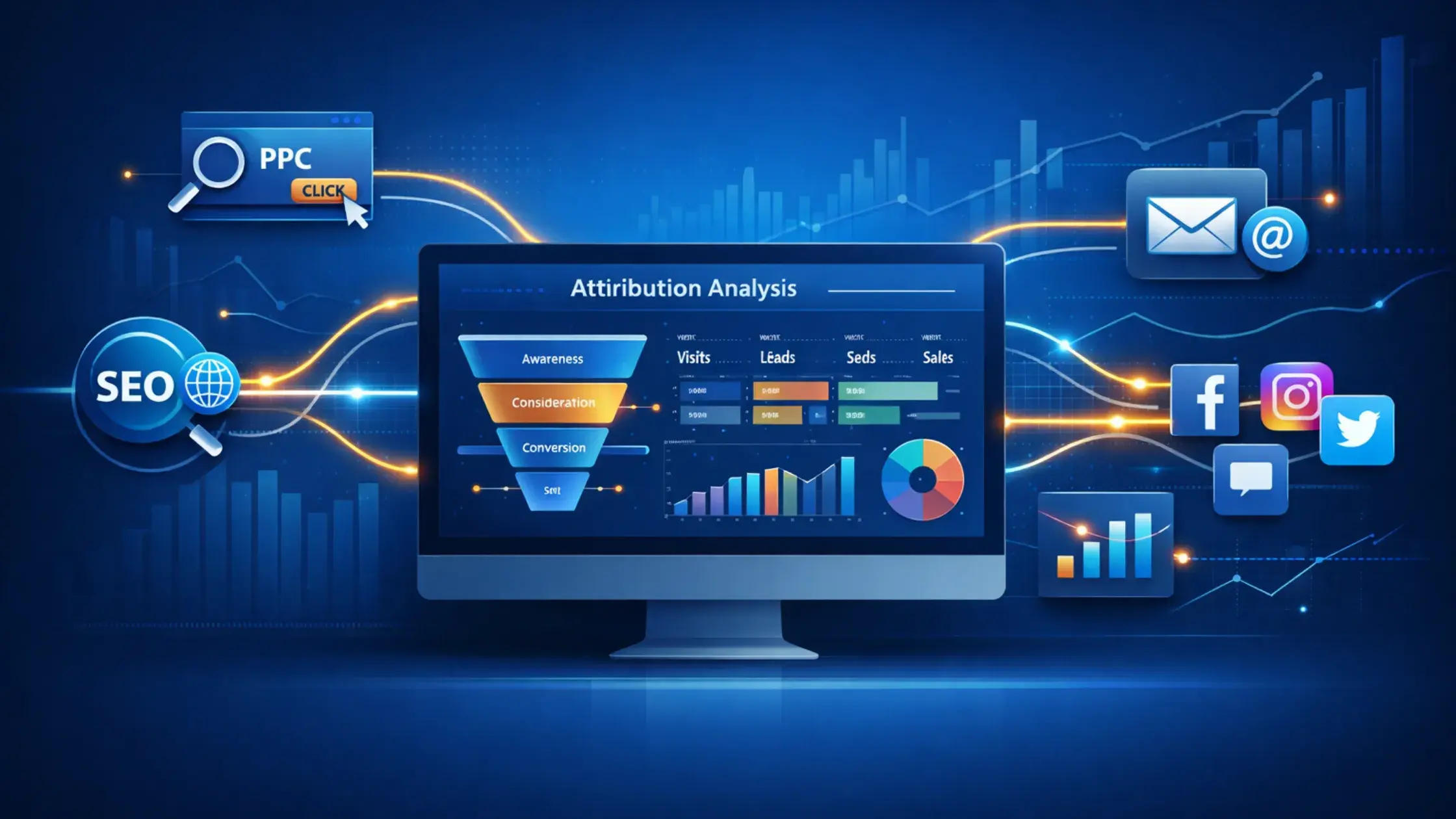
Digital marketing today generates enormous volumes of data, yet many businesses still struggle to identify which campaigns truly drive revenue. Customers rarely convert after a single interaction.
Instead, they engage with multiple touchpoints — organic search, paid ads, social media, email marketing, and retargeting — before making a final decision. Without a structured approach to attribution modeling in digital marketing, companies risk misallocating budgets and undervaluing high-impact channels. A well-implemented data-driven attribution strategy provides clarity, accuracy, and measurable insight.
It transforms fragmented marketing data into actionable intelligence that improves ROI, strengthens decision-making, and supports sustainable business growth.
The Core Challenge: Why Modern Marketing Attribution Is So Complex
The modern buyer journey is no longer linear. A prospect might discover your brand through SEO, engage with your LinkedIn content weeks later, click on a Google Ads campaign, receive nurturing emails, and finally convert after a retargeting ad.
When businesses rely solely on traditional last-click attribution models, they create blind spots that distort performance insights.
Key challenges include:
- Incomplete visibility into multi-channel customer journeys
- Underestimating awareness channels like SEO and content marketing
- Overvaluing bottom-of-funnel paid ads
- Difficulty proving the ROI of long-term strategies
- Fragmented cross-device tracking
For businesses searching for “how to choose the right attribution model for business growth,” the first step is recognizing that attribution complexity is unavoidable — but manageable with the right framework.
What Is Attribution Modeling in Digital Marketing?
Attribution modeling is a structured method for assigning value to different marketing touchpoints based on their influence on conversions. Instead of crediting only one interaction, modern multi-touch attribution modeling evaluates the entire journey.
This approach enables marketing leaders to:
- Understand how channels work together
- Measure assisted conversions accurately
- Identify hidden revenue drivers
- Improve campaign forecasting
- Optimize customer acquisition strategies
A strong marketing attribution analytics platform integrates website data, CRM systems, paid media platforms, and email automation tools to provide a unified performance view.
Deep Dive: Types of Attribution Models and When to Use Them
First-Touch Attribution
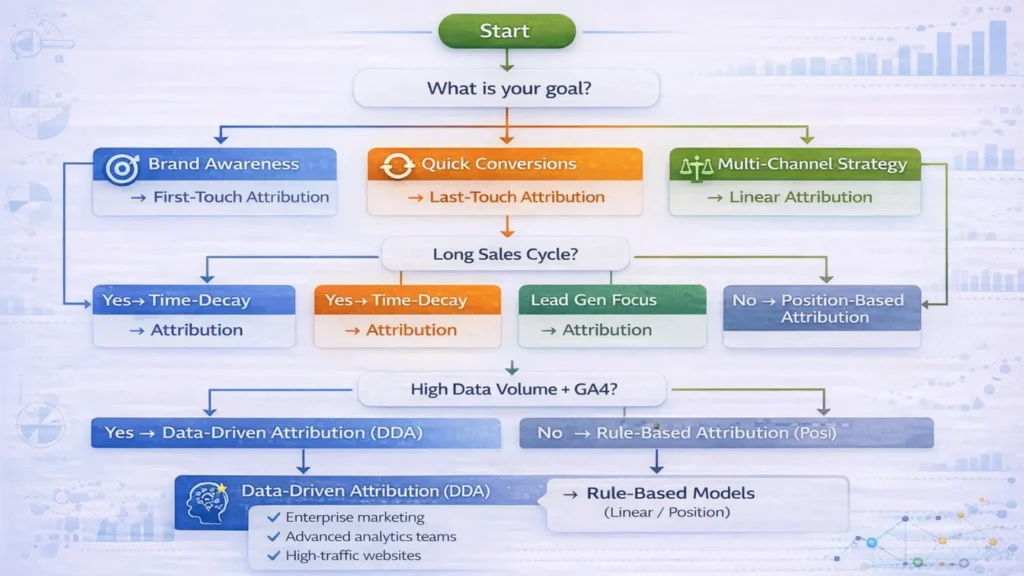
This model assigns full credit to the first interaction. It is useful for analyzing brand awareness efforts and identifying which channels attract new audiences.
However, it fails to recognize nurturing stages that push prospects toward conversion.
Last-Touch Attribution
Last-touch gives 100% credit to the final interaction before conversion. While simple to implement, it creates an incomplete view of the marketing ecosystem.
Businesses relying exclusively on last-click attribution often cut top-of-funnel channels, not realizing their indirect influence.
Linear Attribution
Linear attribution distributes credit evenly across all touchpoints. It provides balanced insights and works well for organizations implementing a structured multi-channel attribution strategy for SaaS or B2B companies.
Time-Decay Attribution
Time decay assigns more weight to interactions closer to the conversion. This model is ideal for long sales cycles, especially in B2B environments where nurturing plays a critical role.
Position-Based (U-Shaped) Attribution
This model gives significant credit to the first and lead-conversion touchpoints while distributing the remainder across middle interactions. It works particularly well for businesses focused on lead-generation funnels.
Data-Driven Attribution (DDA)
Data-driven attribution uses machine learning to analyze historical data and assign credit based on actual behavioral patterns. It is now the preferred approach in GA4 attribution modeling and advanced enterprise analytics platforms.
For companies seeking “enterprise attribution modeling solutions,” this model delivers the most accurate insights.
Why Traditional Attribution Models Limit Growth
Relying on outdated attribution frameworks leads to strategic inefficiencies.
For example:
- SEO may generate initial discovery, but receives no credit in last-click models
- Email nurturing may influence decisions, but appears undervalued
- Paid search may appear overly dominant
Without cross-channel visibility, businesses misinterpret performance data.
Companies implementing cross-channel marketing attribution analytics gain clarity into how awareness, consideration, and decision stages interact. This leads to better resource allocation and higher long-term profitability.
How Data-Driven Attribution Improves Marketing ROI
Advanced data-driven attribution tools solve modern measurement challenges by integrating multiple data sources into a unified framework.
Key benefits include:
- Accurate revenue attribution across channels
- Reduced customer acquisition cost (CAC)
- Higher return on ad spend (ROAS)
- Smarter budget redistribution
- Improved conversion rate optimization strategies
- Predictive performance insights
For organizations exploring a comparison between “data-driven attribution vs last-click attribution comparison,” the difference lies in depth and accuracy. Data-driven models reflect actual influence rather than simplified assumptions.
Attribution Modeling in GA4: A Modern Analytics Standard
Google Analytics 4 has redefined attribution measurement by introducing built-in machine learning capabilities.
With GA4 attribution modeling, businesses can:
- Compare first-touch, last-touch, and data-driven models
- Track cross-device user behavior
- Measure assisted conversions
- Analyze conversion paths
Companies searching for “how to implement GA4 attribution modeling for business growth” benefit from its enhanced privacy compliance and predictive capabilities.
Privacy-First Measurement and the Future of Attribution
With third-party cookies being phased out, businesses must rely on first-party data collection.
Modern cookieless attribution modeling strategies emphasize:
- Server-side tracking
- Consent-based analytics
- CRM data integration
- AI-powered predictive modeling
The future of attribution lies in privacy-safe, machine learning-driven systems that balance compliance with performance optimization.
B2B vs B2C Attribution Strategies
B2B attribution modeling requires deeper analysis due to longer sales cycles and multiple stakeholders. Companies often rely on multi-touch attribution solutions integrated with CRM platforms.
B2C businesses, particularly eCommerce brands, may prioritize time-decay or position-based models due to shorter buying journeys.
Understanding the difference between “attribution modeling for B2B lead generation” and B2C strategies ensures more accurate performance evaluation.
Key Metrics to Measure Attribution Success
Implementing attribution modeling requires tracking specific performance indicators:
- Customer Acquisition Cost (CAC)
- Cost Per Acquisition (CPA)
- Marketing Qualified Leads (MQLs)
- Conversion Rate by Channel
- Assisted Conversion Value
- Customer Lifetime Value (CLV)
- Return on Marketing Investment (ROMI)
A robust marketing attribution analytics platform ensures these metrics align with revenue goals.
Common Attribution Mistakes to Avoid
Businesses often make preventable errors, such as:
- Over-relying on one attribution model
- Ignoring assisted conversion reports
- Failing to integrate CRM and sales data
- Not revisiting the attribution strategy during scaling phases
- Overlooking data privacy regulations
Addressing these issues requires expert strategy and technical implementation.
How Genbe Helps Businesses Build Advanced Attribution Frameworks
At Genbe, we specialize in designing customized data-driven attribution modeling strategies tailored to each client’s business model.
Our approach includes:
- Comprehensive attribution audits
- GA4 implementation and optimization
- Multi-touch attribution framework design
- CRM and analytics platform integration
- Custom reporting dashboards
- Ongoing performance optimization
We help businesses move beyond guesswork and build scalable marketing ecosystems driven by measurable insights.
Frequently Asked Questions
What is the best attribution model for digital marketing?
The best model depends on your industry, sales cycle, and channel mix. Many organizations adopt data-driven attribution modeling for the most accurate results.
How does attribution modeling improve ROI?
It reveals which channels truly drive conversions, enabling businesses to optimize budgets and reduce wasted spend.
Is GA4 better for attribution modeling?
Yes. GA4 provides enhanced machine learning capabilities and cross-device tracking for more accurate measurement.
Can small businesses benefit from multi-touch attribution?
Absolutely. Even small businesses can improve campaign performance using simplified multi-channel attribution strategies.
Conclusion
Attribution modeling in digital marketing has become essential for sustainable growth. As customer journeys grow increasingly complex, businesses that rely on outdated models risk misallocating resources and limiting revenue potential. A structured data-driven attribution strategy provides full visibility into marketing performance, enabling smarter decisions and scalable growth.
If your organization is ready to implement advanced marketing attribution analytics and unlock measurable growth, Genbe is here to help. Our team designs customized attribution frameworks that align with your business objectives and maximize ROI.
Contact Genbe today to transform your marketing data into actionable intelligence and build a scalable, performance-driven future.