
Most marketing videos fail before the message even begins.
Viewers click away within seconds — not because the video is ineffective, but because generic content no longer resonates. Modern audiences expect relevance. They want brands to understand their needs, anticipate their preferences, and speak directly to their situation.
In a digital ecosystem saturated with content, personalization is no longer a competitive advantage — it’s a requirement.
This is where personalized video marketing becomes transformative.
Instead of delivering one static message to everyone, personalized video uses behavioral data, analytics, and segmentation to create tailored viewing experiences. It allows brands to communicate with precision, strengthen engagement, and significantly improve conversion rates.
In this comprehensive guide, you’ll learn:
- Why traditional video marketing underperforms
- How personalized video works
- The strategic framework behind high-performing campaigns
- How data and analytics drive measurable ROI
- How Genbe helps brands implement scalable personalized video strategies
Let’s explore how personalized video can become your most powerful marketing growth lever.
The Core Problem with Traditional Video Marketing
Businesses invest heavily in video production. High-quality visuals, professional editing, and creative storytelling often consume significant budgets. Yet despite these investments, results frequently fall short.
Common challenges include:
- Low average watch time
- Weak engagement rates
- Minimal click-through performance
- High drop-off before the core message
- Poor attribution and ROI measurement
The root issue is not video — it’s irrelevance.
Traditional video marketing operates on a broadcast model. One message is distributed to a broad audience, assuming it will resonate universally. In reality, audiences have different needs, behaviors, and motivations.
When content feels generic, viewers disengage.
Personalized video marketing addresses this disconnect by aligning messaging with individual context.
What Is Personalized Video Marketing?
Personalized video marketing refers to the practice of customizing video content for specific users or audience segments using behavioral, demographic, transactional, or contextual data.
Rather than delivering identical messaging to all viewers, personalized video adapts content based on:
- Past purchase history
- Website browsing behavior
- Geographic location
- Industry or business size
- Customer lifecycle stage
- Email engagement patterns
Examples of personalized video include:
- A prospect receiving a custom video referencing their company name
- A returning customer sees product recommendations based on past purchases
- A subscriber receiving a tailored onboarding video
- A website visitor viewing dynamic content aligned with their previous browsing activity
When personalization is executed effectively, engagement increases because the viewer feels understood.
Relevance builds trust. Trust drives action.
How Personalized Video Works
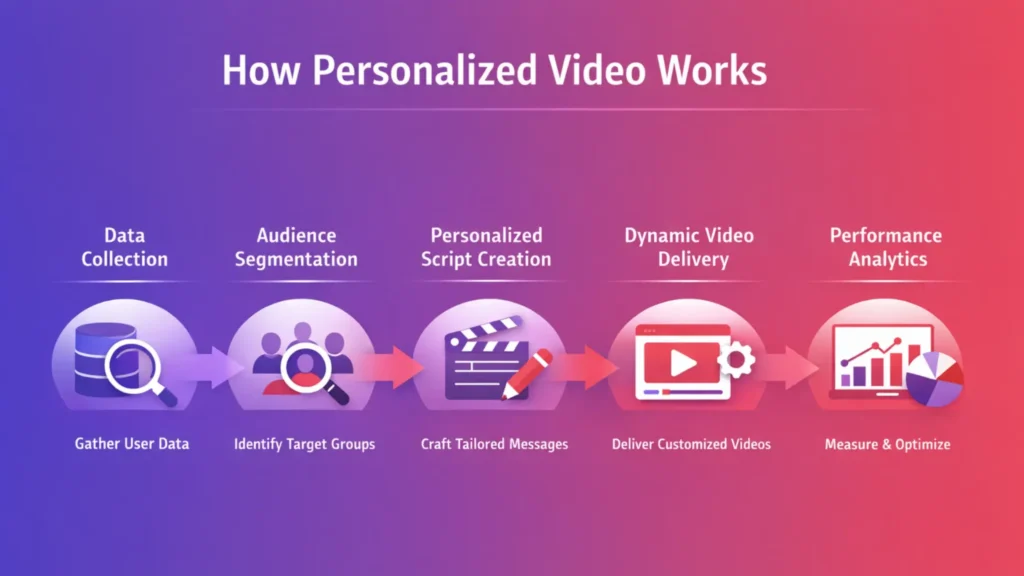
Personalized video marketing is not just about adding a name to a video. It follows a structured, data-driven workflow designed to deliver relevance at scale.
Below is a simplified breakdown of the process:
1. Data Collection
The foundation of personalization begins with gathering meaningful user data.
This may include:
- Website behavior
- Purchase history
- CRM insights
- Email engagement
- Demographic information
Without accurate data, personalization cannot function effectively.
2. Audience Segmentation
Once data is collected, users are grouped into meaningful segments.
Segmentation can be based on:
- Industry
- Buyer stage
- Interests
- Behavioral triggers
- Past interactions
This ensures messaging is relevant instead of generic.
3. Personalized Script Creation
With segments defined, tailored messaging is created for each group.
This step focuses on:
- Addressing specific pain points
- Using contextual language
- Highlighting relevant use cases
- Aligning with buyer intent
This is where strategy meets creativity.
4. Dynamic Video Delivery
The personalized content is then delivered through:
- Email campaigns
- Landing pages
- Retargeting ads
- Website personalization engines
- Customer onboarding flows
Technology enables scalable delivery without producing entirely separate videos for each user.
5. Performance Analytics & Optimization
After launch, performance is continuously monitored.
Key metrics include:
- Watch time
- Engagement rate
- CTR
- Conversion rate
- Drop-off analysis
Insights from analytics feed back into the system, improving future personalization efforts.
Why This Process Matters
This structured workflow ensures that personalized video marketing is not random or experimental — it is strategic, scalable, and measurable.
When implemented correctly, it transforms video from a branding tool into a performance engine.
Why Personalization Matters More Than Ever
Consumer expectations have evolved.
Platforms like Netflix, Amazon, and Spotify have conditioned users to expect personalized experiences. Algorithms recommend content tailored to their interests, behaviors, and preferences.
Marketing is no different.
Today’s buyers expect:
- Relevant messaging
- Timely communication
- Context-aware content
- Seamless cross-channel experiences
Brands that fail to personalize risk appearing disconnected and outdated.
Personalized video aligns marketing with modern expectations — delivering the right message at the right moment.
The Strategic Framework Behind Personalized Video
A high-performing personalized video strategy is not built on creativity alone. It requires structured planning, data integration, and performance measurement.
1. Define Clear Business Objectives
Every personalized video campaign must start with clarity.
Are you trying to:
- Increase qualified leads?
- Accelerate pipeline velocity?
- Improve conversion rates?
- Reduce churn?
- Increase customer lifetime value?
Without defined objectives, personalization becomes fragmented and difficult to measure.
Clear goals determine messaging, targeting, and KPIs.
2. Collect and Integrate Actionable Data
Personalization depends on data quality.
Useful data sources include:
- CRM systems
- Marketing automation platforms
- Website analytics
- Behavioral tracking tools
- Customer surveys
- Purchase history databases
The objective is to identify patterns:
- What content do users engage with most?
- Where do they drop off?
- Which offers convert best?
- Which segments respond to which messaging styles?
These insights allow marketers to design personalized journeys with precision.
3. Align Video Content with the Buyer Journey
Personalized video is most effective when aligned with the customer lifecycle.
Awareness Stage
At this stage, the audience may not fully understand their problem.
Video content should:
- Educate
- Introduce key challenges
- Provide insight
- Position the brand as knowledgeable
Personalization can include industry-specific examples or context relevant to the viewer’s role.
Consideration Stage
Here, prospects evaluate solutions.
Video content should:
- Demonstrate product capabilities
- Address objections
- Compare options
- Showcase use cases
Personalized messaging may include references to the viewer’s company size, sector, or previous content engagement.
Conversion Stage
At this stage, clarity and urgency matter.
Video content should:
- Reinforce value
- Highlight differentiators
- Include strong calls to action
- Reduce friction in the decision-making process
Personalized CTAs significantly increase conversion likelihood.
The Power of Interactive Video
Interactive video strengthens personalization by giving viewers control.
Instead of passively watching, users engage directly with the content.
Interactive features can include:
- Clickable product selections
- Embedded surveys
- Dynamic branching scenarios
- “Choose your solution” paths
- Instant booking links
These elements transform viewing into participation.
Higher interaction leads to longer watch times, improved engagement rates, and deeper brand connection.
The Role of Video Analytics in Optimization
Personalization without measurement is incomplete.
Video analytics provide actionable insights into performance.
Key metrics include:
- View duration
- Engagement rate
- Click-through rate (CTR)
- Conversion rate
- Heatmaps and drop-off points
- Interaction data
For example:
If viewers consistently drop off at a specific timestamp, messaging may need refinement.
If interactive buttons outperform static CTAs, that insight informs future campaigns.
Data-driven optimization ensures continuous improvement.
How Personalized Video Improves Customer Engagement
Customer engagement is the foundation of sustainable growth.
In highly competitive digital markets, switching brands is easy. Relevance and connection are what drive retention.
Personalized video enhances engagement by:
- Delivering context-aware messaging
- Demonstrating brand understanding
- Creating emotional resonance
- Providing timely solutions
- Reducing irrelevant noise
When customers feel seen and understood, loyalty strengthens.
Engagement evolves into advocacy.
How Genbe Helps Brands Scale Personalized Video Marketing
Personalized video requires strategic execution. Data integration, segmentation, creative alignment, and analytics must work together seamlessly.
At Genbe, we help brands design and implement structured personalized video ecosystems.
Our approach includes:
- Audience segmentation strategy
- Behavioral data integration
- Funnel-aligned video scripting
- Interactive content design
- Performance tracking and optimization
- Continuous testing and refinement
Instead of producing isolated campaigns, we build scalable personalized video journeys aligned with measurable business outcomes.
If your organization is ready to move beyond generic video marketing and implement data-driven personalization at scale, Genbe provides the strategic framework to make it happen.
Common Mistakes to Avoid
Even with personalization tools available, mistakes can limit impact.
Avoid:
- Over-personalization that feels invasive
- Poor data hygiene
- Inconsistent messaging across channels
- Ignoring performance metrics
- Focusing on creativity without strategy
Personalization must feel helpful — not intrusive.
Balance relevance with respect.
The Future of Personalized Video
Artificial intelligence and machine learning are accelerating personalization capabilities.
Future developments include:
- Real-time dynamic video adaptation
- Predictive content delivery
- Hyper-segmented micro-audiences
- Automated personalization at scale
- Deeper integration with CRM and automation systems
Brands that invest early will gain long-term competitive advantages.
Key Takeaways
- Traditional video marketing struggles due to lack of relevance.
- Personalized video marketing increases engagement, trust, and ROI.
- Data integration is essential for effective personalization.
- Interactive elements boost participation and conversion.
- Funnel-aligned messaging improves performance across the buyer journey.
- Continuous analytics-driven optimization ensures scalable growth.
Frequently Asked Questions
1. What is personalized video marketing?
Personalized video marketing uses customer data and behavioral insights to customize video content for individual viewers or specific audience segments.
2. How does personalized video improve engagement?
By delivering relevant, context-aware messaging aligned with user interests, personalized video captures attention and increases interaction.
3. Is personalized video expensive to implement?
Costs vary depending on tools and scale. However, the ROI often justifies investment due to improved engagement and conversion rates.
4. What tools are needed for personalized video campaigns?
CRM platforms, analytics tools, audience segmentation software, marketing automation systems, and interactive video hosting platforms are commonly used.
5. Can small businesses use personalized video marketing?
Yes. With the right strategy and scalable tools, small businesses can implement personalized video effectively and cost-efficiently.
6. How can Genbe support personalized video strategies?
Genbe provides end-to-end support — from audience analysis and strategy development to creative execution and performance optimization — ensuring measurable results.
Conclusion
Personalized video marketing is not simply an enhancement to traditional campaigns — it represents a strategic evolution in digital communication.
In an environment where attention is scarce and expectations are high, relevance determines performance.
Brands that combine behavioral data, analytics, and creative storytelling will outperform competitors relying on generic messaging.
If you’re ready to transform video marketing into a measurable growth engine, Genbe can help you build personalized, data-driven campaigns designed for sustainable success.