
Your content is well-written. Your keywords are in the right places. So why isn’t it ranking?
If that question sounds familiar, the answer may lie in a fundamental shift happening right now across search and AI — a shift from keyword matching to intent understanding.
AI tools like ChatGPT don’t simply scan for terms — they interpret what a user actually means. This shift toward ChatGPT intent is reshaping how brands plan content, structure information, and compete for visibility in both traditional search results and AI-generated answers. For SMBs, startups, e-commerce brands, and healthcare businesses, understanding this shift is no longer optional — it’s a competitive necessity.
This guide explains what ChatGPT’s intent is, why it matters for your SEO strategy, and how you can use it to create content that ranks, resonates, and converts.
What Is ChatGPT Intent?
ChatGPT intent refers to the AI model’s ability to interpret the real goal behind a user’s query, not just the words they typed, but the outcome they’re trying to achieve. This goes far beyond traditional keyword matching.
In standard SEO, this concept is known as user intent or search intent. Most queries fall into one of four categories:
| What the user wants | Example query |
|---|---|---|
| User wants to learn | “What is ChatGPT intent?” |
| User seeks a specific page | “Google Search Central” |
| User wants to act or buy | “Buy noise-canceling headphones.” |
| User is comparing options | “best AI SEO tools 2025” |
ChatGPT recognises these intent types using Natural Language Understanding (NLU) — a branch of AI that allows systems to interpret meaning, context, and nuance rather than matching exact phrases.
How AI Reads Meaning, Not Just Keywords
When a user submits a query, ChatGPT analyses multiple layers simultaneously:
- Syntax and semantics: Understanding grammar, synonyms, and related concepts
- Context clues: Reading the full conversation to interpret deeper needs
- Entity recognition: Identifying brands, products, people, and locations
- Conversational flow: Predicting follow-up questions and proactively filling gaps
The result is content discovery that feels natural and complete — without depending on repetitive keyword use. This is the core of modern AI search optimisation, and it’s changing the rules for every content team.
Why Keyword-First Content Is Losing Ground
For years, SEO was a game of keyword density. Writers were told to include primary terms a set number of times per page, stuff secondary keywords into subheadings, and optimise titles for volume over clarity. That approach worked — until search engines got smarter.
Today, keyword-heavy content carries real risks:
- Poor user experience: Robotic, repetitive writing increases bounce rates and reduces dwell time
- Missed search intent: Keywords capture what people type, not what they need — creating content gaps
- Algorithm penalties: Keyword stuffing is flagged by Google’s Helpful Content and spam systems
- Shallow E-E-A-T signals: Keyword-led writing rarely demonstrates genuine expertise or trustworthiness
The shift in one sentence: Intent-first writing doesn’t try to win search engines — it tries to completely satisfy the user. That’s what modern AI content optimisation is built around.
How ChatGPT Intent Recognition Improves Your Content
Because ChatGPT can interpret intent, it becomes a powerful tool for planning and producing content that aligns with the real needs of its audience. Here’s how smart brands are using it — and how Genbe’s content marketing services put these techniques into practice for clients.
Smarter Content Planning
Instead of brainstorming topics at random, you can use ChatGPT to surface intent-driven ideas:
- Generate topic clusters based on real user intent types (informational, commercial, transactional)
- Build detailed outlines for buying guides, comparison pages, and decision-stage content
- Map content themes to funnel stages: awareness, consideration, and decision
More Targeted Content Creation
Intent understanding lets you tailor every piece of content for a specific reader and purpose:
- Adjust tone and complexity for different audiences — healthcare decision-makers vs. e-commerce founders
- Write high-converting sections for landing pages, product pages, and service descriptions
- Generate multiple content angles for sub-intents without rebuilding from scratch
Better Voice Search and Conversational SEO
Voice search queries are longer, more natural, and almost always question-based. ChatGPT — trained on conversational patterns — is ideally suited to help produce content that directly answers these spoken queries. This supports user intent SEO by matching how people actually phrase their questions, especially on mobile and smart devices.
SEO Benefits of Intent-Optimised Content
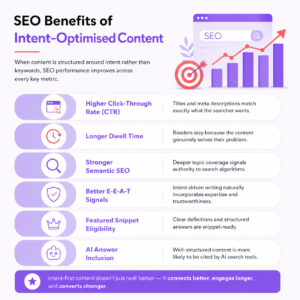
When content is structured around intent rather than keywords, SEO performance improves across every key metric. This is the foundation of a strong AI SEO strategy.
| SEO metric | How intent-first content helps |
|---|---|
| Higher click-through rate (CTR) | Titles and meta descriptions match exactly what the searcher wants |
| Longer dwell time | Readers stay because the content genuinely solves their problem |
| Stronger semantic SEO | Deeper topic coverage signals authority to search algorithms |
| Better E-E-A-T signals | Intent-driven writing naturally incorporates expertise and trust |
| Featured snippet eligibility | Clear definitions and structured answers are snippet-ready |
| AI answer inclusion | Well-structured content is more likely to be cited by AI search tools |
Best Practices for Structuring Intent-Based Content
Even the strongest insights will underperform if the content is hard to read or scan. Here’s how to structure intent-driven articles so both readers and AI systems can extract value quickly. These are the same principles behind Genbe’s digital marketing services.
- Use question-based headings: Subheadings should mirror real queries (e.g., “How does ChatGPT understand intent?”)
- Lead with a clear answer: Open each section with the key takeaway — don’t bury the lead
- Use structured lists: Bullet points and numbered steps are easily extracted for featured snippets
- Match CTAs to intent stage: “Learn more” for awareness; “Book a call” or “Get a free audit” for decision stage
- Apply schema markup: FAQPage, Article, HowTo, and Product schema all improve visibility in AI-driven search
- Include semantic keywords naturally: Cover related concepts (NLU, semantic SEO, voice search) without forcing them
Industry Use Cases: Intent-First Content in Action
E-commerce Brands
- Comparison pages that guide shoppers from consideration to purchase decision
- Product FAQ sections that pre-empt objections and reduce cart abandonment
- Transactional blog content that bridges informational content with product pages
SaaS Companies
- Awareness-stage educational content targeting “what is” and “how to” queries
- Feature comparison guides for commercial investigation intent
- Integration-focused content for decision-stage technical buyers
Healthcare Businesses
- Patient-facing content answering common informational queries (symptoms, treatments, timelines)
- Trust-building service pages that satisfy commercial investigation intent
- Local SEO content targeting navigational and transactional intent for clinic discovery
Genbe has helped healthcare businesses and e-commerce brands across the USA, UK, and Australia move from keyword-heavy content to intent-driven strategies that deliver consistent organic growth. Explore our full digital marketing services to see how we can do the same for you.
What to Watch Out For: Challenges of AI Content Creation
ChatGPT is a powerful co-pilot — but it’s not a set-and-forget tool. To use it effectively without compromising content quality, keep these guardrails in mind:
- Prompt quality matters: Vague inputs produce generic outputs — be specific about audience, intent, and tone
- Add original human insight: Real examples, case studies, and brand perspective separate great content from average AI output
- Fact-check rigorously: AI can state incorrect information confidently — every claim needs verification
- Protect your E-E-A-T: Genuine expertise must come from real people and brands, not AI alone
Frequently Asked Questions
Apply the FAQPage schema to this section to improve eligibility for featured snippets and People Also Ask results.
What is ChatGPT intent in simple terms? ChatGPT intent is the AI’s ability to understand the real goal behind a user’s question — not just the words used. Instead of matching keywords, it identifies whether someone wants to learn, compare, buy, or navigate, and responds accordingly.
How is ChatGPT intent different from traditional search intent? Traditional SEO groups intent into four types: informational, navigational, transactional, and commercial. ChatGPT goes further by interpreting conversational context, follow-up questions, and implied needs — enabling more precise and complete responses.
Can intent-based content rank better on Google? Yes. Google’s Helpful Content system and RankBrain evaluate whether content genuinely satisfies user needs. Intent-driven articles typically earn higher CTRs, longer dwell times, and stronger E-E-A-T signals — all of which support improved rankings.
Is keyword research still relevant in an AI-first world? Keyword research remains valuable — but its role has shifted. Rather than dictating content structure, keywords should guide intent discovery. Use them to understand what topics your audience cares about, then write content that fully answers their underlying questions.
How can a business start using an intent-first content strategy? Start by mapping your audience’s questions to funnel stages. Identify informational, commercial, and transactional content gaps. Then create or update content to address each stage clearly — with the right structure, schema, and CTAs. Genbe can audit your existing content and build this system for you.
Conclusion: The Future Belongs to Intent-First Brands
The keyword-stuffing era is over. ChatGPT intent is reshaping how content is planned, written, and discovered — and brands that adapt earliest will hold the strongest competitive positions in both search rankings and AI-generated answers.
The most effective approach pairs AI’s analytical power with human expertise: AI for speed, structure, and intent mapping; humans for insight, originality, and trust. That combination is what separates content that merely exists from content that consistently performs.
If your current content strategy is still built around keywords alone, now is the time to evolve. Genbe — a leading digital marketing company in Vizag, India, specialises in building AI-driven content ecosystems that rank, resonate, and convert for SMBs, e-commerce brands, startups, and healthcare businesses across the USA, UK, Australia, Brazil, and Chile.
Ready to Build an Intent-First Content Strategy?
At Genbe, we blend generative AI capabilities with expert human refinement to create content that ranks, resonates, and drives measurable ROI.