

Digital competition in B2B has intensified dramatically over the past few years. Buyers now compare vendors across websites, review platforms, LinkedIn thought leadership, pricing pages, and even AI-generated summaries before ever speaking to sales. Transparency is high. Switching costs are lower. Expectations are sharper.
Recently, during a competitive audit for a mid-sized SaaS firm, we discovered their biggest competitor wasn’t another SaaS platform — it was Excel. That single insight reshaped their positioning, messaging, and sales narrative. Within six months, their close rate improved because they were finally competing against the right threat.
Add AI-driven marketing, automated outbound systems, and global competitors targeting your niche, and the pressure multiplies. In this environment, Competitive Analysis for B2B Marketing is no longer optional. It is a strategic growth lever.
The companies winning in 2025–2026 are not guessing. They are studying competitors, identifying positioning gaps, and building smarter B2B marketing strategies based on real data.
Quick Summary: Key Takeaways
If you only have a few minutes, here’s what matters most about Competitive Analysis for B2B Marketing:
- Competitive Analysis for B2B Marketing is a strategic growth driver, not a one-time research task.
- The biggest competitive threat is often misidentified — clarity changes positioning and close rates.
- Effective B2B competitor analysis impacts positioning, pricing, messaging, lead generation, and sales enablement.
- The 7-step framework turns market intelligence into measurable marketing action.
- Businesses that monitor competitors continuously outperform those that react occasionally.
What Competitive Analysis in B2B Actually Means
Let’s move beyond textbook definitions.
Competitive Analysis for B2B Marketing is the structured process of understanding how your competitors position, price, promote, and deliver their solutions — and then using that intelligence to strengthen your own market position.
It is not about copying.
It is about clarity.
In real-world audits, I often see B2B companies struggling not because their product is weak, but because their positioning is unclear compared to competitors. The market does not reward “better.” It rewards “clearer.”
B2B competitor analysis gives you that clarity.
Why Competitive Analysis for B2B Marketing Is Critical
Most small businesses think competitor research is just checking pricing pages.
That is surface-level thinking.
When done properly, Competitive Analysis for B2B Marketing directly influences:
Positioning
If three competitors all claim to be “innovative” and “customer-centric,” differentiation disappears. A strong B2B market analysis reveals whitespace opportunities — underserved industries, overlooked pain points, or under-communicated outcomes.
Pricing Strategy
Pricing in B2B is rarely about being the cheapest. It is about value framing. Competitive insight helps you understand whether you should compete on premium expertise, bundled services, or modular affordability.
Messaging and Content
Your competitors are educating your buyers every day. If their blogs dominate search results and their LinkedIn strategy builds authority, they shape buyer perception before you enter the conversation.
Lead Generation
By analyzing competitor funnels, you can see how they capture leads — gated assets, demo offers, webinars, or AI chat flows — and identify where your own funnel underperforms.
Sales Enablement
Sales teams need competitive battle cards. If your reps cannot articulate why you are better than Vendor X, deals stall.
Competitive strategy in B2B must feed marketing and sales equally.
Key Components of B2B Competitive Analysis
A serious B2B competitor analysis goes far beyond browsing a homepage.
Positioning Analysis
How does each competitor define their core promise? Are they outcome-driven (“Increase revenue 30%”), efficiency-driven (“Save 10 hours per week”), or technology-driven (“AI-powered platform”)?
Positioning gaps often reveal your biggest opportunity.
Offer Comparison
Compare product features, service scope, onboarding processes, guarantees, integrations, and support models.
In many audits, I’ve seen smaller B2B companies overlook packaging strategy. A competitor bundling strategy can outperform a superior standalone service.
Pricing Strategy Review
Even if pricing is not public, signals exist:
- Tiered plans
- Enterprise custom quotes
- Free trials vs. demos
- Usage-based pricing
These indicate their revenue model and target segment.
Digital Presence Audit
Analyze:
- SEO visibility
- Paid ads activity
- Content frequency
- Social engagement
- Backlink authority
Often, the most visible competitor online is not the biggest in revenue, but visibility shapes perception.
Content and Thought Leadership Analysis
What topics do they dominate?
Are they targeting high-intent keywords?
Are they building authority through case studies, reports, and data insights?
Content is now a core component of Competitive Analysis for B2B Marketing.
Funnel Comparison
Walk through their buyer journey.
What happens after you download a resource? How quickly does sales follow up? Is there retargeting?
These small details compound.
Sales Process Review
If possible, analyze:
- Sales call structure
- Proposal presentation
- Demo experience
- Objection handling
Competitive advantage often hides in execution.
Customer Sentiment Research
Read reviews, testimonials, and LinkedIn comments.
What do customers praise? What frustrates them?
Customer dissatisfaction is often your fastest growth opportunity.
SWOT Analysis
Finally, synthesize insights into Strengths, Weaknesses, Opportunities, and Threats.
This transforms scattered data into a strategic direction.
Identifying the Right Competitors
Many B2B companies misidentify competitors.
That alone weakens the strategy.
Direct Competitors
Companies offering similar solutions to the same audience.
Indirect Competitors
Alternative solutions solve the same problem differently. For example, automation software is competing with outsourced service providers.
Emerging Competitors
Startups leveraging AI, automation, or niche specialization. These often disrupt pricing models.
SEO Competitors
Websites ranking for your target keywords, even if their business model differs.
Paid Media Competitors
Brands bidding on your keywords or targeting your audience on LinkedIn and Google.
Competitor research for small businesses must account for digital visibility, not just traditional rivals.
A Step-by-Step Framework for Competitive Analysis for B2B Marketing
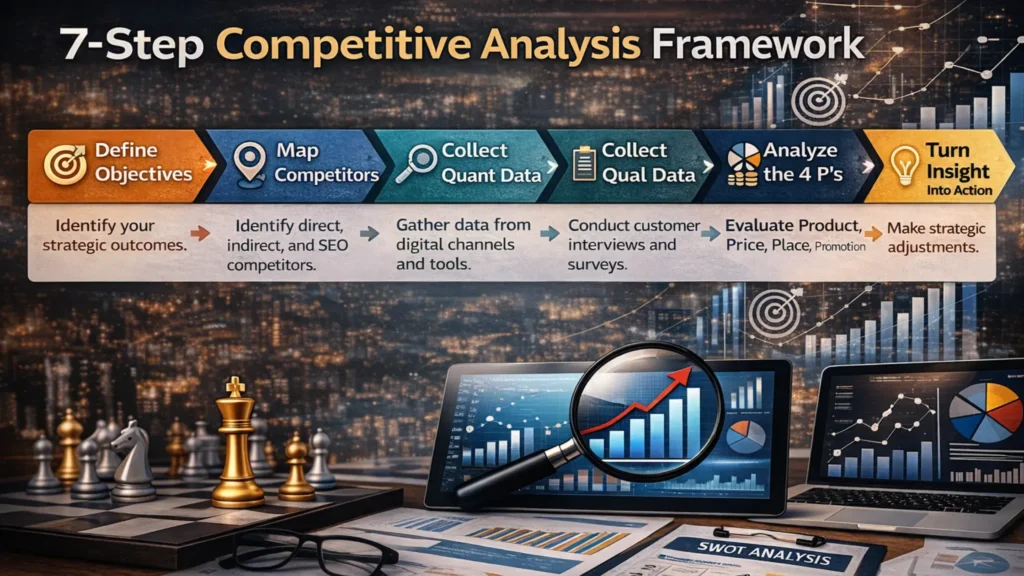
Here is a practical structure used in real consulting projects.
Step 1: Define Your Objective
Are you repositioning? Launching a new service? Entering a new market?
Clear goals prevent analysis paralysis.
Step 2: Map Competitors
Identify 5–10 relevant competitors across categories (direct, indirect, digital).
Step 3: Collect Quantitative Data
- Traffic estimates
- Keyword rankings
- Ad activity
- Content frequency
- Social metrics
Tools like SEMrush, Ahrefs, LinkedIn Ads Library, and Similarweb provide direction.
Step 4: Collect Qualitative Data
- Messaging tone
- Value propositions
- Sales interactions
- Case studies
- Customer reviews
This is where strategic insight emerges.
Step 5: Analyze the 4 P’s
Break down Product, Price, Place, and Promotion.
Step 6: Identify Strategic Gaps
Ask:
- What pain points are underserved?
- Which industries are overlooked?
- Where is messaging generic?
Gap analysis transforms information into opportunity.
Step 7: Convert Insights Into Action
Update:
- Website positioning
- Service packaging
- Pricing communication
- Content strategy
- Sales scripts
Competitive analysis without implementation is wasted effort.
The 4 P’s of Competitor Analysis in B2B
Product
In B2B, the product includes service delivery, integrations, onboarding, reporting, and customization.
Example: Two ERP consultants may implement the same software. The differentiator may be industry specialization or faster deployment methodology.
Price
Analyze structure, not just numbers.
Are they charging retainers? Performance-based fees? Enterprise minimums?
Pricing signals target audience and confidence level.
Place
Where and how do they reach buyers?
- Direct sales teams
- Channel partners
- LinkedIn thought leadership
- SEO-driven inbound
Distribution strategy shapes growth.
Promotion
How do they attract attention?
- Case study marketing
- Paid ads
- Webinars
- Industry reports
- Email nurturing
In a B2B marketing strategy, promotion is increasingly content-led and AI-amplified.
Staying Ahead of Industry Trends and Competition (2025–2026)
Competitive landscapes are evolving faster than ever.
To stay ahead:
Build Market Intelligence Systems
Set up alerts for competitor content, funding announcements, pricing changes, and new product launches.
Use AI for Research
AI tools can summarize competitor messaging, analyze keyword overlap, and detect content gaps at scale.
Implement Customer Feedback Loops
Regularly ask prospects why they chose or rejected you.
That feedback is gold for refining competitive strategy in B2B.
Monitor Performance Monthly
Quarterly reviews are no longer enough in fast-moving sectors.
Create Innovation Cycles
Allocate budget for testing new offers, messaging angles, or niche segments based on competitive findings.
The goal is not reaction.
It is proactive positioning.
Common Mistakes in B2B Competitor Analysis
Copying Competitors Blindly
Imitation erodes differentiation.
Competing Only on Price
Price wars reduce margins and brand perception.
Conducting One-Time Audits
Markets shift constantly.
Ignoring Brand Positioning
Features can be matched. Positioning is harder to replicate.
Misidentifying Competitors
Focusing only on traditional rivals while ignoring digital disruptors weakens long-term strategy.
Competitive Analysis for B2B Marketing must be continuous, strategic, and integrated.
Frequently Asked Questions
What is competitive analysis in B2B marketing?
Competitive analysis in B2B marketing is the structured process of researching competitors’ positioning, pricing, messaging, digital presence, and sales strategy to identify differentiation opportunities and strengthen your market position.
How often should B2B companies conduct competitive analysis?
At a minimum, quarterly reviews are recommended. However, high-growth or highly competitive industries should monitor competitor activity monthly.
What tools help with B2B competitor research?
Common tools include SEMrush, Ahrefs, Similarweb, LinkedIn Ads Library, Google Alerts, review platforms, and CRM win/loss analysis reports.
How can small businesses compete with larger B2B competitors?
Small businesses can compete by specializing in niche industries, offering superior customer experience, building strong thought leadership, and positioning themselves around agility and expertise rather than scale.
Final Thoughts: Turning Insight Into Advantage
Competitive pressure in B2B is not slowing down.
The companies that win are those that treat Competitive Analysis for B2B Marketing as a living strategy — not a spreadsheet exercise.
Clarity in positioning, confidence in pricing, authority in messaging, and precision in targeting are not abstract marketing ideals — they are competitive advantages built through disciplined, data-driven insight.
These advantages are built through data-driven insight.
At Genbe, we help B2B businesses conduct deep competitive audits, uncover strategic gaps, and build marketing strategies designed to outperform competitors — not imitate them.
If you are serious about gaining a measurable market advantage in 2025 and beyond, talk to Genbe. Let’s turn competitive insight into sustainable growth.