
Marketing leaders face constant pressure: deliver more revenue with the same—or even smaller —budgets. Channels are multiplying, customer journeys are becoming more complex, and traditional attribution models no longer tell the full story. Yet many organizations still allocate marketing budgets based on last year’s spend, executive intuition, or platform-reported performance.
This approach is no longer sustainable.
Predictive analytics for marketing budget optimization offers a smarter path forward. By leveraging machine learning, advanced modeling, and first-party data, businesses can forecast outcomes, prioritize high-value audiences, and allocate spend to maximize return.
This guide explains not just what predictive analytics is, but also how to implement it step by step to transform your marketing ROI.
What Is Predictive Analytics in Marketing?
Predictive analytics in marketing uses historical data, statistical modeling, and machine learning algorithms to forecast future customer behavior and campaign outcomes.
To understand its value, it helps to distinguish between four types of analytics:
- Descriptive analytics: What happened? (e.g., last month’s conversions)
- Diagnostic analytics: Why did it happen? (e.g., traffic dropped due to lower paid search spend)
- Predictive analytics: What is likely to happen next? (e.g., which users are likely to convert)
- Prescriptive analytics: What should we do about it? (e.g., shift 20% of display budget to retargeting)
Predictive analytics moves marketing from reactive reporting to proactive decision-making. Instead of analyzing past performance alone, marketers forecast outcomes before allocating spend.
Why Traditional Marketing Budgeting Fails
Many companies still rely on outdated budgeting models:
- Allocating spend based on last year’s performance
- Dividing budgets evenly across channels
- Relying on platform-level attribution
- Making decisions based on “gut feel.”
This leads to three major problems:
- Overinvestment in low-return channels
- Underinvestment in high-LTV customer segments
- Inability to detect diminishing returns
Without predictive modeling, marketing budget allocation becomes static. Yet customer behavior is dynamic.
AI in digital marketing enables brands to move beyond assumptions and allocate resources based on forecasted revenue impact — not just historical averages.
Step-by-Step Guide to Using Predictive Analytics for Marketing Budget Optimization
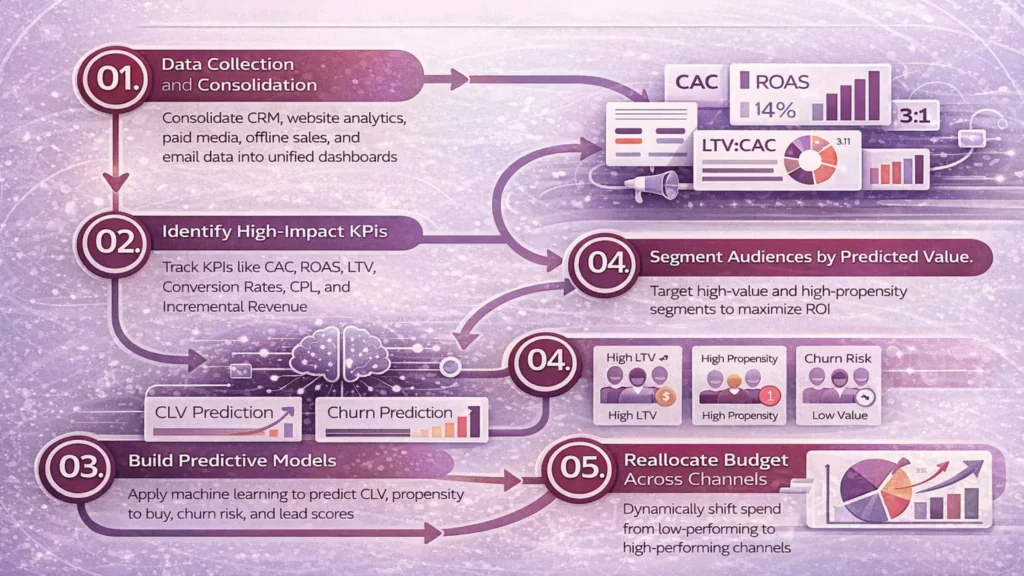
Step 1: Data Collection and Consolidation
Predictive models are only as strong as the data behind them.
Start by consolidating:
- CRM data (purchase history, customer profiles)
- Website analytics (GA4 events, sessions, conversions)
- Paid media data (Google Ads, Meta, LinkedIn)
- Email engagement data
- Sales and revenue data
- Offline conversion data
Focus on first-party data. As privacy restrictions increase, owning and integrating your data is critical.
Ensure:
- Data cleanliness (remove duplicates, fix inconsistencies)
- Consistent attribution windows
- Cross-channel tracking integration
- Clear conversion definitions
Without high-quality data, predictive insights become unreliable.
Step 2: Identify High-Impact KPIs
Predictive analytics should optimize metrics that directly impact profitability, not vanity metrics.
Key metrics include:
- CAC (Customer Acquisition Cost): Total marketing spend divided by new customers acquired.
- ROAS (Return on Ad Spend): Revenue generated per dollar spent.
- LTV (Customer Lifetime Value): Total expected revenue from a customer over time.
- LTV: CAC ratio: Indicates long-term profitability.
- Conversion rate: Percentage of users completing a desired action.
- Cost per lead (CPL)
- Incremental revenue: Revenue generated beyond what would have occurred without the campaign.
Predictive analytics improves these metrics by forecasting which audiences and channels will produce higher lifetime value — not just immediate conversions.
Step 3: Build Predictive Models
This is where machine learning in marketing delivers its true power.
Common predictive models include:
1. Propensity-to-Buy Modeling
Predicts which prospects are most likely to convert based on behavior patterns.
2. Customer Lifetime Value (CLV) Prediction
Forecasts long-term revenue potential per customer segment.
3. Churn Prediction
Identifies customers likely to disengage or cancel.
4. Lead Scoring Models
Ranks lead based on likelihood to convert.
Tools like Python (scikit-learn), BigQuery ML, Salesforce Einstein, and HubSpot predictive scoring simplify implementation.
Step 4: Segment Audiences by Predicted Value
Instead of targeting broad demographics, segment based on predicted behavior:
- High-LTV customers
- High-conversion probability users
- Churn-risk customers
- Low-engagement users
Example:
If predictive modeling identifies a segment with 3x higher lifetime value, budget allocation should prioritize reaching similar audiences through lookalike modeling and retargeting.
This shifts marketing from cost-based optimization to value-based optimization.
Step 5: Reallocate Budget Across Channels
This is where predictive analytics directly impacts marketing budget optimization.
Analyze:
- Marginal returns per channel
- CPA trends by segment
- Conversion probability by funnel stage
- LTV differences across acquisition sources
If paid search generates lower volume but higher LTV customers, increasing spend there may improve overall profitability — even if CPA is slightly higher.
To detect diminishing returns:
- Monitor ROAS at different spend levels
- Use incrementality testing
- Apply Marketing Mix Modeling (MMM)
Reallocate budgets dynamically rather than quarterly or annually.
Key Predictive Models for Budget Optimization
Customer Lifetime Value Prediction
Instead of optimizing for the lowest CPA, optimize for the highest LTV: CAC ratio.
Example:
Two channels produce equal conversions, but Channel A delivers customers with 40% higher lifetime value. The budget should shift accordingly.
Propensity-to-Buy Modeling
Use behavioral data (site visits, product views, email engagement) to predict purchase likelihood.
Allocate retargeting budgets toward high-propensity segments to increase ROAS.
Churn Prediction
Retention is cheaper than acquisition.
If churn models identify at-risk customers, reallocate budget toward retention campaigns rather than purely acquisition-focused efforts.
Marketing Mix Modeling (MMM)
Marketing Mix Modeling evaluates the impact of each channel on overall revenue, accounting for external factors such as seasonality.
MMM helps answer:
- How much revenue does each channel truly drive?
- What is the optimal spend per channel?
- Where are diminishing returns occurring?
This is critical for strategic marketing ROI optimization.
Multi-Touch Attribution
Unlike last-click attribution, multi-touch models distribute credit across the customer journey.
This ensures upper-funnel channels are not underfunded simply because they don’t generate immediate conversions.
Real-World Example
An eCommerce retailer used predictive CLV modeling and discovered that customers acquired via YouTube had a 35% higher lifetime value than those acquired via display ads.
After reallocating 25% of the display budget to YouTube and retargeting high-propensity users:
- ROAS increased by 22%
- CPA decreased by 18%
- Repeat purchase rate increased by 30%
This demonstrates how predictive analytics for marketing budget optimization drives measurable business outcomes.
Tools Used in Predictive Marketing
Organizations can leverage:
- Google Analytics 4 predictive audiences
- Meta Advantage+ AI optimization
- Google Performance Max
- HubSpot predictive lead scoring
- Salesforce Einstein Analytics
- Python (scikit-learn)
- BigQuery
- Tableau / Power BI
These tools combine automation and AI-driven bidding to act on predictive insights in real time.
Funnel-Based Budget Allocation
Predictive analytics also improves allocation by funnel stage:
- Awareness: Optimize CPM and reach forecasting.
- Consideration: Optimize CPC and engagement probability.
- Conversion: Optimize CPA and purchase likelihood.
- Retention: Optimize LTV and churn prevention.
Budget distribution should align with predicted revenue contribution at each stage.
Common Mistakes to Avoid
- Relying solely on platform-reported attribution
- Ignoring data quality issues
- Overfitting predictive models
- Failing to update models regularly
- Optimizing only for short-term conversions
- Neglecting incrementality testing
Predictive systems require ongoing calibration.
The Future of AI-Driven Marketing Budgeting
The future of data-driven marketing strategy is autonomous optimization.
Expect:
- Real-time budget reallocation
- AI-powered media buying
- Privacy-first modeling
- First-party data dominance
- Predictive personalization at scale
Organizations that adopt predictive analytics early will gain a durable competitive advantage.
Frequently Asked Questions (FAQ)
1. What is predictive analytics in marketing?
Predictive analytics in marketing uses historical data and machine learning models to forecast customer behavior, campaign performance, and revenue outcomes. It helps businesses allocate marketing budgets more effectively.
2. How does predictive analytics improve marketing budget allocation?
It identifies high-value customers, forecasts ROI across channels, detects diminishing returns, and enables dynamic reallocation of spend based on expected profitability.
3. What data is required for predictive marketing?
Businesses need integrated first-party data, including CRM records, transaction history, website analytics, ad performance data, and customer engagement metrics.
4. Is predictive analytics suitable for small businesses?
Yes. Even smaller businesses can use tools like Google Analytics 4 predictive audiences or CRM-based lead scoring to improve budget decisions without complex infrastructure.
5. What is the difference between Marketing Mix Modeling and attribution modeling?
Marketing Mix Modeling evaluates overall channel contribution using statistical analysis, while attribution modeling assigns conversion credit across touchpoints within individual customer journeys.
Conclusion
Marketing budgets are finite. Customer behavior cannot be predicted by instinct alone.
Predictive analytics for marketing budget optimization empowers businesses to:
- Allocate budgets based on forecasted ROI
- Prioritize high-value customers
- Detect diminishing returns early
- Improve CAC, ROAS, and LTV simultaneously
In a competitive digital landscape, a data-driven marketing strategy is no longer optional — it is foundational.
Brands that combine predictive modeling, automation, and strategic budget reallocation will outperform those relying on outdated budgeting methods.
The question is no longer whether to adopt predictive analytics, but how quickly you can implement it.
Ready to Optimize Your Marketing Budget?
If you’re looking to implement predictive analytics, improve marketing budget allocation, and maximize ROI, Genbe can help.
At Genbe, we combine advanced analytics, AI-driven marketing strategies, and performance-focused execution to help businesses unlock scalable growth. From data integration and predictive modeling to campaign optimization and real-time budget reallocation, our team ensures every marketing dollar works harder.
👉 Contact Genbe today to build a smarter, data-driven marketing strategy that delivers measurable results.