Data is everywhere. Every click, scroll, purchase, inquiry, refund, and abandoned cart creates a trail. Most businesses collect it. Very few truly use it.
And that’s where the gap lies.
The companies winning today aren’t just tracking performance. They’re anticipating it. They’re predicting customer behavior before it happens, identifying risks before they escalate, and adjusting strategies before competitors even notice a shift.
This is the power of predictive analytics.
If you’ve ever wished you could see next quarter’s sales, know which leads will convert, or stop customer churn before it starts, predictive analytics is how you get there.
Let’s break it down properly — not in technical jargon, but in practical business terms.
What Is Predictive Analytics?
Predictive analytics is the practice of using historical data, statistical modeling, and machine learning to forecast future outcomes.
Instead of asking:
- “What happened last month?”
- “Why did our revenue drop?”
You start asking:
- “What is likely to happen next?”
- “Which customers are at risk?”
- “Where should we invest our marketing budget?”
- “How can we prevent losses before they occur?”
It moves your business from reactive to proactive.
And that shift changes everything.
Why Predictive Analytics Is No Longer Optional
Markets are volatile. Consumer behavior shifts fast. Advertising costs fluctuate daily. Supply chains break. Competition intensifies.
Operating on instinct alone doesn’t work anymore.
Predictive analytics gives you:
- Forecast clarity in uncertain markets
- Smarter marketing investment decisions
- Reduced operational risk
- Higher customer retention
- More accurate revenue projections
It doesn’t guarantee the future. But it dramatically increases your probability of making the right decision.
And in business, probability is power.
How Predictive Analytics Actually Works
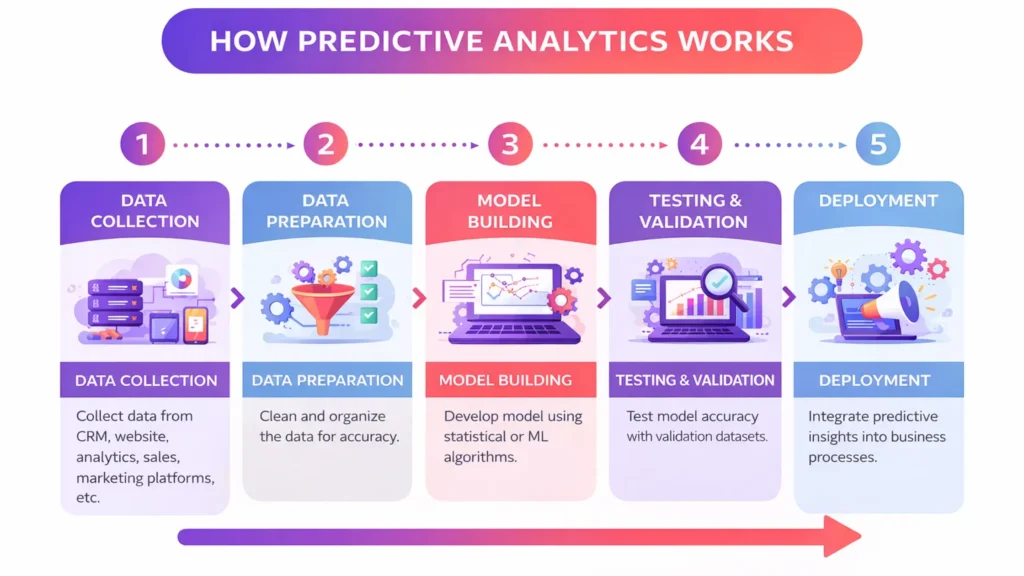
There’s a misconception that predictive analytics requires a massive AI team or advanced data scientists. In reality, the core process is structured and practical.
1. Data Collection
Every prediction begins with historical data. This includes:
- CRM data (customer purchases, inquiries, support tickets)
- Website analytics (GA4, behavior flow, engagement data)
- Marketing platform data (email performance, ad campaigns)
- Sales pipeline data
- Inventory and operational data
The richer your dataset, the more accurate your predictions.
2. Data Preparation
Raw data is messy.
Duplicate records, inconsistent formats, and missing fields — these reduce accuracy. Cleaning and organizing data is often the most critical step.
Without reliable data, predictive modeling becomes guesswork.
3. Model Building
Here’s where statistical modeling and machine learning come in.
Common predictive techniques include:
- Regression analysis (forecasting numerical outcomes like revenue)
- Classification models (predicting yes/no outcomes like churn)
- Decision trees (mapping behavior paths)
- Time-series forecasting (projecting trends over time)
- Neural networks (advanced pattern recognition)
These models identify patterns humans might miss.
4. Testing and Validation
Models are tested against real historical scenarios to measure accuracy.
If predictions align closely with known outcomes, the model is reliable.
If not, adjustments are made.
Predictive analytics is iterative — it improves over time.
5. Deployment
Once validated, insights are integrated into business decisions:
- Sales prioritizes high-probability leads
- Marketing reallocates budget to high-performing segments
- Operations adjust inventory planning
- Finance refines revenue forecasting
Predictions only create value when acted upon.
Practical Ways to Use Predictive Analytics in Your Business
This is where it becomes tangible.
Let’s explore real-world applications.
1. Predictive Lead Scoring
Not all leads are equal.
Predictive models analyze behavior patterns such as:
- Pages visited
- Time spent on site
- Email engagement
- Past buying behavior
- Demographic alignment
Each lead receives a probability score.
Sales teams stop chasing low-intent prospects and focus on those most likely to convert.
Result:
Higher close rates. Shorter sales cycles. More efficient teams.
2. Customer Churn Prediction
Customer acquisition costs are rising across industries. Losing customers hurts more than ever.
Predictive models identify early warning signs:
- Reduced purchase frequency
- Declining engagement
- Delayed renewals
- Negative service interactions
You can then trigger retention strategies before churn happens.
Retention campaigns become strategic, not reactive.
3. Sales Forecasting and Revenue Prediction
Revenue volatility can destabilize planning.
By analyzing historical sales data, seasonality, economic indicators, and pipeline velocity, predictive analytics improves forecast accuracy.
This supports:
- Budget allocation
- Hiring decisions
- Inventory investment
- Cash flow planning
Forecasting shifts from hopeful estimation to data-backed probability.
4. Marketing ROI Optimization
Marketing budgets often get allocated based on historical averages or internal assumptions.
Predictive analytics identifies:
- Which channels drive long-term value
- Optimal customer acquisition cost thresholds
- Campaign timing impact
- Customer lifetime value predictions
You invest smarter. Waste less. Scale confidently.
5. Inventory and Demand Forecasting
Retailers, manufacturers, and eCommerce brands rely heavily on demand predictions.
Predictive analytics prevents:
- Overstocking (capital lock-up)
- Stockouts (lost revenue)
- Supply chain inefficiencies
It allows businesses to prepare for seasonal spikes and market fluctuations.
6. Dynamic Pricing Strategy
Pricing affects profit margins directly.
Predictive models analyze:
- Demand elasticity
- Competitive pricing
- Historical sales trends
- Market sensitivity
Businesses adjust pricing dynamically to maximize profitability.
Airlines, hospitality brands, and online retailers have mastered this.
The Role of Machine Learning in Predictive Analytics
Machine learning enhances predictive models by allowing systems to learn and adapt automatically.
Instead of static rules, ML algorithms:
- Continuously improve from new data
- Identify emerging patterns
- Reduce manual intervention
This makes predictive analytics scalable and sustainable.
Over time, the system becomes more accurate.
Big Data and Predictive Intelligence
The volume and variety of modern data — known as big data — strengthen predictive capabilities.
Data types include:
- Structured data (databases, transactions)
- Unstructured data (social media, reviews, emails)
- Behavioral data (click paths, dwell time)
- External indicators (weather, economic shifts)
Advanced analytics platforms can process these complex datasets to uncover hidden correlations.
The more diverse your data sources, the stronger your predictions.
Challenges Businesses Face
Predictive analytics is powerful, but it isn’t plug-and-play magic.
Common challenges include:
- Poor data quality
- Siloed data systems
- Unrealistic expectations
- Lack of skilled interpretation
- Resistance to data-driven change
The solution isn’t avoiding predictive analytics — it’s implementing it strategically.
How to Successfully Implement Predictive Analytics
If you’re starting from scratch, follow this roadmap:
Define One Clear Goal
Examples:
- Increase lead-to-sale conversion by 15%
- Reduce churn by 10%
- Improve forecast accuracy
Start focused.
Audit Your Data Infrastructure
Ensure:
- Clean CRM records
- Proper analytics tracking
- Integrated systems
Without integration, predictive models lose effectiveness.
Pilot Before Scaling
Run a limited test within one department. Measure results. Refine models.
Scale once ROI is proven.
Align Teams Around Insights
Predictions must influence action.
Marketing, sales, finance, and operations need alignment to drive growth through predictive analytics.
The Future of Predictive Analytics
Predictive analytics is evolving toward:
- Real-time AI forecasting
- Automated marketing decision systems
- Hyper-personalized customer journeys
- AI-powered operational optimization
Businesses that adopt predictive intelligence today build long-term strategic resilience.
Those who wait risk falling behind.
Frequently Asked Questions (FAQs)
Is predictive analytics suitable for small and mid-sized businesses?
Yes. Many modern CRM and analytics platforms include built-in predictive capabilities that don’t require enterprise-level budgets.
How long does it take to see ROI?
Basic predictive use cases can show measurable improvement within weeks, especially in lead scoring and retention strategies.
Does predictive analytics replace human decision-making?
No. It enhances it. Predictive models provide probability insights — strategic decisions remain human-led.
What’s the difference between predictive and prescriptive analytics?
Predictive analytics forecasts outcomes. Prescriptive analytics recommends specific actions based on those forecasts.
How accurate are predictive models?
Accuracy depends on data quality and continuous optimization. Well-maintained models can significantly improve forecast reliability.
Conclusion
Predictive analytics transforms businesses from reactive operators into strategic planners.
It improves marketing efficiency, increases customer retention, stabilizes forecasting, and reduces operational risk.
In a data-driven economy, the ability to anticipate outcomes is one of the strongest competitive advantages you can build.
The question is no longer whether predictive analytics matters.
The question is how quickly you implement it.
Turn Predictive Insights into Measurable Growth with Genbe
At Genbe, we don’t just collect data — we transform it into actionable intelligence.
Our advanced analytics and AI-driven solutions help businesses:
- Improve sales forecasting accuracy
- Build predictive lead scoring systems
- Reduce customer churn
- Optimize marketing ROI
- Integrate AI-powered business intelligence dashboards
- Unlock scalable growth strategies
We combine marketing expertise, data science, and strategic consulting to ensure predictive analytics delivers real business outcomes — not just reports.
If you’re ready to move from reactive reporting to a predictive growth strategy, Genbe is your partner.
👉 Let’s build a smarter, data-driven future for your business. Connect with Genbe today and unlock the power of predictive analytics.