
In the rapidly evolving landscape of digital advertising, the strategies that once guaranteed success for Meta Ads are now relics of a bygone era. For marketers and small business owners navigating the complexities of paid social advertising in 2026, the harsh reality is clear: simply boosting posts or blindly scaling budgets no longer moves the needle. The days of set-it-and-forget-it campaigns yielding significant returns are over.
Today, the challenges facing advertisers are multifaceted. Increased competition, rising customer acquisition costs, and evolving privacy regulations have made it harder than ever to achieve profitable growth. Many businesses find themselves pouring money into Meta Ads with diminishing returns, struggling to understand why their once-effective tactics are failing. The problem isn’t necessarily the platform itself, but rather a fundamental misunderstanding of how Meta’s sophisticated advertising ecosystem now operates.
This shift isn’t just a minor update; it’s a paradigm change. Success in Meta Ads 2026 no longer hinges on the size of your spend, but on the intelligence of your systems. It demands a holistic approach, where every component works in concert to optimize for conversions and maximize return on ad spend (ROAS). Without a robust, interconnected strategy, businesses risk being left behind, their ad budgets swallowed by an increasingly competitive and AI-driven environment.
This comprehensive will explain why and how the new rules of engagement require a deep dive into data, creative, funnels, AI, and conversion rate optimization to truly thrive in the age of intelligent paid media performance.
The Shift: From Ads to Optimization Systems
The traditional view of advertising as a standalone “ad” is obsolete. In 2026, a successful Meta Ads strategy is about orchestrating an entire optimization ecosystem. Think of it not as individual campaigns, but as a dynamic system where data feeds creative, creative fuels funnels, funnels drive conversions, and AI continuously learns and optimizes. This integrated approach is the cornerstone of Meta Ads optimization and the key to unlocking sustainable growth.
Here are the five critical pillars of this optimization system:
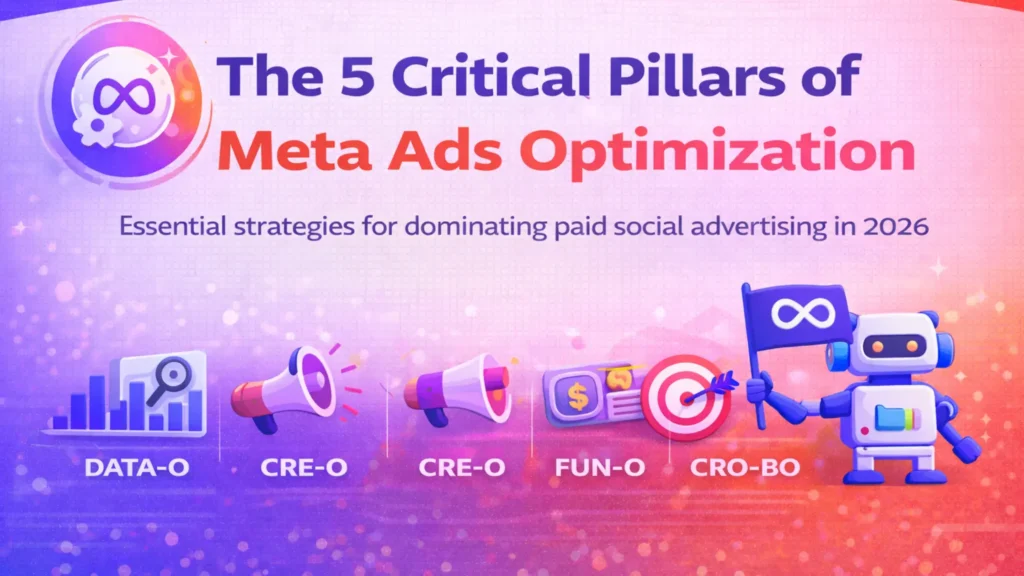
DATA-O: Data & Tracking Optimization
At the core of any high-performing paid social advertising strategy in 2026 is impeccable data. Meta’s AI thrives on signals, and if your data is messy, incomplete, or incorrectly attributed, the AI simply cannot do its job effectively.
Why it Matters: In an era of increasing data privacy and signal loss, clean, reliable data is your most valuable asset. Without it, Meta’s algorithms operate in the dark, leading to inefficient ad spend and wasted opportunities. Accurate tracking allows you to understand the true customer journey, identify bottlenecks, and make informed optimization decisions.
Key Components:
- Pixel & Conversions API (CAPI) Integration: A robust implementation of both the Meta Pixel and the Conversions API is non-negotiable. CAPI provides a server-side data pathway, offering a more reliable and privacy-resilient method for sending conversion events back to Meta, especially as browser-based tracking becomes more restricted.
- Event Prioritization: Not all data events are equal. Prioritize key conversion events (e.g., purchases, leads, add-to-carts) within your Events Manager to clearly signal to Meta’s AI what actions are most valuable to your business. This helps the algorithm focus on finding users most likely to complete those high-value actions.
- Reliable Tracking & Deduplication: Ensure your tracking is consistent across all touchpoints and that duplicate events are properly handled. This prevents inflated conversion counts and ensures Meta’s AI is optimizing based on accurate figures. Regular audits of your data health are crucial for sustained Meta Ads optimization.
CRE-O: Creative Optimization
In the battle for user attention on crowded social feeds, “polish” takes a back seat to “pattern interruption.” Creative optimization is no longer about producing glossy, high-budget ads, but about creating content that resonates instantly and drives engagement.
Why it Matters: Meta’s feed is a fast-moving stream of content. Your ad has mere seconds to capture attention, convey value, and prompt action. If your creative doesn’t stand out, it gets scrolled past, regardless of how well your targeting or bidding is set. Engaging creatives reduces CPMs and increases click-through rates, directly impacting paid media performance.
Key Components:
- UGC-Style Ads: User-generated content (UGC) or content that mimics it often outperforms highly produced studio ads. It feels authentic, relatable, and trustworthy. Leverage testimonials, unboxing videos, and organic-looking content creators.
- Short-Form Video First: With the dominance of Reels and Stories, short-form video is paramount. Aim for snappy, engaging videos that hook viewers within the first 3-5 seconds. Experiment with different formats like quick tutorials, product demonstrations, or behind-the-scenes glimpses.
- Strong Hooks & Intrigue: The opening of your creative is everything. Use compelling headlines, unexpected visuals, or thought-provoking questions to stop the scroll. Test various hooks to see what resonates best with your audience.
- Feed-First Creative: Design your creative specifically for the native environment of Meta’s platforms. This means vertical video, clear text overlays, and visuals that look natural within a user’s feed, rather than repurposed from other channels.
FUN-O: Funnel Optimization
An effective Meta Ads strategy understands that not every user is ready to buy immediately. Funnel optimization is about guiding potential customers through a structured journey, nurturing them from initial awareness to loyal advocacy.
Why it Matters: Relying solely on cold traffic conversion is expensive and inefficient. A well-designed funnel allows you to segment audiences, deliver relevant messages at each stage, build trust, and ultimately increase conversion rates and customer lifetime value. This layered approach is critical for conversion rate optimization (CRO) in a competitive market.
Key Components:
- Cold → Warm → Customer Journey: Develop distinct ad sets and creative for each stage:
- Cold Audience: Focus on brand awareness, problem identification, and generating initial interest with broad appeal.
- Warm Audience (Retargeting): Engage users who have interacted with your brand (website visitors, video viewers, engagers). Offer valuable content, social proof, or specific solutions to their pain points.
- Hot Audience (Customer): Nurture existing customers for repeat purchases, cross-sells, or referrals.
- Retargeting & Behavioral Sequencing: Implement sophisticated retargeting campaigns based on user behavior. Show ads for products abandoned in carts, offer discounts to recent website visitors, or re-engage users who viewed specific content.
- Offer Stacking & Value Ladders: Don’t just hit users with a single offer. Introduce a sequence of increasing value, from free guides to low-cost products, leading to your core offering. This builds commitment and trust.
- Frequency Control: Monitor and manage ad frequency to avoid ad fatigue. Over-exposure can lead to negative sentiment and decreased performance. Use custom audience exclusions and frequency caps strategically.
CRO-BO: Conversion Rate Optimization & Buying Optimization
Getting clicks is only half the battle; the real goal is to turn those clicks into paying customers. Conversion Rate Optimization (CRO) is the process of maximizing the percentage of website visitors who take a desired action. When combined with Meta’s AI buying optimization, this becomes a powerhouse for digital advertising trends 2026.
Why it Matters: A high click-through rate means nothing if your landing page or checkout process is broken. Even marginal improvements in conversion rates can significantly impact your ROAS and overall profitability. By optimizing the post-click experience, you ensure that the traffic Meta’s AI sends you is converted efficiently.
Key Components:
- Landing Page Clarity & Relevance: Your landing page must be a seamless extension of your ad. Message match is crucial. Ensure a clear headline, concise value proposition, and an obvious call to action (CTA).
- Page Speed & Mobile Responsiveness: Slow loading times are conversion killers. Optimize images, use efficient hosting, and ensure your site is flawlessly responsive across all devices, especially mobile, where the majority of Meta traffic originates.
- Trust Signals & Social Proof: Build confidence with testimonials, reviews, security badges, money-back guarantees, and media mentions. Address potential objections proactively.
- Offer Alignment & Simplicity: Ensure the offer on your landing page exactly matches what was promised in the ad. Make the conversion process as simple and friction-free as possible. Minimize form fields, offer guest checkout, and use clear pricing.
AI-BO: AI Buying Optimization
Meta’s artificial intelligence is arguably the most sophisticated ad-buying engine in the world. In 2026, understanding and leveraging this AI buying optimization is paramount. It’s about feeding the AI good data, giving it broad parameters, and letting it find your best customers.
Why it Matters: Meta’s AI processes billions of data points in real-time to identify users most likely to convert based on their behavior, interests, and signals across its platforms. Trying to outsmart it with overly narrow targeting or manual bidding is a losing battle. The future of Meta Ads 2026 is about intelligent automation.
Key Components:
- Broad Targeting & Advantage+ Campaigns: Embrace broader targeting strategies. Instead of hyper-specific interest groups, give Meta’s AI more room to explore and find new, high-converting audiences. Advantage+ Shopping Campaigns are a prime example of Meta’s move towards AI-driven, end-to-end automation, often outperforming traditional setups.
- Smart Delivery & Dynamic Creative: Trust Meta’s smart delivery algorithms to optimize for the lowest cost per action. Utilize Dynamic Creative Optimization (DCO) to allow Meta to automatically combine different headlines, images, and calls to action to create the best-performing ad variations for each user.
- High-Quality Data Feed: For e-commerce businesses, a clean and optimized product catalog (data feed) is critical. This powers dynamic product ads and ensures the AI has accurate information to match products with interested buyers.
- Account Structure for Learning: Structure your campaigns to facilitate maximum learning for Meta’s AI. This often means consolidating ad sets, ensuring sufficient budget for the learning phase, and avoiding frequent, drastic changes that disrupt the algorithm.
How the System Works Together
It’s crucial to understand that none of these pillars work in isolation. They form a synergistic whole, where the strength of one amplifies the others.
- Clean Data (DATA-O) empowers Meta’s AI (AI-BO) to accurately identify ideal customers.
- Engaging Creative (CRE-O) stops the scroll, driving traffic into your Funnels (FUN-O).
- A well-designed Funnel (FUN-O) nurtures leads, making them more receptive to your offer, which then benefits from Conversion Rate Optimization (CRO-BO).
- Optimized Conversion Rates (CRO-BO) provide clear, positive signals back to Meta’s AI (AI-BO), further refining its ability to find more valuable customers.
When all these layers support Meta’s learning system, you unlock true Meta Ads optimization. The AI becomes incredibly efficient at finding buyers, your ad spend works harder, and your profitability soars. This holistic approach is the definitive digital advertising trend 2026 for Meta Ads success.
Conclusion
In 2026, the landscape of paid social advertising on Meta platforms has fundamentally changed. The era of quick fixes and brute-force spending is over. Sustainable success with Meta Ads 2026 isn’t about throwing more money at campaigns; it’s about designing and implementing intelligent systems where data, creative, funnels, AI, and conversion rate optimization work seamlessly together.
By prioritizing clean data, crafting attention-grabbing creatives, building robust funnels, optimizing the conversion journey, and strategically leveraging Meta’s powerful AI, marketers and small business owners can transform their ad spend into a predictable engine of growth. This integrated approach is no longer a luxury but a necessity for achieving real, measurable profitability in the highly competitive world of paid media performance.
Want your Meta Ads built as a performance system—not just campaigns? → Talk to Genbe about optimizing paid social for real growth.