

In the high-stakes world of organic search, the difference between a top-three ranking and page-two obscurity often comes down to the integrity of a website’s underlying architecture. While content remains king, web standards are the kingdom’s infrastructure. If the roads are broken, the king cannot move.
Google’s ranking systems have moved past simple keyword matching toward a sophisticated understanding of page experience and semantic meaning. Adhering to World Wide Web Consortium (W3C) standards is no longer just a “best practice” for developers; it is a fundamental requirement for technical SEO.
Understanding Web Standards: The W3C Framework
Web standards represent a formal set of guidelines maintained by the World Wide Web Consortium (W3C). These protocols ensure that the web remains open, accessible, and interoperable across different browsers and devices. For SEO professionals, the most critical components include:
- HTML5 (Semantic Markup): Using tags according to their intended meaning (e.g., <main>, <article>, <nav>) rather than generic containers.
- CSS3: Decoupling presentation from structure to ensure lightweight, fast-loading pages.
- ECMAScript (JavaScript): Implementing scripts in a way that does not obstruct the rendering of critical content.
- WCAG (Web Content Accessibility Guidelines): Ensuring that a site is usable by all people, including those with disabilities, which mirrors Google’s focus on user experience.
How Web Standards Directly Impact SEO
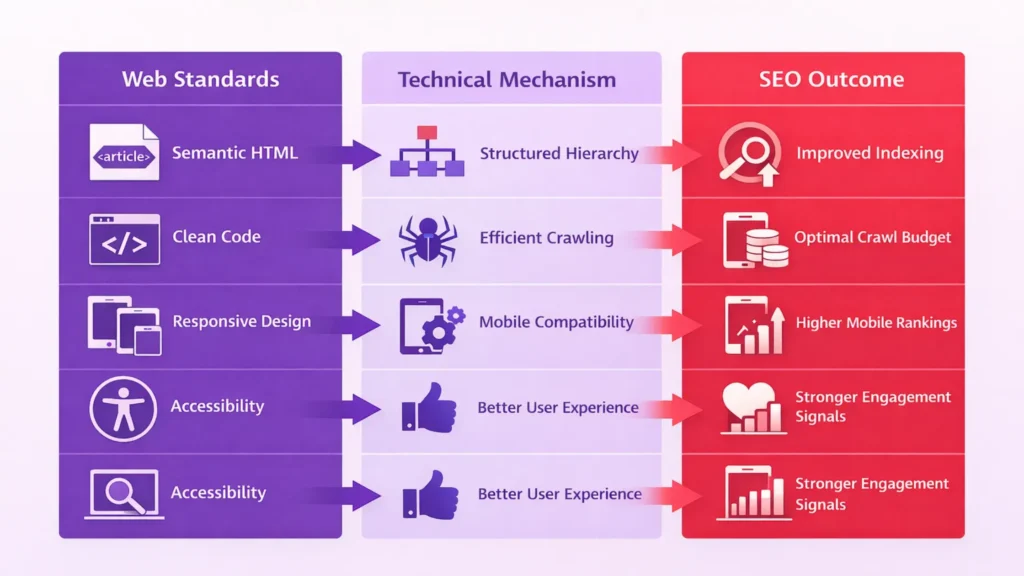
The relationship between web standards and SEO is both structural and functional. Googlebot, the crawler responsible for discovering and indexing the web, is a headless browser. When a site follows standardized code, Googlebot can parse it efficiently.
1. Enhanced Crawl Efficiency and Indexing
When code is non-standard or “messy”—characterized by unclosed tags or improper nesting—crawlers must use extra resources to “guess” the intended structure. This wastes crawl budget. Google has explicitly stated that if a page has significant syntax errors, particularly in the <head> section, it may fail to process critical signals like rel= “canonical” or hreflang tags.
2. Semantic HTML for Entity Recognition
Semantic HTML helps Google understand the hierarchy and relationship of information on a page. By using <header>, <footer>, and <section>, you provide a roadmap for the crawler.
- Example: Wrapping a blog post in an <article> tag tells Google that this content is a standalone, independent piece of information, making it easier for the algorithm to extract relevant snippets.
3. Reduced Code-to-Text Ratio
Standards-compliant sites typically use external CSS and JavaScript files, keeping the HTML document lean. A high code-to-text ratio can dilute the “thematic weight” of your content. Lean HTML ensures that the primary text is easily found and indexed.
Core Web Vitals & Performance
In 2024, performance is a confirmed ranking factor under Google’s Page Experience umbrella. Web standards are the primary vehicle for achieving “Good” scores in Core Web Vitals (CWV).
Largest Contentful Paint (LCP)
LCP measures loading performance. Adhering to standards like responsive image syntax (srcset) and avoiding render-blocking JavaScript ensures that the largest element on the screen loads within the recommended 2.5-second threshold.
Interaction to Next Paint (INP)
Replacing First Input Delay (FID) as of March 2024, INP measures a page’s overall responsiveness to user interactions. Standardized, optimized JavaScript prevents the “main thread” from becoming blocked, allowing for the fluid interactions that Google now demands for high rankings.
Cumulative Layout Shift (CLS)
CLS measures visual stability. Web standards require that developers always include width and height attributes on image and video elements. This allows the browser to reserve the correct amount of space while the asset loads, preventing the “jumping” effect that ruins user experience and tanks CLS scores.
Google’s Official Perspective
Google Search Central has consistently signaled that while W3C validation is not a direct ranking signal (meaning you won’t get a “boost” just for passing a validator), the consequences of invalid code are detrimental to SEO.
“Googlebot generally handles broken HTML well, but it can be a problem if the error is in a place where we need to find important information, such as the <head> of a document or within structured data.” – Google Search Central Documentation.
Furthermore, Google’s shift to Mobile-First Indexing makes standards even more critical. Because mobile devices have less processing power than desktops, inefficient or non-standard code has a disproportionately negative impact on mobile performance and, consequently, mobile rankings
Web Standards vs. Technical SEO
Web standards and technical SEO are closely related, but they are not the same. Technical SEO is the strategy of making a website accessible and understandable to search engines. Web standards are the technical rules that ensure that the strategy works properly.
Clean, standards-compliant code improves crawlability and indexing because search engines can parse structured markup more efficiently. Accessibility standards enhance usability, which supports stronger page experience signals. Semantic HTML provides machine-readable structure, increasing the chances of rich snippet eligibility. Responsive design ensures a consistent experience across devices, supporting mobile-first indexing success.
In simple terms, technical SEO defines the goal, and web standards provide the framework to achieve it.
Real-World Impacts: The Risk of Poor JavaScript
One of the most significant threats to SEO in the modern era is the “JavaScript SEO Gap.” Many modern frameworks (React, Vue, Angular) do not follow traditional web standards for document delivery, relying instead on client-side rendering.
If a site’s JavaScript is not implemented in accordance with progressive enhancement principles, Google may see a blank page during the first wave of crawling. This delays indexing and can lead to a complete loss of organic visibility. Standards-compliant development ensures that the “core” content is available in the initial HTML response, even if the advanced features require JavaScript.
Implementation Best Practices
To align your website with both W3C standards and Google’s SEO requirements, follow this technical checklist:
- Validate Critical Pages: Use the W3C Markup Validation Service to identify “hard” errors in your HTML, such as unclosed tags or duplicate IDs, which can break JavaScript functionality.
- Prioritize Semantic Hierarchy: Ensure your <h1>-<h6> tags are used in a logical order. Never skip heading levels (e.g., jumping from <h2> to <h4>) just for visual styling.
- Optimize Structured Data: Use Schema.org markup in JSON-LD format. This is the global standard for helping search engines understand the context of your data, directly increasing your chances of earning Rich Results.
- Implement ARIA Roles: While primarily for accessibility, ARIA (Accessible Rich Internet Applications) roles help Google understand the purpose of complex UI elements, such as tabbed interfaces and accordions.
- Adopt Modern Image Formats: Use WebP or AVIF, which are the current web standards for high-compression, high-quality web imagery.
FAQ:
Do web standards directly affect Google rankings?
Not as a single “check-the-box” ranking factor. However, web standards improve page speed, mobile-friendliness, and crawlability—all of which are direct ranking factors. A site that ignores standards will almost inevitably struggle with performance-based ranking signals.
Does W3C validation matter for SEO?
Yes, but as a diagnostic tool rather than a goal. You don’t need a 100% error-free report to rank, but you must fix “catastrophic” errors that prevent Googlebot from parsing your content or understanding your site’s architecture.
How do web standards improve Core Web Vitals?
Standards-compliant code is more efficient. By defining image dimensions, using lean CSS, and managing JavaScript execution, you reduce the browser’s workload, improving LCP, CLS, and INP scores.
Can messy code harm crawlability?
Absolutely. If Googlebot encounters “spaghetti code” or significant syntax errors in the document head, it may stop parsing the page entirely, missing your meta tags, canonicals, and even your main content.
Are web standards required for technical SEO?
They are the foundation. Technical SEO without web standards is like trying to optimize a car’s engine when the chassis is falling apart. You must have a stable, standardized base before advanced optimizations can be effective.
Conclusion: The Long-Term SEO Advantage
In an era where Google’s algorithm is increasingly focused on User Experience (UX) and Helpful Content, web standards serve as the bridge between technical excellence and search visibility. By adhering to HTML5, CSS3, and accessibility guidelines, you create a site that is resilient, fast, and—most importantly—easily understood by both humans and machines.
Investing in web standards is not merely a task for the development team; it is a strategic SEO move. It future-proofs your site against algorithm updates and ensures that your content has the best possible chance to compete in a crowded digital marketplace.
Ready to Strengthen Your Technical SEO Foundation?
At Genbe, we help businesses build technically sound, performance-driven websites that align with modern web standards and Google’s evolving search systems. From structured data implementation and Core Web Vitals optimization to full technical SEO audits, our team ensures your website is built for visibility, scalability, and long-term growth.
If your site’s performance, crawlability, or technical structure is holding back your rankings, it may be time to evaluate your foundation.
Connect with Genbe today and transform your website into a standards-compliant, SEO-optimized growth engine.