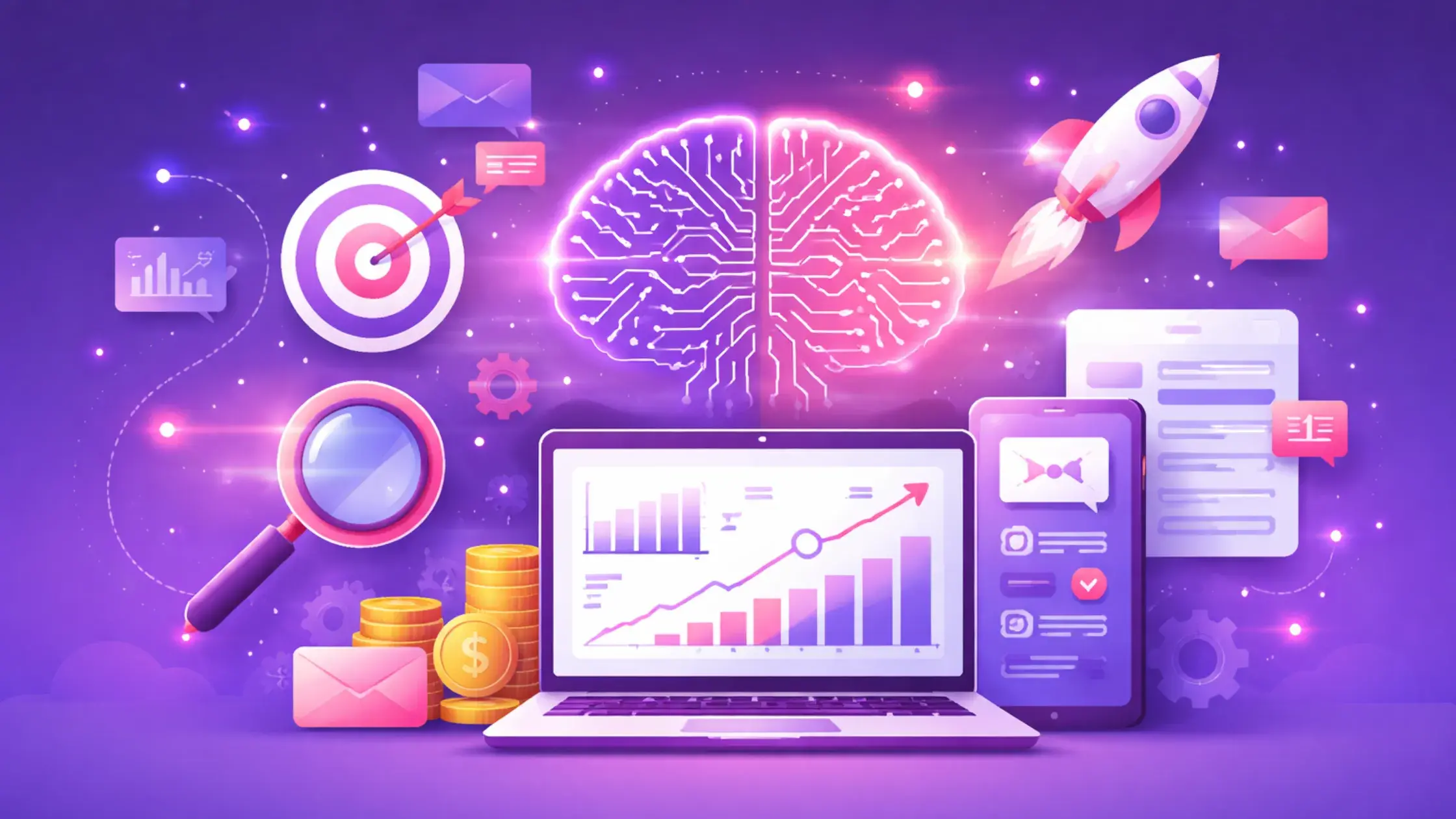
Machine learning is important for digital marketing. It helps businesses quickly analyze large amounts of data, spot trends, and make better decisions. By using machine learning, marketers can tailor customer experiences, improve advertising campaigns, and boost engagement. This technology also helps predict what customers will do and what they like, allowing companies to reach their audiences more effectively. Overall, using machine learning in digital marketing can make processes more efficient and lead to better results.
For marketing leaders, CMOs, performance strategists, and growth teams, machine learning is not a futuristic concept. It is already embedded in Google Ads smart bidding, CRM lead scoring systems, personalization engines, recommendation models, and marketing automation tools. The real question is no longer whether to use it, but how to use it strategically to improve marketing ROI.
This article looks at how machine learning is used in digital marketing, its core applications, its business impact, and how marketing professionals can leverage it to drive measurable growth.
Executive Summary: Why Machine Learning Matters
- It improves marketing ROI through predictive targeting and automated optimization.
- It enables AI-driven personalization at scale across customer journeys.
- It helps businesses move from reactive reporting to a proactive, data-driven marketing strategy.
Understanding Machine Learning in a Marketing Context
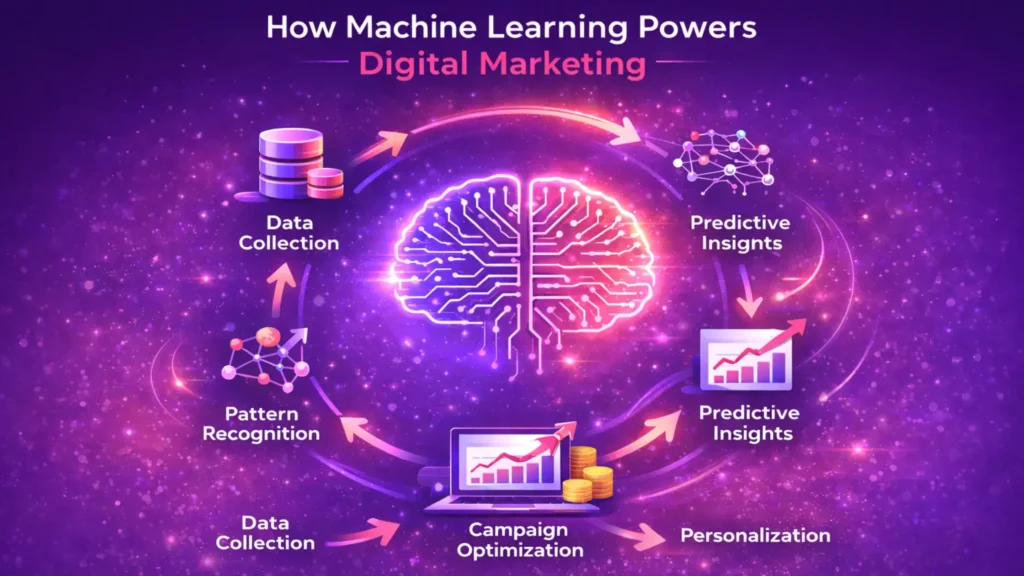
Machine learning is a type of artificial intelligence. It helps systems learn from data and improve their performance over time. This happens without needing to program each possible outcome . Instead of following fixed rules, machine learning models identify patterns within large datasets and refine their predictions as new data becomes available.
In digital marketing, this translates into smarter ad targeting, behavioral customer segmentation, predictive marketing analytics, and more accurate conversion forecasting.
At its core, machine learning applications in marketing revolve around three capabilities:
- Pattern recognition across large behavioral datasets
- Continuous campaign optimization based on live performance feedback
- Predictive modeling of future customer actions
These capabilities allow marketing teams to shift from descriptive analytics to predictive and prescriptive decision-making.
Types of Machine Learning Used in Digital Marketing
While most marketing professionals do not build algorithms themselves, understanding how these systems function helps teams align technology with business goals.
Supervised Learning
Supervised learning models use labeled datasets for training. In marketing terms, this includes historical campaign data labeled with outcomes such as “converted” or “did not convert.” The model learns which signals correlate with success and applies those insights to new audiences.
Common applications include:
- Predictive lead scoring in CRM platforms
- Conversion rate prediction in paid advertising
- Customer churn prediction for subscription businesses
- Email engagement forecasting
Unsupervised Learning
Unsupervised learning identifies hidden patterns and audience clusters without predefined labels.
In digital marketing, this supports:
- Behavioral audience segmentation
- Product recommendation engines
- Customer clustering beyond demographics
For example, an eCommerce brand may discover that customers who view comparison pages and return within 48 hours have a higher purchase probability. That insight can trigger automated remarketing campaigns.
Reinforcement Learning
Reinforcement learning focuses on optimizing decisions over time using reward-based mechanisms. Many predictive targeting systems and automated bidding strategies rely on this method.
Google Ads smart bidding, for example, evaluates thousands of signals—device, time, location, intent probability—to dynamically adjust bids and maximize return on ad spend (ROAS).
Strategic Applications of Machine Learning in Digital Marketing
Now that we understand how machine learning works, let’s look at how it can improve business results.
1. Intelligent Ad Targeting and Smart Bidding
Machine learning improves digital advertising performance by identifying high-intent users and adjusting bids in real time.
Benefits include:
- Predictive targeting in digital advertising
- Automated bid optimization based on conversion probability
- Smarter budget allocation toward high-performing segments
- Reduced cost per acquisition (CPA)
According to industry benchmarks, automated bidding strategies can significantly outperform manual bidding when conversion tracking is properly configured, particularly in high-volume accounts.
2. Advanced Customer Segmentation
Traditional segmentation relied heavily on demographics. Machine learning for customer segmentation goes deeper by analyzing behavior, engagement, and purchase intent.
Marketers can segment audiences based on:
- Purchase frequency
- Engagement depth
- Content interaction patterns
- Lifetime value tiers
This enables more relevant messaging and improved campaign performance.
3. Personalization at Scale
AI-driven personalization for marketing is no longer optional. Customers expect relevant recommendations and contextual communication.
Machine learning supports:
- Dynamic website content personalization
- Personalized email automation
- Intelligent product recommendation engines
- Content sequencing based on behavior
Research consistently shows that personalized campaigns outperform generic messaging in click-through rate (CTR) and conversion rate. More importantly, personalization increases customer lifetime value (CLV).
4. Predictive Analytics and Revenue Forecasting
Predictive analytics in marketing helps organizations forecast demand, identify high-value prospects, and anticipate churn.
Key use cases include:
- Conversion likelihood scoring
- Customer lifetime value prediction
- Revenue forecasting for seasonal campaigns
- Early churn detection
Rather than reacting to declining performance, marketing teams can intervene early with targeted retention strategies.
5. Marketing Automation and Workflow Optimization
Machine learning enhances marketing automation by making workflows adaptive.
Examples include:
- Email sequences that adjust based on engagement
- Retargeting windows that shift based on browsing behavior
- Chatbots that improve responses based on user intent
This creates a responsive, performance-focused digital marketing ecosystem.
Data-Driven Marketing as the Foundation
Machine learning depends on strong data architecture. Data-driven marketing requires structured collection and integration of signals across:
- Website analytics platforms
- CRM systems
- Paid advertising dashboards
- Email marketing platforms
- Customer support tools
For machine learning to improve marketing ROI, businesses must ensure:
- Clean tracking implementation
- Unified customer profiles
- Accurate attribution models
- Clearly defined KPIs
Without reliable data, predictive models cannot deliver reliable insights.
Measuring the Business Impact
For marketing leaders, technology adoption must translate into measurable outcomes.
Machine learning in digital marketing contributes to:
- Higher conversion rates through predictive targeting
- Lower acquisition costs via automated optimization
- Improved retention through churn prediction
- Increased lifetime value through personalization
- More accurate revenue forecasting
Performance metrics typically influenced include:
- Click-through rate (CTR)
- Conversion rate
- Cost per acquisition (CPA)
- Return on ad spend (ROAS)
- Customer lifetime value (CLV)
The strategic advantage lies not only in automation but in improved decision quality and forecasting accuracy.
Ethical Considerations and Data Responsibility
As AI in digital marketing expands, ethical considerations become critical.
Marketing professionals must account for:
- Data privacy regulations such as GDPR and CCPA
- Transparent consent practices
- Algorithmic bias mitigation
- Responsible personalization boundaries
Trust remains a competitive asset. Sustainable growth requires responsible data governance.
Challenges and Limitations
Machine learning is powerful, but not a universal solution.
Common limitations include:
- Incomplete or poor-quality data
- Over-reliance on automation without strategic oversight
- Misalignment between AI tools and business objectives
- Lack of internal analytics expertise
Human judgment remains essential for interpreting model outputs and maintaining long-term alignment with brand strategy.
The Future of Machine Learning in Digital Marketing
The future of machine learning in digital marketing will involve deeper integration across omnichannel customer journeys.
Emerging developments include:
- Real-time personalization across platforms
- AI-driven creative testing
- Predictive customer journey orchestration
- Voice and visual search optimization
- Unified AI-powered analytics dashboards
Marketing professionals will increasingly operate as data strategists rather than campaign operators.
Strategic Recommendations for Marketing Leaders
To maximize the benefits of machine learning in marketing:
- Audit data infrastructure and tracking accuracy.
- Align machine learning initiatives with revenue-focused KPIs.
- Invest in analytics and data literacy within teams.
- Balance automation with strategic oversight.
- Continuously test and validate predictive models.
Machine learning should enhance strategic thinking, not replace it.
Conclusion
Machine learning has fundamentally reshaped digital marketing. It enables smarter targeting, scalable personalization, predictive forecasting, and continuous performance optimization.
For business and marketing professionals, its true value lies in improved decision-making, stronger ROI, and sustainable competitive advantage.
Organizations that combine strong data foundations, strategic clarity, and responsible implementation will extract the greatest value from machine learning technologies.
Machine learning is not a shortcut. It is a strategic capability—and when applied thoughtfully, it becomes a powerful driver of long-term growth.
Ready to Turn Machine Learning Into Measurable Growth?
At Genbe, we help marketing leaders implement AI-driven digital strategies that align data, automation, and revenue objectives. From predictive analytics integration to performance optimization frameworks, our approach ensures machine learning delivers measurable ROI—not just technological complexity.
If you’re looking to strengthen your marketing intelligence, improve forecasting accuracy, and scale performance responsibly, connect with Genbe to build a data-driven growth engine designed for long-term success.
Frequently Asked Questions (FAQs)
1. What is machine learning in digital marketing?
Machine learning in digital marketing uses AI algorithms to analyze customer data, identify behavioral patterns, and automatically optimize campaigns for better targeting and personalization.
2. How does machine learning improve marketing ROI?
It improves ROI by enabling predictive targeting, reducing wasted ad spend, optimizing bidding strategies, and increasing conversion rates and customer lifetime value.
3. What are common machine learning applications in marketing?
Key applications include smart bidding, predicting lead scores, segmenting behaviors, personalizing experiences, predicting customer churn, and forecasting revenue.
4. Is machine learning suitable for small and mid-sized businesses?
Yes. Most modern marketing platforms include built-in machine learning capabilities, allowing businesses of all sizes to benefit from advanced optimization without building custom AI systems.