

In today’s hyper-connected digital world, identity has become both an asset and a liability. Every online transaction, login attempt, onboarding process, and regulatory verification depends on accurate identity validation. Traditional identity systems rely on centralized databases, which makes them more vulnerable to data breaches, identity theft, and large-scale cyberattacks. Organizations store a lot of personal information in a single place, making them easy targets for hackers. As digital ecosystems expand, these centralized models struggle to keep pace with evolving threats and compliance demands. blockchain Identity management offers a fundamentally different approach: decentralized, tamper-resistant, and user-controlled digital identity systems designed to restore security, privacy, and trust.
Why Traditional Identity Systems Are Failing
Before understanding how to use blockchain for identity management, it’s important to recognize why current systems are breaking down.
Most digital identity frameworks rely on centralized data storage. Banks, hospitals, enterprises, and social platforms collect and store sensitive personal data in centralized servers. While this approach has worked for decades, it presents significant risks:
- Single point of failure
- Increased exposure to cyberattacks
- Expensive breach recovery processes
- Complex regulatory compliance management
- Limited user ownership of personal data
When a centralized identity database is compromised, millions of records can be exposed simultaneously. Even with strong encryption, centralized storage remains vulnerable to insider threats, phishing attacks, and credential stuffing.
Organizations are now exploring decentralized identity solutions that eliminate reliance on a single authority while strengthening security architecture.
What Is Blockchain Identity Management?
Blockchain identity management leverages distributed ledger technology to create, verify, and manage digital identities without central control. Instead of storing personal information in one location, encrypted identity data is distributed across a blockchain network.
This system enables:
- Decentralized identity storage
- Cryptographic verification
- Tamper-resistant authentication
- User-controlled data access
- Fraud-resistant digital identity verification
Rather than using passwords stored in vulnerable servers, blockchain-based authentication relies on cryptographic keys. Only the identity holder controls the private key, thereby significantly reducing the risk of unauthorized access.
This model aligns with modern privacy principles and supports secure digital transformation strategies.
Blockchain Identity Architecture Explained
To fully understand blockchain identity systems, it helps to examine their architecture.
Identity Holder
The individual or organization that owns a decentralized identifier (DID) and manages cryptographic keys.
Issuer
An authority such as a bank, university, or government body that issues verifiable credentials.
Verifier
An entity that validates credentials using blockchain-based cryptographic proofs.
Blockchain Network
Stores decentralized identifiers and verification proofs while maintaining immutability.
Digital Wallet
A secure application where users store verifiable credentials and manage permissions.
Importantly, personal data is not stored directly on the blockchain. Instead, encrypted proofs confirm authenticity without revealing raw data.
How to Use Blockchain for Identity Management: Step-by-Step Framework
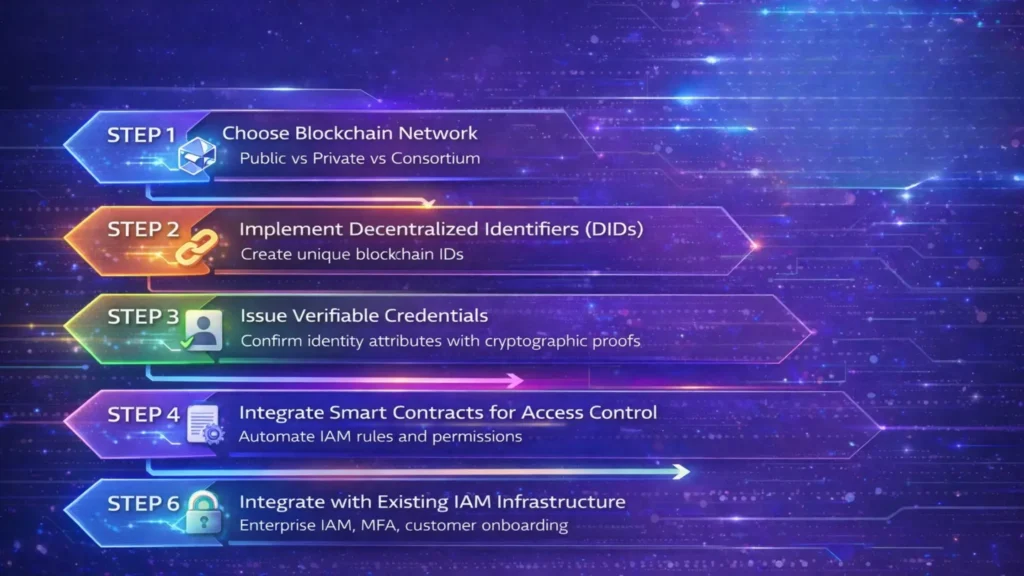
Implementing blockchain identity management requires careful planning. Below is a structured approach organizations can follow.
Step 1: Choose the Appropriate Blockchain Network
Organizations must select the right infrastructure:
- Public blockchain (e.g., Ethereum)
- Private blockchain (enterprise-controlled)
- Consortium blockchain (shared governance model)
Public networks provide transparency and decentralization. Private networks offer greater scalability and governance control for enterprise IAM integration.
Step 2: Implement Decentralized Identifiers (DIDs)
Decentralized Identifiers replace traditional usernames and centralized identity records. DIDs enable secure, blockchain-based identity creation without reliance on third parties.
DIDs support:
- Cross-platform interoperability
- Privacy-preserving authentication
- User ownership of identity data
Step 3: Issue Verifiable Credentials
Verifiable credentials are cryptographically signed digital proofs confirming specific identity attributes.
Examples include:
- Bank-issued KYC verification
- University-issued academic degrees
- Government-issued digital ID
These credentials are stored in the user’s digital wallet rather than centralized databases.
Step 4: Integrate Smart Contracts for Access Control
Smart contracts automate identity validation processes.
Examples:
- Grant system access if KYC is verified
- Deny access if compliance requirements are unmet
- Automatically validate identity during login
This automation enhances blockchain-based identity and access management systems.
Step 5: Enable Privacy-Preserving Techniques
Advanced identity systems use zero-knowledge proofs (ZKPs), allowing users to confirm attributes without revealing sensitive information.
For example:
- Proving age eligibility without revealing birth date
This approach strengthens identity theft prevention while preserving privacy.
Step 6: Integrate with Existing IAM Infrastructure
Blockchain identity frameworks must connect with:
- Enterprise access management systems
- Multi-factor authentication tools
- Customer onboarding platforms
- KYC compliance systems
Hybrid implementation models allow a gradual transition from centralized systems.
Governance and Compliance Considerations
Blockchain identity management must align with regulatory standards such as GDPR, HIPAA, and financial compliance regulations.
Key considerations include:
- Data residency compliance
- Consent tracking
- Credential revocation mechanisms
- Cross-border data governance
- Audit transparency
To comply with the “right to be forgotten,” organizations often store encrypted hashes on-chain while keeping sensitive data off-chain.
Governance planning is critical before deployment.
Key Use Cases of Blockchain for Identity Management
Blockchain for KYC
Financial institutions use blockchain to streamline Know Your Customer verification. Once identity is verified, credentials can be securely reused across institutions.
Benefits:
- Reduced onboarding time
- Lower compliance costs
- Improved fraud detection
- Enhanced auditability
Self-Sovereign Identity (SSI)
Self-sovereign identity allows individuals to control their digital credentials independently.
Benefits include:
- Full ownership of personal data
- Reduced platform dependency
- Improved data portability
Healthcare Identity Verification
Hospitals can secure patient records while ensuring authorized access through blockchain-based verification.
Enterprise Identity and Access Management (IAM)
Blockchain-based IAM reduces reliance on passwords and supports zero-trust security frameworks.
Web3 Authentication
Decentralized applications (dApps) use blockchain identity to enable secure, passwordless login.
Benefits of Blockchain Identity Management
Organizations implementing blockchain identity systems gain:
- Enhanced cybersecurity resilience
- Reduced identity fraud
- Tamper-proof audit trails
- Stronger privacy protection
- Lower long-term operational costs
- Greater customer trust
Decentralization eliminates single points of failure common in traditional systems.
Challenges and Considerations
Despite its promise, blockchain identity management presents challenges:
- Scalability limitations in public networks
- Integration complexity with legacy infrastructure
- Regulatory uncertainty in some regions
- Implementation cost and expertise requirements
A phased enterprise roadmap helps mitigate risks.
Enterprise Implementation Roadmap
Phase 1: Strategy and Assessment
Evaluate current identity systems and identify security gaps.
Phase 2: Pilot Deployment
Launch a limited use case (e.g., employee authentication).
Phase 3: System Integration
Connect blockchain identity with IAM platforms and authentication tools.
Phase 4: Scale and Optimize
Expand adoption across business units and continuously monitor performance.
Emerging Technologies Enhancing Blockchain Identity
Blockchain identity systems increasingly integrate with:
- Artificial intelligence for fraud detection
- Biometric authentication systems
- Zero-trust cybersecurity models
- Internet of Things device authentication
These integrations represent the future of secure digital identity.
The Future of Digital Identity
Global adoption of decentralized identity frameworks is accelerating. Governments and enterprises are investing in blockchain-based identity verification to enhance trust, security, and operational efficiency.
Emerging trends include:
- Cross-border digital identity networks
- AI-enhanced identity analytics
- Interoperable global identity standards
Blockchain identity management is positioned to become foundational to digital security architecture.
Frequently Asked Questions
What is blockchain identity management?
It is a decentralized approach to creating and verifying digital identities using distributed ledger technology.
How does blockchain prevent identity theft?
It eliminates centralized storage, uses encryption, and distributes verification across a network, reducing attack vectors.
What is self-sovereign identity?
A model where individuals control their own digital credentials without relying on centralized authorities.
Is blockchain suitable for KYC compliance?
Yes, blockchain can streamline KYC processes while maintaining regulatory compliance and audit transparency.
Can blockchain integrate with traditional IAM systems?
Yes, hybrid integration allows a gradual transition while maintaining operational continuity.
Conclusion
Digital identity security demands a paradigm shift. Centralized systems can no longer provide adequate protection in a landscape of evolving cyber threats and regulatory pressures. Blockchain identity management introduces a decentralized, tamper-resistant framework that enhances security, privacy, and trust. While implementation requires strategic planning and governance alignment, the long-term benefits — fraud reduction, operational efficiency, and improved digital trust — make blockchain identity systems a compelling solution for modern enterprises.
Ready to eliminate identity fraud and modernize your authentication systems?
Genbe specializes in secure blockchain-based identity solutions tailored for enterprises, fintech platforms, and digital-first organizations.
Connect with Genbe today to architect a secure, decentralized identity management solution built for the future