
Reaching B2B decision makers has never been easy. In most industries, buying decisions are made by a group of senior stakeholders rather than a single person. CEOs, CXOs, department heads, and procurement leaders are constantly bombarded with sales messages, ads, and cold outreach—most of which they ignore.
LinkedIn is the best platform for B2B marketing. It is focused on professional identity, job roles, and company information, which sets it apart from other social networks. When used wisely, LinkedIn helps marketers connect with those who can influence and make business decisions.
This guide breaks down how to target B2B decision-makers effectively on LinkedIn using a mix of ads, organic strategies, account-based marketing, and Sales Navigator. Whether you’re running LinkedIn Ads, doing outbound outreach, or building long-term demand generation, the principles remain the same.
Who Are B2B Decision Makers?
Before you start targeting, you need clarity on who you are actually trying to reach.
B2B decision makers are individuals who have the authority to approve, influence, or veto a business purchase. In most organizations, decisions are rarely made by a single person. Instead, they involve a buying committee made up of senior stakeholders from different functions.
Decision Makers vs Influencers vs End Users
Understanding this distinction is critical for LinkedIn targeting:
- Decision-makers hold final approval power (CEOs, CXOs, and Directors).
- Influencers shape the decision but may not sign the contract (Managers, Team Leads).
- End users use the product but don’t control budgets.
Many LinkedIn campaigns fail because they target only end users or junior roles, assuming they can “sell upward.” In reality, effective B2B targeting speaks to decision makers directly while acknowledging influencers in the buying process.
Common B2B Decision Maker Roles
Depending on the solution, decision makers may include:
- CEOs, Founders, Managing Directors
- CMOs, CTOs, CIOs, CFOs
- Heads of Marketing, IT, Operations, HR, or Finance
- Procurement and sourcing leaders
Your targeting strategy should reflect the actual roles involved in the buying decision—not just the person who might use the product.
Why LinkedIn Is the Best Platform to Reach B2B Decision Makers
LinkedIn outperforms other platforms for B2B marketing because of its data quality and user intent.
Unlike consumer-focused social networks, LinkedIn users actively maintain their job titles, company information, and professional history. This makes LinkedIn uniquely powerful for B2B audience targeting.
LinkedIn vs Other Platforms for B2B
On platforms like Facebook and Instagram, targeting is largely based on interests. While that works for consumer products, it’s unreliable for B2B decision makers.
LinkedIn allows you to target users based on:
- Job title and function
- Seniority level
- Company size and industry
- Skills and professional experience
This level of precision is essential when you’re selling high-value B2B solutions.
Professional Intent Matters
Another advantage of LinkedIn is context. Users are already in a professional mindset—reading industry insights, networking, and researching solutions. This makes them far more receptive to B2B messaging compared to other social channels.
Defining Your Ideal Customer Profile (ICP) for LinkedIn Targeting
Before launching any LinkedIn campaign, you need a clearly defined Ideal Customer Profile (ICP).
An ICP describes the type of company and the decision-maker most likely to buy your solution. Without this clarity, even the best targeting tools won’t deliver results.
What an ICP Means in B2B Marketing
In B2B, your ICP includes both:
- Company-level attributes (industry, size, revenue)
- Individual-level attributes (role, seniority, responsibilities)
LinkedIn allows you to target both simultaneously, which is why the ICP definition is so important.
ICP Criteria That Matter on LinkedIn
When defining your ICP, focus on:
- Industry or vertical
- Company size (employees)
- Geographic location
- Seniority level
- Department or function
- Decision-making authority
Strong ICPs lead to smaller but higher-quality audiences—and better lead quality.
LinkedIn Audience Targeting Options
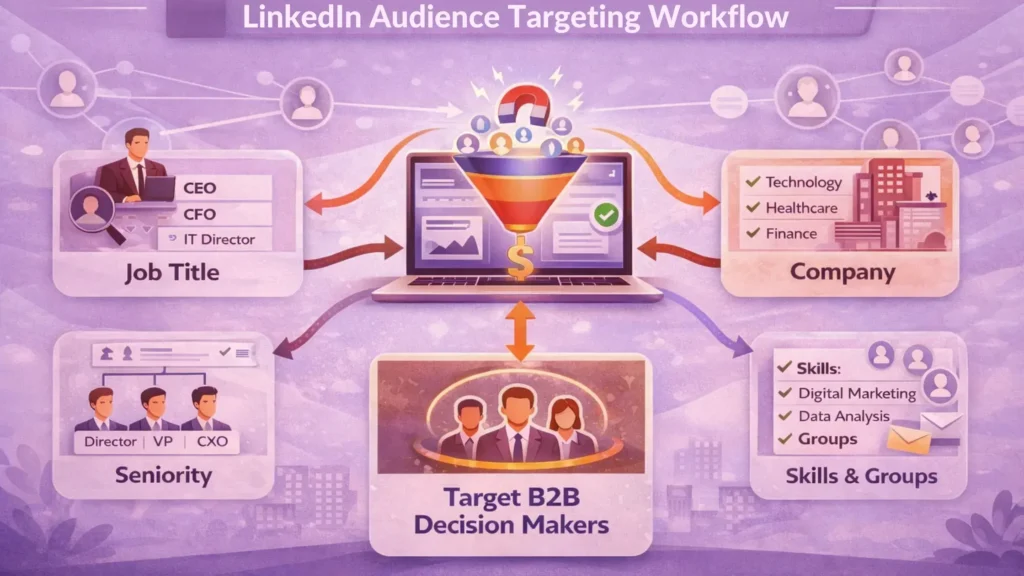
LinkedIn offers multiple targeting layers that can be combined for precision.
Job Title Targeting
Job title targeting is a popular method for reaching specific groups of people. It lets you connect with users who have titles like “CEO,” “Head of Marketing,” or “IT Director.”
However, job titles can differ widely between companies. For example, a Vice President at one company might be similar to a Director at another. Because of this, relying only on job titles can lead to missed opportunities or irrelevant traffic.
Job Function and Seniority Targeting
A more reliable approach is combining job function with seniority.
For example:
- Job Function: Marketing
- Seniority: Director, VP, CXO
This approach captures a broader range of relevant decision-makers without being overly restrictive.
Company-Based Targeting
Company targeting allows you to filter by:
- Industry
- Company size
- Company name (uploaded lists)
This is especially useful for B2B campaigns where deal size increases with company scale.
Skills, Groups, and Interests
These options can add depth but should be used carefully. Skills and groups work best as secondary filters, not primary ones, especially when targeting senior leaders.
How to Target B2B Decision Makers Using LinkedIn Ads
LinkedIn Ads are one of the fastest ways to reach decision makers at scale—if done correctly.
Best LinkedIn Ad Formats for B2B
The most effective formats for B2B decision makers include:
- Single image ads for clear value propositions
- Video ads for thought leadership and education
- Lead Gen Forms for frictionless conversions
Decision-makers respond better to insight-driven messaging than to aggressive sales pitches.
Layering Targeting for High-Quality Leads
Effective LinkedIn B2B targeting often involves layering:
- Job function + seniority
- Company size + industry
- Geography + role relevance
Exclusions are equally important. Removing entry-level roles, students, and unrelated departments significantly improves lead quality.
Budget and Bidding Considerations
LinkedIn CPCs are higher than those on other platforms, but the value lies in the quality of leads. In B2B, one qualified lead can be worth far more than dozens of low-intent clicks.
Account-Based Marketing (ABM) on LinkedIn
For high-value deals, Account-Based Marketing (ABM) is one of the most effective LinkedIn strategies.
What Is ABM and Why It Works
ABM focuses on targeting specific companies rather than broad audiences. LinkedIn supports this by allowing advertisers to upload company lists and target decision makers within those accounts.
This approach works particularly well for:
- Enterprise sales
- Long sales cycles
- High-ticket B2B services
Running ABM Campaigns on LinkedIn
A typical LinkedIn ABM strategy includes:
- Uploading a target account list
- Targeting multiple roles within each company
- Serving role-specific messaging
- Aligning ads with sales outreach
ABM shifts the focus from lead volume to pipeline quality.
Want to Reach the Right B2B Decision Makers — Not Just More Leads?
Targeting B2B decision makers on LinkedIn requires more than filters and ad budgets. It demands strategic ICP definition, layered targeting, persuasive messaging, and tight alignment between marketing and sales.
At Genbe, we help businesses design high-performance LinkedIn B2B targeting strategies — from LinkedIn Ads targeting B2B audiences to full-scale LinkedIn account-based marketing (ABM) campaigns.
If you’re ready to move beyond surface-level targeting and start generating qualified pipeline conversations, Genbe can help you build a scalable LinkedIn growth system.
Using LinkedIn Sales Navigator to Find Decision Makers
LinkedIn Sales Navigator is a powerful tool for organic and outbound targeting.
Advanced Lead and Account Filters
Sales Navigator allows filtering by:
- Seniority
- Function
- Company size
- Recent activity
This makes it easier to identify real decision-makers rather than guessing.
Building and Managing Decision-Maker Lists
Saving leads and accounts helps you track activity, role changes, and engagement over time. This is especially useful for long-term nurturing and outbound strategies.
InMail vs Connection-Based Outreach
While InMail can work, personalized connection requests often deliver better results. Decision-makers are more likely to respond to relevance than to paid messages.
Content Strategy That Attracts B2B Decision Makers
Content plays a critical role in LinkedIn targeting success.
Decision makers don’t engage with promotional posts. They engage with content that helps them think, plan, and make better decisions.
Content Types That Work Best
High-performing B2B content includes:
- Industry insights
- Thought leadership
- Case studies
- Strategic frameworks
This type of content builds credibility before any sales conversation begins.
Personal Profiles vs Company Pages
Personal profiles often outperform company pages in terms of organic reach. Decision makers prefer engaging with people, not logos. A strong executive or founder presence can significantly boost LinkedIn performance.
LinkedIn Outreach Messaging Best Practices
Outreach is most effective when it feels human and relevant.
Writing Personalized Connection Requests
Avoid pitching in the first message. Instead:
- Reference a shared interest or insight
- Keep the message short
- Focus on relevance, not selling
Follow-Up Messaging That Works
Effective follow-ups:
- Add value
- Share insights or resources
- Invite conversation, not demos
This approach builds trust over time.
Measuring and Optimizing LinkedIn B2B Campaigns
Targeting is only effective if performance is tracked and optimized.
Key Metrics That Matter
For B2B LinkedIn campaigns, focus on:
- Click-through rate (CTR)
- Cost per lead (CPL)
- Lead quality
- Pipeline contribution
Vanity metrics don’t translate into revenue.
Testing and Optimization
Regularly test:
- Targeting combinations
- Ad formats
- Messaging angles
Small improvements compound over time.
Common Mistakes When Targeting B2B Decision Makers on LinkedIn
Some of the most common mistakes include:
- Targeting too broadly
- Relying only on job titles
- Ignoring buying committees
- Using overly salesy messaging
Avoiding these pitfalls dramatically improves performance.
Best Practices to Reach B2B Decision Makers Consistently
Long-term success comes from consistency and alignment.
- Target multiple stakeholders, not individuals
- Combine ads, content, and outreach
- Align sales and marketing teams
- Focus on education and trust-building
LinkedIn works best as part of an integrated B2B strategy.
FAQs
How do I target decision-makers with LinkedIn ads?
Use a combination of job function, seniority, and company size rather than relying only on job titles.
Is LinkedIn effective for B2B lead generation?
Yes. LinkedIn consistently delivers higher-quality B2B leads compared to most social platforms.
What is the best LinkedIn targeting strategy for B2B?
Layered targeting combined with strong ICP definition and relevant messaging works best.
Can LinkedIn ABM work for small businesses?
Yes, especially when focused on a small list of high-value accounts.
Conclusion
Targeting B2B decision makers on LinkedIn isn’t about reaching the largest audience—it’s about reaching the right one.
With the right ICP, layered targeting, thoughtful content, and consistent optimization, LinkedIn becomes one of the most powerful channels for B2B growth. Whether you’re running ads, doing outbound outreach, or building demand over time, strategy matters far more than spend.
When done correctly, LinkedIn doesn’t just generate leads—it builds real business conversations.
Ready to Reach the Right B2B Decision Makers?
Targeting B2B decision makers on LinkedIn requires more than filters and ads — it requires strategy.
At Genbe, we help businesses design high-performance LinkedIn B2B targeting strategies that drive qualified leads and real pipeline growth.
Connect with Genbe today and turn LinkedIn into a predictable B2B lead generation engine.