

B2B marketing has entered a new era. Buyers today are no longer dependent on sales teams for information. They research independently, compare vendors extensively, and expect marketing content to educate rather than persuade. As buying committees grow larger and sales cycles become more complex, the role of marketing has shifted from lead generation alone to revenue enablement and long-term growth.
In this environment, businesses that rely on disconnected campaigns or outdated tactics struggle to scale. What separates high-performing B2B organizations from the rest is a well-defined, continuously evolving B2B marketing strategy—one that aligns people, processes, data, and technology.
This guide offers a comprehensive and detailed breakdown of B2B marketing strategies, how they are built, the different strategy models businesses can adopt, and how B2B marketing will evolve in 2026 and beyond.
What Are B2B Marketing Strategies?
B2B marketing strategies are structured, long-term frameworks that guide how a business positions its offerings, communicates value, and engages other companies throughout the buying journey. Unlike B2C marketing, which often emphasizes emotional appeal and impulse buying, B2B marketing is driven by rational decision-making, ROI justification, operational impact, and risk mitigation.
A B2B marketing strategy does not focus on individual campaigns in isolation. Instead, it defines:
- Who the ideal customers are
- What problems does the business solve?
- How value is communicated
- Where and how prospects are engaged
- How success is measured and optimized
In essence, a B2B marketing strategy acts as a blueprint for sustainable growth, ensuring every marketing activity supports broader business objectives.
Why B2B Marketing Strategies Are Critical for Growth
Many B2B organizations struggle not because they lack effort, but because they lack direction. Without a clear strategy, marketing teams often chase trends, prioritize volume over quality, and measure success using surface-level metrics.
A well-developed B2B marketing strategy provides:
- Consistency: Messaging and positioning remain aligned across all channels
- Efficiency: Resources are focused on high-impact initiatives
- Predictability: Marketing outcomes become measurable and scalable
- Alignment: Sales and marketing operate toward shared revenue goals
In highly competitive markets, strategy is the difference between reactive marketing and intentional growth.
How a B2B Marketing Strategy Is Developed (Step-by-Step, Detailed)
Developing a B2B marketing strategy is an iterative process that blends business insight, customer understanding, and execution discipline.
1. Establish Clear Business and Revenue Objectives
Every effective B2B marketing strategy begins with clarity around business goals. These goals typically extend beyond traffic or engagement metrics and focus on outcomes such as:
- Pipeline growth
- Revenue contribution
- Customer acquisition efficiency
- Market penetration
Marketing objectives must directly support business priorities. Without this alignment, even high-performing campaigns can fail to drive real impact.
2. Deep Buyer Persona Research and Validation
Buyer personas are the foundation of relevance in B2B marketing. However, effective personas go far beyond basic demographics. They capture:
- Organizational context (industry, size, maturity)
- Decision-making roles and influence
- Key challenges and operational pain points
- Buying triggers and success criteria
This level of detail allows marketing teams to craft messaging that resonates with real-world business needs rather than generic assumptions.
3. Mapping the B2B Customer Journey in Detail
The B2B buying journey is rarely linear. Buyers move back and forth between research, evaluation, and internal discussions. Mapping this journey helps marketers understand:
- What information buyers seek at each stage
- Which channels do they rely on
- Where friction or drop-offs occur
A well-mapped journey ensures marketing delivers the right message, in the correct format, at the right time.
4. Strategic Channel Selection and Prioritization
One of the most common B2B marketing mistakes is spreading efforts too thin across channels. Strategy development requires prioritization based on:
- Buyer behavior
- Sales cycle length
- Budget and resources
- Historical performance data
Rather than “being everywhere,” effective strategies focus on channels that consistently influence buying decisions.
5. Creating a Scalable Content and Messaging Architecture
Content is the primary driver of modern B2B marketing. A detailed content strategy defines:
- Core messaging pillars
- Content themes aligned to buyer pain points
- Formats for each funnel stage
- Distribution and amplification methods
This structure ensures content is purposeful, cohesive, and aligned with long-term goals.
6. Leveraging Technology, Data, and Automation
Technology transforms strategy into execution at scale. CRM systems, marketing automation platforms, and analytics tools enable:
- Personalization at scale
- Real-time performance tracking
- Data-driven decision-making
In advanced B2B organizations, technology is not a support function—it is a strategic enabler.
7. Continuous Measurement, Optimization, and Learning
A B2B marketing strategy is never “finished.” Performance data must be reviewed continuously to identify:
- What drives a qualified pipeline
- Which channels influence revenue
- Where optimization is needed
This feedback loop ensures the strategy evolves with market conditions and buyer behavior.
Different Types of B2B Marketing Strategies
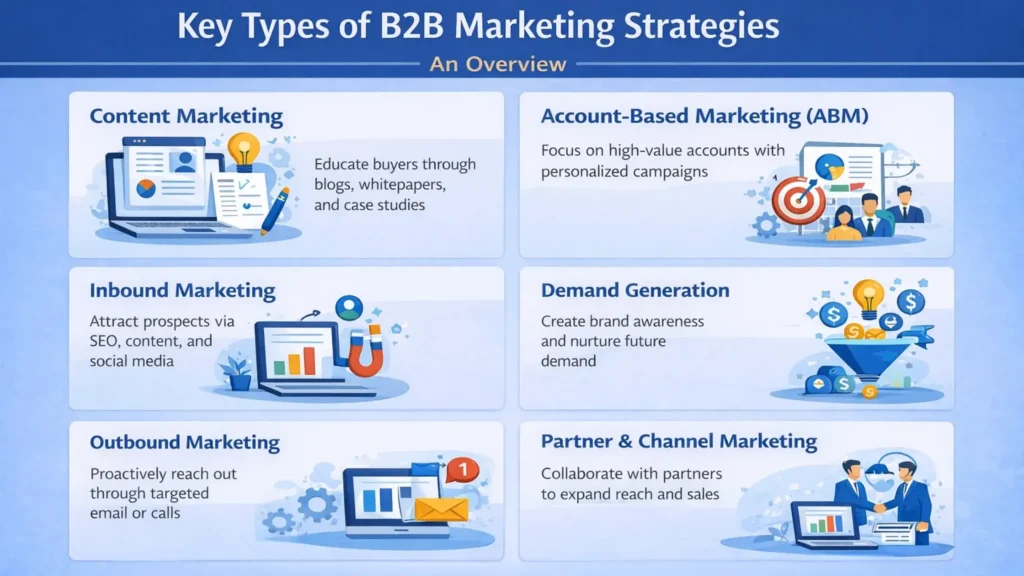
Most successful B2B companies use a hybrid approach, combining multiple strategy types.
Content Marketing Strategy
Content marketing focuses on educating buyers, building authority, and supporting decision-making. Long-form blogs, whitepapers, and case studies help prospects understand complex problems and evaluate solutions with confidence.
Inbound Marketing Strategy
Inbound marketing attracts buyers through search, organic discovery, and value-driven engagement. It is especially effective for building long-term demand and reducing dependency on paid acquisition.
Outbound Marketing Strategy
Outbound marketing accelerates pipeline growth by proactively engaging targeted prospects. When supported by substantial research and personalization, outbound can effectively complement inbound efforts.
Account-Based Marketing (ABM)
ABM shifts focus from individual leads to strategic accounts. Marketing and sales collaborate to deliver highly tailored messaging that engages multiple stakeholders within target organizations.
Demand Generation Strategy
Demand generation focuses on shaping market perception and creating future buying intent. It prioritizes awareness, trust, and thought leadership over immediate conversions.
Performance Marketing Strategy
Performance marketing emphasizes measurable ROI. It relies on analytics, experimentation, and optimization to improve efficiency and scalability across paid and owned channels.
Partner and Channel Marketing
Channel marketing leverages external partners to expand reach and credibility. Strategic alliances often accelerate growth in complex or highly specialized markets.
B2B Marketing Strategies in 2026: A Forward-Looking View
By 2026, B2B marketing will be defined by intelligence, precision, and trust. Volume-based tactics will continue to lose effectiveness, while intent-driven, AI-powered strategies take center stage.
1. AI-Driven Personalization at Scale
AI will power real-time personalization across channels, enabling marketers to:
- Predict buyer intent
- Personalize content automatically
- Optimize campaigns continuously
AI will become the backbone of B2B marketing strategies.
2. Intent-Based Marketing Over Lead Volume
Marketing teams will prioritize buying signals over form fills, focusing on:
- Search behavior
- Content engagement
- Account readiness indicators
This improves sales efficiency and conversion quality.
3. Account-Centric Growth Models
ABM will evolve into complete lifecycle account management, focusing on:
- Expansion
- Retention
- Lifetime value
Growth will be measured at the account level, not just acquisition.
4. High-Impact Content for Decision-Makers
Content will shift from volume to depth, focusing on:
- Real business challenges
- Data-backed insights
- Decision-stage enablement
Authority will outperform visibility.
5. Sales and Marketing as One System
By 2026, marketing and sales will operate as a single revenue system with:
- Shared KPIs
- Unified data platforms
- Consistent messaging
Alignment will directly impact revenue growth.
6. Privacy-First, Trust-Led Marketing
With tighter regulations and rising buyer skepticism, trust will be a key differentiator. Successful brands will prioritize:
- Ethical data usage
- Transparent communication
- Value-first engagement
7. Revenue-Centric Performance Measurement
Marketing success will be measured by:
- Pipeline contribution
- Revenue influence
- Customer lifetime value
Activity metrics will give way to business impact metrics.
Common B2B Marketing Mistakes to Avoid
- Prioritizing tactics over strategy
- Targeting broad audiences instead of niches
- Ignoring sales and marketing alignment
- Focusing on traffic instead of conversions
- Underinvesting in long-term content
Conclusion
B2B marketing strategies are no longer tactical playbooks—they are growth systems. From foundational planning to AI-driven execution in 2026, successful strategies require clarity, alignment, and continuous evolution.
Organizations that invest in deeply structured, insight-driven B2B marketing strategies will not only generate leads but also build a durable competitive advantage.
Building a future-ready B2B marketing strategy requires expertise, data, and execution discipline.
Genbe helps B2B organizations design and execute marketing strategies that align with buyer intent, leverage technology, and deliver measurable business growth.
👉 Let’s build a B2B marketing strategy designed for today—and ready for 2026 and beyond.