
Despite investing heavily in digital channels, many companies still struggle with underperforming B2B email marketing campaigns—open rates plateau. Click-through rates decline. Leads go cold. Sales teams complain about poor-quality prospects. Marketing blames targeting. Sales blames lead quality. Leadership questions ROI.
The problem is rarely the email itself.
It’s a strategy.
B2B email marketing is the structured use of segmented, personalized, and automated email campaigns to nurture business buyers, influence multiple decision-makers, and generate measurable pipeline revenue. In B2B environments—where buying cycles are longer, budgets are scrutinized, and stakeholders demand proof of value—generic newsletters and batch-and-blast campaigns don’t work.
A modern, data-driven B2B email marketing strategy transforms email from a simple communication channel into a predictable revenue engine.
In this pillar guide, you’ll learn how to build high-performing B2B email marketing campaigns using advanced segmentation, personalization, automation workflows, content mapping, deliverability optimization, CRM integration, and performance analytics—so you can consistently generate qualified leads and accelerate business growth.
Key Takeaways
- B2B email marketing must align directly with revenue and pipeline objectives.
- Email list segmentation is the foundation of high-converting campaigns.
- Personalization must be contextual and behavior-driven.
- Marketing automation enables scalable, timely communication.
- Deliverability and compliance protect long-term brand credibility.
- Continuous testing and optimization drive sustained ROI growth.
1. Understand the Modern B2B Buying Process
Before designing campaigns, you must understand how B2B buying decisions are made.
Unlike B2C purchases, B2B decisions:
- Involve 3–7 stakeholders on average
- Require budget approval and ROI validation
- Include technical and operational evaluation
- Follow longer, research-driven timelines
Typical roles in the Decision-Making Unit (DMU) include:
- Economic buyer (CFO/Founder)
- Technical evaluator (IT/Engineering)
- End user (Operations/Marketing)
- Procurement/legal approvers
Each role consumes different content and evaluates value differently.
To create effective B2B email marketing strategies:
- Build detailed buyer personas.
- Map content needs by buyer stage (awareness, consideration, decision).
- Identify objections and barriers at each stage.
- Align email messaging with specific stakeholder concerns.
The more precisely you understand your audience, the stronger your value proposition becomes.
2. Define Revenue-Aligned SMART Objectives
Email marketing should support measurable business outcomes.
Set SMART goals tied to pipeline and revenue metrics:
Examples:
- Increase email-attributed MQLs by 25% in six months.
- Improve click-to-conversion rate from 4% to 7%.
- Reduce sales cycle time by 15% using automated nurture sequences.
- Increase the re-engagement rate of inactive leads by 20%.
Beyond open rates and clicks, measure:
- Pipeline contribution
- Opportunity creation rate
- Deal velocity
- Customer lifetime value (CLV)
When email performance is tied to revenue outcomes, it becomes a strategic growth lever—not just a communication channel.
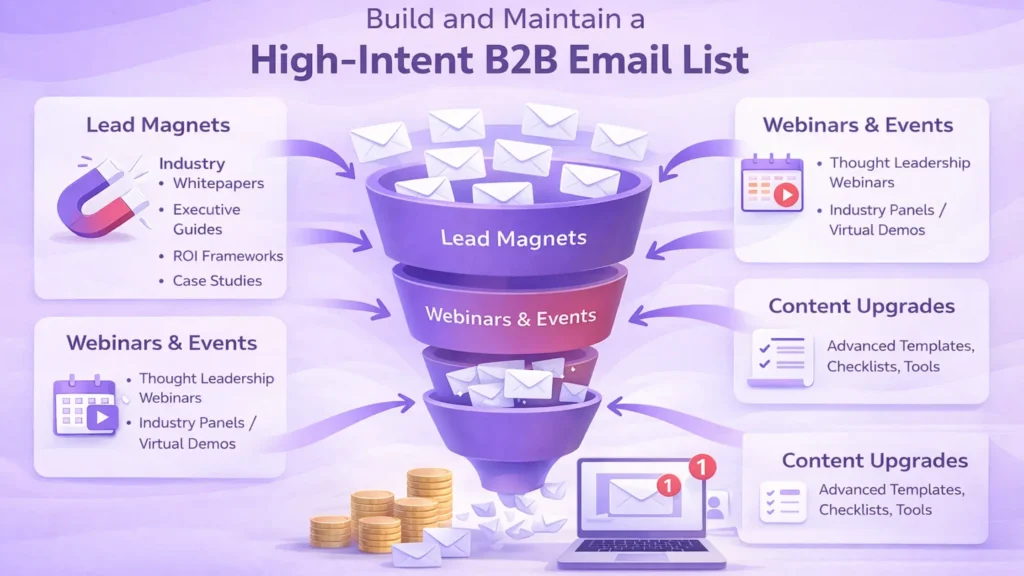
3. Build and Maintain a High-Intent Email List
Quality always outweighs quantity in B2B email marketing.
Avoid purchased lists. They harm deliverability, reduce trust, and inflate vanity metrics.
Instead, implement structured list-building strategies:
Lead Magnets
- Industry whitepapers
- Executive guides
- ROI frameworks
- Case studies
Webinars & Events
- Thought leadership webinars
- Industry panels
- Virtual demos
Account-Based Marketing (ABM)
For high-value accounts, combine targeted LinkedIn outreach with gated assets to capture decision-maker emails.
Content Upgrades
Offer advanced templates, checklists, or tools within blog posts.
Regularly clean your list by removing inactive subscribers and invalid emails to maintain strong email deliverability.
4. Advanced Email List Segmentation for Performance
Segmentation is the backbone of effective B2B email marketing.
Segment your list by:
- Industry vertical
- Company size
- Buyer stage
- Job function
- Engagement history
- Purchase intent signals
Advanced segmentation techniques include:
- Behavioral scoring
- Predictive lead scoring
- Account-level segmentation (ABM)
- Dynamic content personalization
Example segmentation strategy:
- Cold leads → Educational nurture sequence
- Engaged leads → Case studies and ROI proof
- High-intent leads → Demo invitations and pricing breakdown
Precise segmentation improves relevance, increases open rates, and enhances conversion performance.
5. Personalization at Scale
Personalization must go beyond inserting a first name.
Effective personalization includes:
- Industry-specific subject lines
- Role-based messaging
- Dynamic content blocks
- Behavioral triggers
- Previous interaction references
Example: Instead of “See Our Platform,” use: “Reduce Manufacturing Downtime by 18% with Predictive Monitoring.”
Behavior-based emails (triggered after content downloads or demo requests) significantly improve engagement.
Personalization builds trust, authority, and long-term brand credibility.
6. Design High-Converting Email Content
Content must educate, persuade, and guide.
Core Content Types
- Educational guides
- Case studies
- ROI calculators
- Product comparisons
- Testimonials
Structuring a Drip Campaign
- Awareness Email – Industry challenge overview
- Insight Email – Research-backed data
- Authority Email – Case study proof
- Decision Email – Demo invitation
- Follow-Up Email – Objection Handling
Keep emails concise, visually clean, and mobile-optimized. Strong calls-to-action (CTA) should be visible and action-oriented.
7. Marketing Automation and CRM Integration
Marketing automation ensures the right message reaches the right prospect at the right time.
Key workflows:
- Welcome series
- Lead nurture campaigns
- Event follow-ups
- Re-engagement sequences
- Post-purchase onboarding
Integrate email marketing with your CRM to:
- Sync contact data
- Align marketing and sales teams
- Track pipeline attribution
- Trigger sales notifications
Automation combined with CRM intelligence creates a unified customer journey.
8. Optimize Email Deliverability and Compliance
Deliverability determines whether your strategy reaches its audience.
Best practices:
- Authenticate domains (SPF, DKIM, DMARC)
- Maintain sender reputation
- Avoid spam-trigger language
- Monitor bounce rates
- Provide clear unsubscribe options
Comply with GDPR, CAN-SPAM, and regional regulations to maintain trust and avoid penalties.
Deliverability is foundational to long-term success.
9. Data-Driven Optimization Framework
Continuous optimization separates average campaigns from revenue-driving systems.
Track and analyze:
- Open rates
- Click-through rates
- Conversion rates
- Revenue attribution
- Segment-level performance
- Email frequency impact
Run A/B tests on:
- Subject lines
- CTA placement
- Send times
- Content structure
Adopt a quarterly optimization review cycle to refine workflows and messaging.
10. Real-World Example: From List to Revenue
Consider a SaaS company targeting mid-market IT teams.
Step 1: Segment by industry and company size.
Step 2: Launch an awareness email series sharing cybersecurity trends.
Step 3: Trigger follow-up case study emails after engagement.
Step 4: Send the ROI calculator to high-intent users.
Step 5: Notify sales after demo request.
Result: Improved lead quality, shorter sales cycle, higher conversion rates.
This structured approach demonstrates how strategy—not volume—drives results.
Frequently Asked Questions (FAQ)
1. Why is B2B email marketing still effective in 2025?
It delivers measurable ROI, supports complex buying journeys, and provides direct access to decision-makers.
2. How long should a B2B email nurture sequence be?
Typically 4–8 emails over several weeks, depending on buying cycle length.
3. What makes segmentation effective?
Clear role-based messaging, behavioral tracking, and buyer-stage alignment.
4. How often should B2B emails be sent?
Weekly or bi-weekly is common, but testing determines optimal cadence.
5. What tools are best for B2B email marketing?
CRM-integrated marketing automation platforms that support segmentation and analytics.
6. How can automation improve sales alignment?
By triggering sales alerts when leads show high-intent behaviors.
7. What is the biggest mistake in B2B email marketing?
Sending generic messages without segmentation or personalization.
Conclusion:
B2B email marketing remains one of the highest-ROI digital channels when executed strategically.
By combining:
- Audience intelligence
- Revenue-aligned objectives
- Advanced segmentation
- Strategic personalization
- High-value content
- Automation and CRM integration
- Deliverability optimization
- Continuous data analysis
You transform email from a simple communication channel into a predictable, scalable revenue engine.
In competitive B2B markets, success comes not from sending more emails—but from building smarter, structured, data-driven systems that influence buying decisions and drive measurable growth.
🚀 Ready to Strengthen Your B2B Email Marketing Strategy?
At Genbe, we help B2B brands design revenue-focused email marketing systems that leverage segmentation, automated workflows, CRM integration, and continuous performance optimization.
From strategy audits to full-scale automation deployment, our team aligns email execution with measurable pipeline growth.
👉 Book a strategy consultation with Genbe today and transform your email marketing into a scalable growth engine.