
Artificial Intelligence (AI) is not a new concept—it has existed for decades—but only in recent years has it gained serious traction in digital marketing. As businesses compete in increasingly crowded digital spaces, marketers are under pressure to deliver better results with less manual effort. This is where AI-driven website optimization becomes especially powerful.
Artificial Intelligence enables marketers to automate complex tasks that previously required significant human involvement. AI helps make websites better by studying how users behave and finding patterns. It also delivers personalized experiences that turn visitors into leads and customers. This process is called Conversion Rate Optimization (CRO).
In this, we’ll explore how artificial intelligence is used in conversion rate optimization, how AI-driven website optimization works, and why it has become one of the most impactful tools in modern digital marketing.
What Is Artificial Intelligence in Digital Marketing?
Artificial Intelligence refers to technologies that aim to mimic human thinking and behavior. In digital marketing, AI commonly includes:
- Machine learning
- Natural language processing
- Predictive analytics
- Behavioral modeling
AI is already widely used in areas such as search engine optimization (SEO), marketing automation, customer support chatbots, and content recommendations. In this article, the focus is specifically on how AI enhances conversion rate optimization.
Unlike traditional marketing tools, AI systems continuously learn from data. The more they are used, the more accurate and effective they become—making them especially valuable for CRO.
Why Artificial Intelligence Matters for Conversion Rate Optimization
Traditional CRO methods often rely on manual testing, intuition, and limited datasets. While these approaches can work, they are slow, resource-intensive, and difficult to scale.
Artificial intelligence changes this by introducing automation, speed, and data-driven decision-making into the optimization process.
Key Benefits of Using AI in CRO
Improved Accuracy
AI algorithms are trained on large datasets collected from real users across different industries. These models analyze patterns and predict which variations of a webpage, CTA, or message are most likely to convert.
This reduces human error and removes guesswork from optimization decisions.
Cost Efficiency
AI systems operate continuously without breaks or manual supervision. This reduces reliance on large in-house teams, lowers operational costs, and increases optimization output.
Faster Results
AI-driven CRO dramatically shortens testing cycles. Instead of running experiments for weeks, AI can identify winning variations faster by continuously analyzing and reallocating traffic in real time.
AI vs Traditional CRO: What’s the Real Difference?
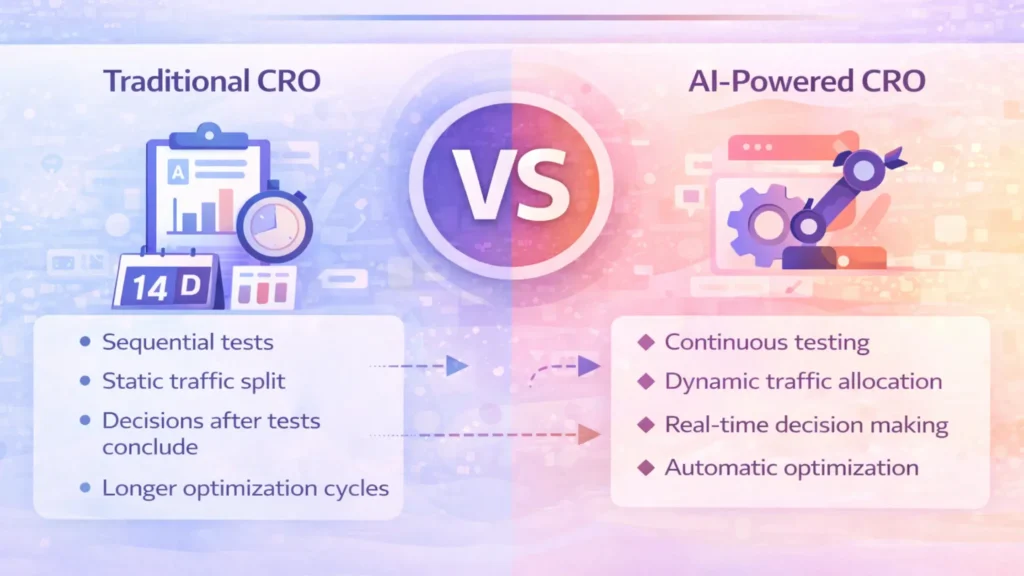
Traditional conversion rate optimization relies heavily on static testing, historical data, and manual interpretation. While effective in controlled scenarios, it struggles to keep pace with rapidly changing user behavior and traffic patterns.
In traditional CRO:
- Tests are run sequentially
- Traffic is split evenly regardless of intent
- Decisions are made only after tests conclude
- Optimization cycles can take weeks or months
With AI-powered CRO:
- Testing happens continuously
- Traffic is dynamically allocated based on performance
- Decisions are made in real time
- Optimization adapts automatically as behavior changes
AI does not replace CRO principles—it enhances them by adding speed, scale, and predictive intelligence. This allows businesses to optimize experiences while users are actively engaging, rather than reacting after performance drops.
Website Optimization With Artificial Intelligence
AI-powered website optimization focuses on delivering personalized, relevant experiences to every visitor. Instead of showing the same static content to all users, AI dynamically adjusts website elements based on user intent and behavior.
To successfully use AI in CRO, it’s important to understand how it integrates into web design and optimization strategies.
How AI Is Used in Website Optimization
AI-Powered A/B Testing
One of the most common applications of AI in CRO is A/B testing. Unlike traditional testing methods, AI-powered A/B testing can:
- Test multiple variations simultaneously
- Analyze user behavior in real time
- Automatically identify high-performing elements
Machine learning models evaluate headlines, layouts, images, and CTAs to determine which combinations perform best for specific audience segments.
What Is AI-Driven Website Optimization?
AI-driven website optimization goes beyond simply driving traffic. It focuses on customizing each visitor’s experience using real-time data.
AI systems analyze information such as:
- Browsing behavior
- Past interactions
- Traffic sources
- External behavioral signals
Based on this data, AI algorithms determine what content should be displayed at specific moments during a visitor’s session. The result is a seamless, personalized experience that feels natural rather than forced.
Machine Learning and Personalization Engines Explained
Machine Learning in CRO
Machine learning is a subset of AI that enables systems to learn from data without being explicitly programmed. In CRO, machine learning models analyze historical user behavior to predict future actions.
These models are trained using large datasets that include examples of users who converted and those who didn’t. Over time, the model becomes increasingly accurate at predicting conversion likelihood.
How Personalization Engines Work
Personalization engines use machine learning to deliver tailored content and recommendations. They make educated guesses about what visitors want based on their behavior and the behavior of similar users.
For example:
- Returning visitors may see content aligned with past interests
- New users may receive recommendations based on aggregated behavior patterns
- Product suggestions may change dynamically during a session
As more data is collected, personalization becomes more precise.
Real-World Example of AI Personalization
Consider an ecommerce website that sells footwear. A visitor lands on the site after clicking an image on a social media platform. AI-powered analytics identify traffic sources, devices, and browsing behavior.
As the visitor explores the site, the personalization engine dynamically recommends products based on the preferences of similar users. On future visits, the system refines recommendations based on previous interactions—without any manual input from marketers.
How Artificial Intelligence Boosts Lead Generation and Sales
AI-powered CRO helps businesses increase leads and sales by anticipating user needs and reducing friction throughout the conversion journey.
Dynamic Content Personalization
AI systems adjust content in real time based on user behavior. Unlike static campaigns, dynamic personalization evolves continuously as visitors interact with the website.
This results in:
- Higher engagement
- Faster decision-making
- Increased conversion likelihood
Where AI-Powered CRO Delivers the Biggest Impact
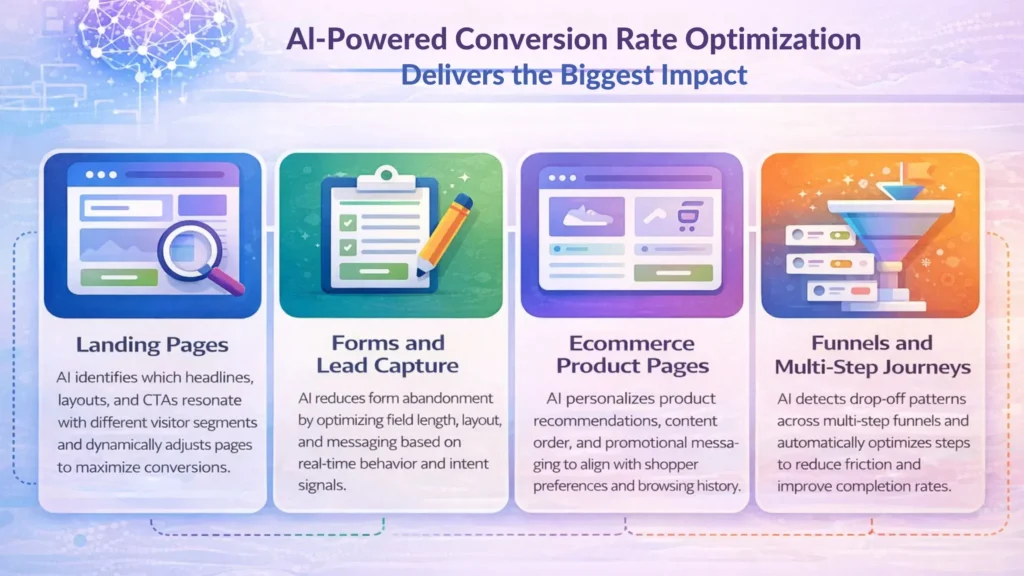
AI-driven conversion optimization produces the strongest results when applied to high-friction or high-volume touchpoints across the customer journey.
Landing Pages
AI identifies which headlines, layouts, and CTAs resonate with different visitor segments and dynamically adjusts pages to maximize conversions.
Forms and Lead Capture
AI reduces form abandonment by optimizing field length, layout, and messaging based on real-time behavior and intent signals.
Ecommerce Product Pages
AI personalizes product recommendations, content order, and promotional messaging to align with shopper preferences and browsing history.
Funnels and Multi-Step Journeys
AI detects drop-off patterns across multi-step funnels and automatically optimizes steps to reduce friction and improve completion rates.
Key Advantages of AI-Powered Website Optimization
- Delivers relevant content to every visitor
- Reduces reliance on manual testing
- Improves conversion accuracy
- Enhances user experience
- Scales across audiences and channels
AI-powered CRO enables businesses to offer the right experience at the right time—consistently and at scale.
Challenges and Best Practices for AI-Powered CRO
Common Challenges
- Incomplete or inaccurate data
- Over-automation without strategic oversight
- Poorly defined conversion goals
- Limited collaboration between teams
Best Practices
- Start with clear business objectives
- Maintain clean, reliable data sources
- Combine AI insights with human judgment
- Monitor performance continuously and refine strategies
AI is most effective when used as a decision-support tool rather than a replacement for strategy.
Measuring the ROI of AI-Powered CRO
Implementing AI for CRO is only valuable if success can be clearly measured. Businesses should track metrics that reflect both performance and efficiency.
Key KPIs include:
- Conversion rate uplift
- Revenue per visitor
- Cost per acquisition (CPA)
- Engagement metrics such as time on site and scroll depth
- Funnel completion rates
AI-powered optimization often delivers incremental improvements across many touchpoints. Over time, these gains compound, producing significant long-term growth.
Frequently Asked Questions (FAQs)
What is artificial intelligence for conversion rate optimization?
Artificial intelligence for conversion rate optimization uses machine learning and data analysis to understand user behavior, personalize experiences, and automatically improve website conversions in real time.
How does AI improve conversion rates compared to traditional CRO?
AI improves conversion rates by analyzing large volumes of user data, predicting intent, and dynamically optimizing content, layouts, and CTAs—without relying solely on manual testing or assumptions.
Can AI replace traditional A/B testing?
AI does not replace A/B testing but enhances it. AI-powered testing runs continuously, adapts in real time, and identifies winning variations faster than traditional, fixed A/B tests.
What types of businesses benefit most from AI-powered CRO?
Ecommerce, SaaS, B2B, and lead-generation businesses benefit the most from AI-powered CRO, especially those with high traffic volumes and complex user journeys.
What data is required to use AI for CRO effectively?
AI-powered CRO requires behavioral data such as page views, clicks, session duration, traffic sources, and conversion events. Clean, centralized data improves accuracy and performance.
Conclusion
Artificial Intelligence is no longer a future trend—it is actively shaping the present of digital marketing. AI-driven website optimization enables businesses to deliver personalized experiences, improve lead generation, and increase conversion rates with greater speed and accuracy.
Organizations that embrace AI-powered CRO gain a significant competitive advantage by making smarter decisions, reducing manual effort, and responding to user behavior in real time.
👉 Ready to improve your conversion performance with AI?
GenbeCloud helps businesses implement AI-powered conversion rate optimization strategies that drive measurable growth, higher engagement, and long-term ROI.