

In today’s digitally connected economy, the B2B sales cycle has undergone a fundamental transformation. The traditional linear funnel—where a lead enters through an ad and is immediately called by sales—is largely extinct. Today, B2B buyers research, compare, and evaluate brands long before they ever speak to a sales representative.
Decision-makers are scrolling LinkedIn during commute hours. Procurement teams are validating vendors through peer discussions on X (Twitter). Executives are consuming long-form thought leadership on YouTube and industry-specific newsletters before shortlisting partners. In fact, research suggests that nearly $70\%$ of the B2B buyer journey is completed anonymously before a prospect even identifies themselves to a vendor.
Social media is no longer an optional “extra” for B2B organizations. It is the central nervous system of your strategic growth engine. True mastery in B2B social media marketing is not about posting consistently or chasing vanity metrics like “likes.” It is about engaging your business audience with relevance, authority, and precision—while aligning every effort with measurable business outcomes.
Why Social Media Mastery is the New B2B Competitive Advantage
B2B marketing differs fundamentally from B2C. The sales cycle is measured in months, not minutes. Multiple stakeholders—the “buying committee”—influence a single decision. Risk mitigation outweighs impulse. In this environment, social media serves as a multi-touchpoint validation machine.
According to industry insights and Neil Patel’s research on B2B social media marketing, businesses that prioritize value-driven content see significantly higher engagement from decision-makers seeking concrete solutions rather than sales pitches.
Effective B2B social media mastery enables organizations to:
- Establish Radical Trust: By the time a buyer reaches out, they should already view you as the definitive expert in your niche.
- Shorten Sales Cycles: Strategic content answers objections before the prospect even raises them.
- Humanize the Enterprise: “De-branding” corporate communication in favor of human-to-human interaction builds trust that a logo simply cannot.
- Drive Predictable Revenue: By moving from “awareness” to “attribution,” social media becomes a measurable part of the pipeline.
The 5P Framework for B2B Social Media Success
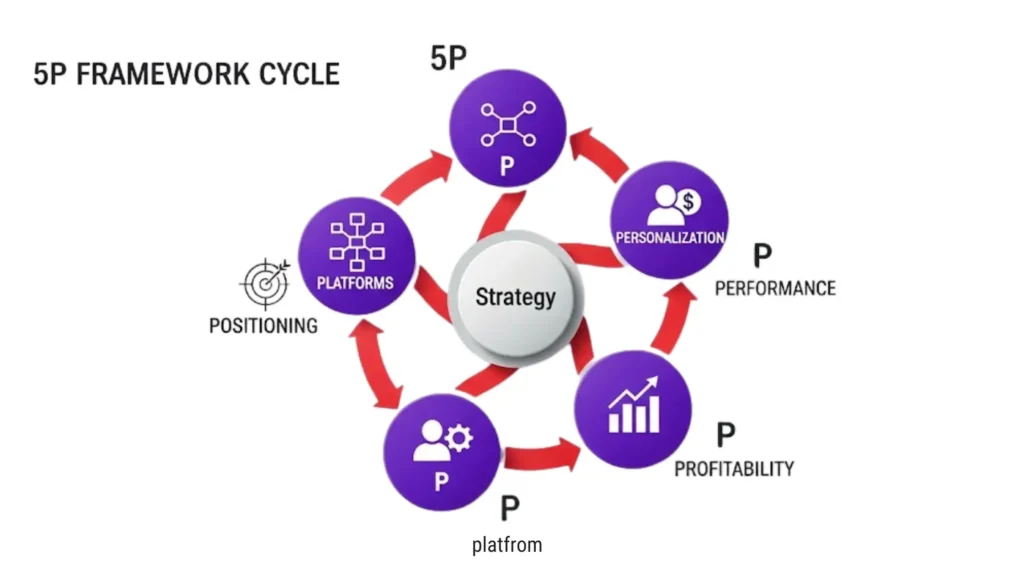
To move from random activity to strategic impact, B2B brands must operate within a strategic framework. The 5P Model provides a structured path:
1. Positioning (Owning the Narrative)
Clarify your brand authority. In a crowded market, what specific expertise do you own? You cannot be “the best software for everyone.” You must be the definitive solution for a Specific Industry solving a Specific Problem. Positioning ensures your social content has a unique POV that cuts through the noise.
2. Platforms (Intent-Based Selection)
Select channels based on where your business audience has the highest intent, not just where they are “popular.”
- LinkedIn: The professional HQ for networking, ABM, and executive thought leadership.
- YouTube: The world’s second-largest search engine, perfect for deep-dive tutorials, webinars, and authority building.
- X (Twitter): The real-time pulse of industry trends, customer service, and PR.
3. Personalization (AI-Driven Relevance)
The modern buyer expects content tailored to their role. Use AI-powered personalization to ensure that a CFO sees content regarding ROI Calculations while a CTO sees content regarding Infrastructure Security.
4. Performance (Data-Driven Discipline)
Track metrics that indicate real business health. While engagement shows content resonance, B2B brands must look deeper into “Leading Indicators,” such as profile visits from target accounts, and “Lagging Indicators,” such as demo requests and pipeline contribution.
5. Profitability (The Revenue Connection)
Social media must ultimately be a profit center. This requires measuring ROI through multi-touch attribution, ensuring you can prove that a LinkedIn post in Q1 contributed to a closed-won deal in Q3.
The Rise of Social SEO: Optimizing for Discovery
A critical shift in B2B social media is the transition from “browsing” to “searching.” Platforms like LinkedIn and YouTube are increasingly used as search engines.
Optimizing for the Social Algorithm
To master Social SEO, your content must be discoverable. This involves:
- Keyword Integration: Natural use of industry-specific terms in your headlines, “About” sections, and post captions.
- Hashtag Strategy: Using a mix of broad industry tags (#SaaS) and niche-specific tags (#SupplyChainAI) to categorize your content.
- Rich Media & Alt-Text: Utilizing alt-text on images to allow platform algorithms to “read” your visual assets.
Building an Authority-First Content Strategy
Content is the fuel for your B2B engine. However, your strategy should be built on a “Value-First” architecture that prioritizes the reader’s needs over your sales goals.
The 60/30/10 Content Rule
To maintain a healthy feed that attracts and retains high-value prospects, follow this ratio:
- 60% Educational (The Teacher): Industry insights, “how-to” frameworks, and data-driven reports. This builds your “Expertise” score.
- 30% Engagement & Culture (The Human): Behind-the-scenes looks, employee stories, and “Unpopular Opinions” that spark discussion.
- 10% Promotional (The Provider): Product updates, webinar invites, and case studies.
The Tactical Insert: B2B Social Media Audit Checklist
Before scaling your efforts, use this checklist to ensure your foundation is solid:
- [ ] Profile Optimization: Does every executive profile have a clear value proposition in the headline?
- [ ] Content Pillars: Are your top 3 expertise areas clearly defined?
- [ ] Tracking Pixels: Are LinkedIn Insight Tags and conversion pixels active on your website?
- [ ] Engagement Protocol: Do you have a standard for responding to comments within 4 hours?
- [ ] Employee Advocacy: Is there a simplified way for employees to share company updates?
- [ ] Visual Consistency: Does your social imagery match your brand’s premium positioning?
⚡ Strategic Growth Opportunity
Is your B2B Social Media strategy underperforming? > If you’ve completed the audit above and identified gaps in your pipeline, it’s time to move beyond guesswork. Genbe specializes in high-performance B2B advertising and funnel optimization. We help brands turn complex LinkedIn strategies into predictable revenue streams.
Connect with Genbe for a Performance Audit
Precision Targeting: Engaging the Buying Committee
Engaging a business audience requires surgical precision. You aren’t looking for “virality”; you are looking for “relevance” among a very small group of people who have the power to sign a contract. Modern B2B decisions are made by committee, and your social strategy must address each member of the committee.
The Buying Committee Decision Grid
To convert high-value accounts, your content must satisfy three distinct personas simultaneously:
- CFO (The Decision Maker): Focus: ROI, Cost Savings, and Long-term Value.
- Content: Data-backed case studies and whitepapers on efficiency.
- CTO/IT (The Gatekeeper): Focus: Integration, Security, and Technical Specs.
- Content: Technical breakdowns, security certifications, and API documentation summaries.
- End User (The Champion): Focus: UX, Ease of Use, and Tactical How-To.
- Content: Short “Quick Tip” videos and community discussions on workflow optimization.
Storytelling for Authority
Complex B2B solutions are often dry. Storytelling bridges the gap between technical specs and emotional resonance. Instead of stating features, share Transformation Narratives. For example, share how a specific client saved $\$2M$ in lost productivity by migrating to a more robust infrastructure during peak season.
Social Media Advertising: The B2B Growth Engine
While organic content builds the foundation, paid social accelerates the results. In B2B, social advertising is the ultimate “Account-Based Marketing” (ABM) tool.
Account-Based Advertising (ABM)
High-performing B2B organizations use social platforms to “surround” their target accounts. By uploading a list of target companies to LinkedIn, you can ensure that only the decision-makers at those specific companies see your high-value content.
Creative Strategy for B2B Ads
B2B ads should look like valuable resources, not commercials.
- Lead Gen Forms: Use native forms to offer “Gated Content” like whitepapers or templates directly within the app.
- Video Testimonials: Short, authentic clips of customers explaining the outcome of your solution.
- Retargeting: If someone visits your pricing page, show them a specific case study ad on their social feed the next day.
Measuring Success: Connecting Metrics to the C-Suite
Vanity metrics are “ego metrics.” The C-Suite cares about “Impact Metrics.
Key Performance Indicators (KPIs)
- MQLs & SQLs: Number of Qualified Leads sourced from social traffic.
- Cost Per Lead (CPL): The efficiency of social vs. other channels.
- Pipeline Velocity: How much faster deals close when prospects engage with social content.
- Share of Voice (SOV): Your brand’s percentage of mentions in industry-wide discussions.
Multi-Touch Attribution
In B2B, the “Last Click” is rarely the whole story. A user might see a LinkedIn post in month one, watch a YouTube video in month two, and finally request a demo in month three. Multi-touch attribution models assign value to all these interactions, giving you a true picture of your social media ROI.
Frequently Asked Questions (FAQ)
1. Which platform should my B2B brand prioritize first?
For 90% of B2B organizations, LinkedIn is the non-negotiable starting point. It offers the most robust professional targeting and is where decision-makers go with a business mindset.
2. How do we get our executives to post on social media?
The most successful approach is a “Ghostwriting for SMEs” model. Marketing teams interview executives for 15 minutes once a week to extract original insights, which are then formatted into high-impact social posts.
3. Is organic social still worth it, or should we just run ads?
Organic and Paid are two sides of the same coin. Organic builds credibility and trust, while Paid builds predictability and scale. An “Ads-only” strategy often fails because prospects will inevitably visit your profile to vet you.
4. How long does it take to see a measurable ROI from social?
B2B social media is a long-game strategy. While you can see “leading indicators” within 30 days, actual pipeline impact typically takes one full sales cycle to manifest (usually 3–6 months).
Conclusion: From Presence to Performance
Social Media Mastery for B2B is not an overnight achievement. It is a disciplined commitment to providing more value to your audience than your competitors do. By selecting the right platforms, leveraging the power of executive branding, and backing every decision with data-driven ROI, your organization can transform social media from a “cost center” into a “revenue engine.”
The opportunity to dominate your niche through digital authority has never been greater. The strategy is clear. The tools are available. The next step is execution.
Need Expert Support to Scale Your B2B Social Media Advertising? If your organization is ready to move beyond experimentation and build a scalable growth engine, connect with Genbe. We specialize in high-performance B2B strategies, from LinkedIn ABM to conversion-focused funnel design, helping you turn social media into a predictable revenue channel.