The digital landscape is no longer shifting; it has fundamentally transformed. As we move through 2026, the “move fast and break things” era of social media has been replaced by an era of intentionality, utility, and integrated intelligence.
For business owners, marketers, and content creators, staying ahead isn’t just about posting more frequently. It is about understanding the future of social media trends 2026 and how the intersection of AI, community, and commerce is rewriting the rules of engagement.
How Social Media Is Evolving Toward 2026
The social media evolution 2026 is defined by a move away from the “global town square” toward fragmented, high-intent “neighborhoods.” Users are no longer passive consumers; they are active researchers.
Platforms have pivoted from purely entertainment-based algorithms to utility-based discovery engines. This means the way people find your brand is changing—shifting from accidental discovery in a feed to purposeful searching within social apps. We are seeing a “Quality Reset” in which audiences prioritize depth over volume, leading to a resurgence of purposeful, high-production content.
Key Social Media Trends Defining 2026
To build a winning social media strategy for 2026, you must align your content with the behaviors that now dominate the major platforms.
Short-Form Video Dominance: The Vertical-First Standard
By 2026, short-form video isn’t just a trend; it is the primary language of the internet. However, the “viral dance” era is over. Audiences now demand “info-first” content that respects their time.
- The 3-Second Hook: With attention spans at an all-time low, your video must provide immediate value or solve a problem within the first three seconds.
- Serial Storytelling: Brands are moving away from one-off clips toward episodic content that builds long-term retention and “binge-ability.”
- Silent Optimization: Over 75% of users watch mobile video with the sound off. In 2026, high-fidelity captions and “text-first” visual storytelling are mandatory.
Social Search as a Discovery Engine
One of the most significant social media marketing trends for 2026 is the decline of traditional search engines for younger demographics. Gen Z and Gen Alpha now use TikTok, Instagram, and YouTube as their primary search tools.
If you aren’t optimizing your captions, on-screen text, and spoken keywords for social media SEO, your brand is effectively invisible. Social search is about intent—users are looking for “how-to” guides, authentic reviews, and local recommendations directly in the search bar of their favorite apps.
AI Integration Across Marketing Workflows
AI in social media marketing has moved from a novelty to the “operating system” of the industry. In 2026, AI is used for:
- Predictive Analytics: Identifying which content will trend before it hits the mainstream.
- Hyper-Personalization: Tailoring ad creative in real-time to match the specific sentiment of a user.
- Agentic Workflows: AI “agents” now handle the grunt work of resizing assets for 10 different platforms, allowing humans to focus on high-level creative strategy.
Authenticity and Human-First Content
As AI-generated content floods the internet, human-first authenticity has become a premium currency. Audiences in 2026 are highly skeptical of overly polished, corporate messaging.
Lo-fi, unpolished, and “behind-the-scenes” content consistently outperforms high-production advertisements. People want to see the “Proof of Human”—real faces, honest mistakes, and real-world application of your products.
The Strategic Power of YouTube in 2026
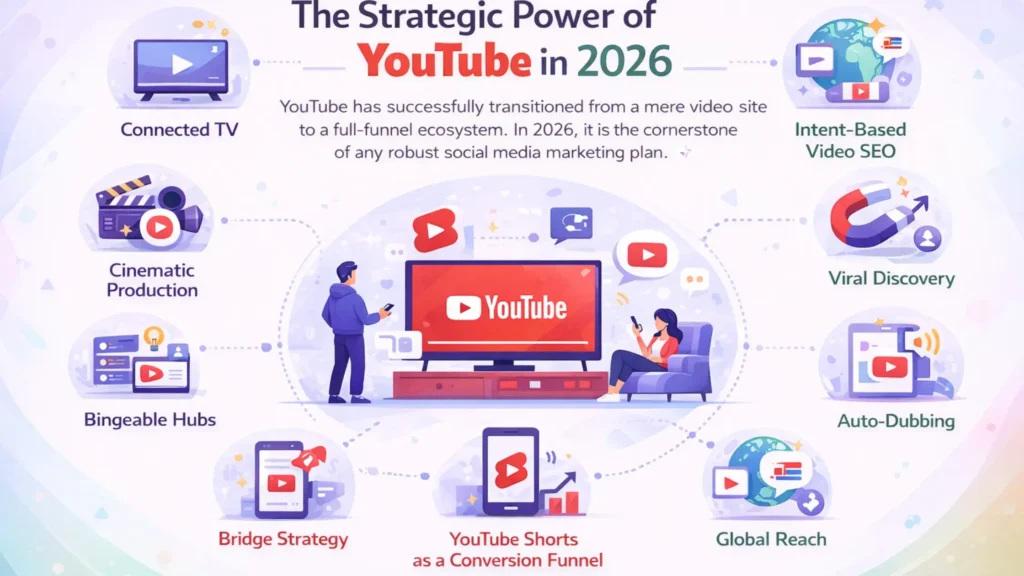
YouTube has successfully transitioned from a mere video site to a full-funnel ecosystem. In 2026, it is the cornerstone of any robust social media marketing plan.
1. The “TV-First” Storytelling Shift
YouTube is the new television. With more people watching YouTube on Connected TV (CTV) than ever before, the platform is competing directly with Netflix and traditional cable.
- Cinematic Production: For long-form content (15–30 minutes), audiences now expect higher production values, better pacing, and 4K quality suitable for a 65-inch screen.
- Bingeable Hubs: Your channel shouldn’t be a video dump. It must be organized into “knowledge hubs” via playlists that guide viewers from awareness to purchase.
2. YouTube Shorts as a Conversion Funnel
While long-form builds authority, YouTube Shorts is the discovery engine.
- The “Bridge” Strategy: Successful creators use Shorts to tease long-form videos. A 60-second tip leads to a 20-minute masterclass.
- Viral Discovery: The Shorts algorithm is more democratic, allowing small channels to gain massive visibility based on watch time rather than subscriber count.
3. Intent-Based Video SEO
YouTube is the world’s second-largest search engine. In 2026, how AI will change social media marketing is visible through AI-driven timestamps and auto-dubbing.
- Spoken Keywords: Speaking your keywords naturally in the video helps the AI index your content for voice search.
- Global Reach: AI-powered dubbing allows a single video to reach global markets in their native languages, effectively multiplying your reach with zero extra production cost.
Social Commerce and AR Experiences
Shopping is now a native social behavior. Social commerce trends in 2026 show that the friction between discovery and checkout has been eliminated.
- In-App Checkout: Users no longer want to click “link in bio.” They want to buy directly within the post or video.
- AR Try-Ons: Augmented Reality has become a standard tool for retail, allowing users to “place” furniture in their homes or “try on” makeup using their phone cameras.
- YouTube Shopping: The integration of shoppable tags in both Shorts and long-form videos has turned YouTube into a “Digital QVC” for the modern age.
Community-Based and Niche Social Platforms
The fragmentation of the internet has led to the rise of niche platforms. Instead of one platform for everything, users are choosing specific apps for specific needs:
- Vertical Networks: Platforms dedicated solely to professional niches, particular hobbies, or localized communities.
- Private Groups & “Dark Social”: The shift toward messaging apps (WhatsApp, Discord, Telegram), where the most influential brand discussions happen away from public algorithms.
Influencer Marketing Evolution in 2026
Influencer marketing trends for 2026 point to a decisive shift toward “Expert Personal Brands.”
- Nano & Micro-Influencers: These creators have the highest levels of trust because they are viewed as peers rather than celebrities.
- Long-Term Partnerships: One-off “shoutouts” are dead. Brands are now signing multi-year contracts with creators who act as true brand ambassadors and product co-creators.
- Performance-Based Pay: Influencers are increasingly compensated based on actual sales and ROI rather than just “impressions.”
Privacy, Ethics, and Trust in Social Media
In 2026, trust is the ultimate metric. As deepfakes and AI-generated misinformation become more prevalent, brands must act as a “source of truth.”
- Transparency Labels: Clearly marking any AI-generated or enhanced content is now a legal and ethical requirement.
- Data Sovereignty: Users are gravitating toward brands that let them control their data and opt out of aggressive tracking.
Strategic Shifts: How Businesses Should Prepare for 2026
To thrive in this new landscape, businesses must adjust their social media strategy in 2026 by focusing on three core pillars:
- Optimize for Search Intent: Stop thinking about “posts” and start thinking about “answers.” Use keywords in your video scripts, captions, and thumbnails to capture high-intent searchers.
- Invest in Multi-Format Content: A single idea should be a YouTube Long-form (Authority), a LinkedIn Post (Insight), and 5 TikToks/Shorts (Awareness).
- Prioritize “Human” Video: In an AI world, the human element—messy, honest, and passionate—is what sells.
FAQ: Future of Social Media Trends 2026
What will social media look like in 2026?
Social media in 2026 will be a hybrid of entertainment, search, and commerce. It will be more decentralized, with users spending more time in niche communities and using social platforms as their primary means of searching for information and products.
How will AI change social media marketing in 2026?
AI will move from a content creation tool to a strategic partner. It will handle real-time campaign optimization, predict audience sentiment shifts, and provide hyper-personalized experiences, making marketing more efficient and targeted.
What are the top influencer marketing trends for 2026?
The top trends include the dominance of micro-influencers, the shift toward performance-based compensation, and the transition of creators from “promoters” to “expert brand partners” who provide authentic thought leadership.
Why is social search important for businesses in 2026?
Social search is vital because users are bypassing Google to find information on TikTok, Instagram, and YouTube. If your content isn’t optimized with relevant keywords, youwill miss out on high-intent traffic from younger demographics.
How should businesses use YouTube in 2026?
Businesses should use YouTube as a “Searchable Knowledge Hub.” This includes using Shorts for discovery, long-form for building authority on the TV screen, and YouTube Shopping features to drive direct revenue from videos.
Conclusion: The Future belongs to the Authentic
The future of social media trends 2026 isn’t about chasing every new algorithm update. It is about returning to the core of why social media exists: connection. While AI and automation provide the speed and scale, it is human authenticity and community that give a brand its soul.
As search becomes social and commerce becomes conversational, the businesses that will win are those that provide the most value, transparency, and seamless experiences. The landscape of 2026 is complex, but for those who prioritize the user journey over vanity metrics, the growth opportunities are limitless.
As a leading digital marketing company in Visakhapatnam, Genbe delivers result-driven marketing services designed to help brands grow with clarity and confidence. By combining strategic thinking, data-led execution, and human-centered storytelling, we help businesses build meaningful digital presence and long-term value.
From strategy to execution, Genbe focuses on delivering marketing solutions that are effective, sustainable, and aligned with real business goals.