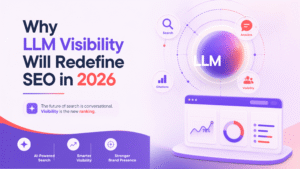

There’s a quiet revolution happening in the way people find information online — and most brands are completely unprepared for it.
A few years ago, the game was straightforward: rank on Google’s first page, drive traffic, convert visitors. Simple enough. But that playbook is showing its age. Today, a growing number of people aren’t scanning blue links at all. They’re typing questions directly into ChatGPT, Perplexity, Gemini, or Microsoft Copilot — and they’re trusting whatever answer comes back. No clicking. No comparing. Just a synthesized response that feels authoritative enough to act on.
This isn’t a distant trend. It’s already reshaping how buying decisions are made, how trust is formed, and most critically, which brands get remembered and which ones get skipped entirely.
So What Exactly Is LLM Visibility?
LLM visibility is exactly what it sounds like: the degree to which your brand, product, or expertise shows up inside responses generated by large language models.
Think about that for a second. When someone asks ChatGPT, “What’s the best enterprise SEO agency for AI search?” — that AI isn’t pulling up a ranked list. It’s drawing on patterns it has learned from thousands of credible sources, identifying brands that consistently appear in authoritative contexts around that topic, and generating a confident, consolidated answer.
If your brand isn’t part of those patterns, it simply doesn’t exist in that response. And increasingly, that response is where trust is formed before a buyer ever lands on your website.
This is fundamentally different from traditional SEO. Traditional optimization is about rankings, keywords, and backlinks. LLM visibility is about something deeper: contextual authority. It’s about whether an AI system, having processed an enormous amount of information, naturally associates your brand with the problems you solve.
Why Traditional SEO Alone Won’t Cut It Anymore
Let’s be clear — SEO isn’t dead. It’s not even close to dying. Rankings still drive traffic, technical optimization still matters, and content quality still plays a central role. If you’re currently running an enterprise SEO strategy, keep going. You need it.
But here’s the uncomfortable truth: ranking #1 on Google is no longer a guarantee of visibility.
Here’s a real scenario. A potential client is researching B2B marketing agencies. They search Google — sure. But they also open ChatGPT and ask, “Which agencies are best at AI-era digital marketing strategy?” Your competitor, who ranks #3 on Google but has built strong topical authority across credible publications and structured their content for AI interpretation — gets mentioned in the AI response. You don’t. That prospect forms their shortlist before they ever visit your site.
This is what we call the Visibility Gap. And it’s widening every month. As we’ve explored in our deeper analysis of how AI and GEO are redefining business growth, brands that don’t adapt their discoverability strategy are already falling behind — quietly, invisibly.
How AI Systems Actually Decide What to Reference
Here’s where most marketers get confused. They assume AI search works like traditional search — that it rewards the same signals. It doesn’t.
LLMs don’t crawl and rank pages in real time the way Google does. They’ve been trained on vast bodies of information and have internalized associations between brands, topics, and authority. When generating a response, they surface information based on:
- Consistency: Does your brand appear repeatedly across reputable sources in relation to a specific topic?
- Clarity: Is your positioning clearly associated with a defined expertise area?
- Coherence: Does your messaging say the same thing across your website, publications, interviews, and platforms?
- Structure: Is your content written in a way that’s easy for a model to interpret, summarize, and trust?
The brands that thrive in AI-generated responses aren’t the ones gaming a system. They’re the ones that have genuinely invested in becoming the most credible, clearly positioned answer in their space.
This connects directly to Answer Engine Optimization (AEO) — a discipline focused specifically on making your brand the one AI generators choose to mention. It’s not SEO’s replacement; it’s its evolution.
What Smart Marketers Are Doing Differently Right Now
The brands winning in AI search share a few habits that set them apart from those still running 2020-era playbooks.
They own a topic, rather than scatter across many. Trying to rank for everything means being authoritative in nothing. The brands showing up in AI responses have picked their lane and dominated it. A narrow, deep focus on one or two core expertise areas creates stronger contextual signals than broad, shallow content coverage.
They invest in depth, not just volume. A single, comprehensive, well-structured guide will outperform ten thin blog posts whenever it comes to LLM recognition. AI systems are built to synthesize credible explanations — and they favor content that actually explains things thoroughly.
They build credibility off their own site. Your website alone isn’t enough. AI systems pull from the broader information ecosystem — industry publications, podcasts, expert roundups, forum discussions, third-party research. Earning mentions in credible external channels is a core part of any modern digital marketing strategy.
They track AI mentions as a KPI. Rather than only measuring rankings and organic traffic, these brands regularly audit whether their name appears in AI-generated answers for their key topics. Visibility must be observed, not assumed.
A Practical Framework for Building LLM Visibility
Getting started doesn’t require burning down your existing strategy. Here’s how to layer LLM visibility on top of what you’re already doing:
- Define your topic territory. What do you want to be known for? Be specific. “Digital marketing” is too broad. “AI search visibility for B2B SaaS companies” is ownable. Clarity of focus is the foundation of contextual authority.
- Build pillar content that actually earns trust. Create structured, comprehensive resources — not for keyword density, but for genuine usefulness. Explain concepts clearly. Define terms. Make your expertise legible to both human readers and AI systems.
- Strengthen your off-site presence. Seek guest contributions to authoritative publications. Join expert commentary in your industry. Build a consistent voice across LinkedIn, podcasts, and industry forums. Learn how to effectively target decision-makers on LinkedIn — they’re the same audiences AI pulls from when generating business recommendations.
- Align your messaging everywhere. If your website says one thing, your LinkedIn bio says another, and your press mentions frame you differently again — AI systems struggle to confidently categorize you. Consistency isn’t just good branding. It’s a discoverability signal.
- Pair with performance channels. LLM visibility is a long-term play. In the short term, local PPC and paid campaigns can keep your pipeline moving while you build organic authority.
What’s Coming — And Why Acting Now Matters
The trajectory here is clear. AI-powered search is embedding itself into daily workflows at every level. As AI search strategy evolves through 2026, the brands that have built genuine contextual authority will compound their advantage. Those that wait will be playing catch-up in a market where the ground rules have already shifted.
LLM visibility isn’t a nice-to-have. In 2026, it will simply be the cost of being discoverable.
Frequently Asked Questions
What is LLM visibility, and how does it differ from regular SEO? LLM visibility refers to how and whether your brand appears in responses generated by AI systems like ChatGPT, Perplexity, or Google Gemini. Unlike traditional SEO — which focuses on ranking positions and keyword targeting — LLM visibility is about contextual authority: how clearly and consistently AI systems associate your brand with the topics you’re expert in.
Does traditional SEO still matter in 2026? Absolutely. Rankings still drive meaningful traffic, and technical SEO remains important infrastructure. But ranking alone no longer guarantees visibility. As more buying research moves into AI tools before users even visit a website, brands need both — strong traditional SEO and a strategy for appearing inside AI-generated answers.
How do I know if my brand is showing up in AI responses? Regularly query AI tools like ChatGPT, Perplexity, and Gemini with the questions your prospects would actually ask. Search for your core topics and see which brands appear. If your competitors show up and you don’t, that’s your gap. Treating AI mentions as a tracked KPI — not an afterthought — is how leading brands stay ahead.
How long does it take to build LLM visibility? It varies, but building contextual authority is a medium-to-long-term investment — typically 3 to 6 months of consistent effort before you see meaningful traction. That’s why starting early is a genuine competitive advantage. Brands that begin building authority now will be the ones AI systems reference when the stakes are highest.
What kind of content performs best in AI-generated responses? Structured, in-depth, clearly written content that genuinely explains a concept or solves a problem. AI systems favor content that is easy to interpret and summarize — think comprehensive guides, detailed explainers, and well-sourced resources over keyword-stuffed listicles or thin articles.
Can small businesses benefit from LLM visibility strategies? Yes — in fact, this may be where smaller brands have the biggest opportunity. By owning a specific niche clearly and consistently, a small business can become the go-to answer for AI systems within their domain, competing with much larger brands on authority rather than budget.
Ready to Become the Answer — Not Just a Result?
AI systems are already influencing how your prospects research, shortlist, and choose vendors. The question isn’t whether LLM visibility matters. It’s whether your brand is building it now or waiting until your competitors have locked it down.
Genbe’s full-service digital marketing team helps growth-focused organizations build authority-driven strategies designed for the AI era — from content architecture to cross-platform credibility, measurement frameworks to positioning clarity.
Contact Genbe today, and let’s map out exactly how your brand can start showing up where decisions are being made.
Because in 2026, being visible inside AI answers isn’t a bonus. It’s the baseline.