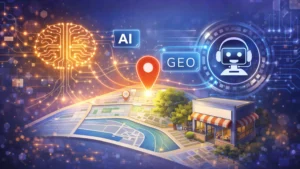

For years, digital presence followed a predictable formula.
Businesses invested in websites, focused on search rankings, published content for keywords, and measured success through traffic and conversions. Visibility meant being seen. Growth meant being clicked.
That model is rapidly changing.
As we approach digital presence 2026, visibility alone no longer guarantees relevance or growth. Today, businesses must be understood by AI systems, not just discovered by users. Decisions are increasingly shaped before a website visit ever happens—inside AI-generated answers, summaries, and recommendations.
In this new landscape, AI-driven growth and Generative Engine Optimization (GEO) are redefining how businesses compete, influence, and grow.
Digital Presence in 2026: Beyond Websites and Rankings
In the past, digital presence was primarily defined by owned assets:
- Websites
- Blogs
- Social media profiles
- Search engine rankings
While these still matter, they no longer represent the whole picture.
In 2026, digital presence includes how your business is represented across AI-powered discovery systems. These systems don’t simply retrieve information—they interpret it. They decide which brands are credible, which solutions are relevant, and which businesses deserve recommendations.
This means your digital presence now includes:
- Mentions and explanations inside AI-generated answers
- How clearly is your expertise described across platforms
- Whether your brand is consistently associated with specific problems and solutions
- How easily AI systems can summarize what your business does
In short, presence is no longer just about visibility. It’s about interpretability.
This marks a defining shift in the future of search—from navigation to decision support.
AI’s Expanding Role in Discovery and Decision-Making
Artificial intelligence has moved from being a backend optimization tool to a front-facing decision layer.
Today, users increasingly rely on AI to:
- Research unfamiliar topics
- Compare services and providers
- Filter overwhelming choices
- Make faster, more confident decisions
Instead of clicking through multiple websites, users ask one question and receive a synthesized response. This response often includes recommendations, context, and conclusions, thereby removing much of the traditional evaluation process.
For businesses, this changes where influence happens.
In AI discovery, trust is built before interaction. Brands that are clearly understood and consistently positioned become part of AI-generated narratives. Brands that are vague, inconsistent, or unclear are excluded—regardless of how much content they publish.
This is why AI in digital marketing is no longer just about automation or personalization. It is about representation.
What Is Generative Engine Optimization (GEO)?
Generative Engine Optimization (GEO) is the strategic practice of shaping your digital presence so AI systems can accurately understand, contextualize, and recommend your business within generated responses.
While traditional SEO focuses on optimizing pages for search engine rankings, GEO focuses on optimizing meaning.
GEO helps AI systems answer questions such as:
- What does this business specialize in?
- Who is it best suited for?
- Why is it credible?
- When should it be recommended?
Unlike classic SEO tactics—keywords, backlinks, and technical signals—GEO emphasizes:
- Clear positioning
- Consistent messaging
- Contextual authority
- Trustworthiness across sources
GEO does not replace SEO. It extends it, reflecting the ongoing evolution of SEO toward AI-driven discovery.
How GEO Differs From Traditional SEO
The difference between SEO and GEO is subtle—but profound.
Traditional SEO is built around:
- Ranking pages
- Competing for clicks
- Optimizing for algorithms
GEO is built around:
- Being the best answer
- Competing for trust
- Optimizing for understanding
In a GEO-driven environment:
- Brands are treated as entities, not URLs
- Context matters more than exact keywords
- Authority is inferred from consistency, not volume
- Visibility can occur without traffic
This shift forces businesses to rethink what success looks like. High traffic without AI recognition may deliver diminishing returns. Apparent authority with fewer clicks may drive greater long-term impact.
AI + GEO as a Growth Engine
When AI-driven growth and GEO align, they create a new business growth dynamic—one built on trust, clarity, and efficiency.
Faster Trust Formation
AI systems prioritize sources they can confidently explain. When your digital presence reinforces expertise and consistency, trust is established instantly—often before direct engagement.
Shorter Decision Cycles
AI reduces friction. Businesses that are clearly positioned benefit from faster decision-making, as users rely on AI summaries rather than extensive research.
Compounding Visibility
When AI repeatedly references a brand as a trusted source, visibility compounds. Over time, this creates a durable influence that outlasts algorithm changes.
Higher Intent Alignment
AI-driven discovery surfaces brands that closely match user intent. This leads to fewer but more qualified interactions—improving overall business efficiency.
This is not growth driven by volume.
It is growth driven by clarity and confidence.
What Businesses Must Rethink in 2026
To succeed in this environment, businesses must challenge long-standing assumptions about digital strategy.
Content Quality Over Quantity
Publishing more content no longer guarantees authority. AI systems favor depth, structure, and coherence over frequency.
Authority Over Activity
Being active online matters less than being credible. Thought leadership, expertise, and trust signals now outweigh sheer output.
Consistency Across the Ecosystem
AI cross-references websites, profiles, reviews, articles, and mentions. Inconsistent messaging weakens credibility and reduces AI confidence.
New Success Metrics
Clicks and rankings are no longer sufficient indicators of success. Businesses must consider:
- AI visibility and mentions
- Contextual authority
- Brand inclusion in AI-generated answers
- Influence without direct traffic
This shift requires a new business growth strategy—one aligned with AI-driven realities.
The Growing Importance of AI Discovery
AI discovery reshapes how brands are surfaced and remembered.
Instead of browsing, users:
- Ask one question
- Receive one synthesized response
- Retain one or two brands
This concentration effect raises the stakes for clarity. Businesses that lack clear positioning risk being excluded entirely, even if they are technically optimized.
In this environment:
- Generic messaging disappears
- Ambiguous brands are ignored
- Clear specialists dominate
Digital presence becomes less about being everywhere and more about being unmistakable.
Looking Ahead: The Future of Digital Presence
As we move deeper into 2026, several trends are becoming unavoidable:
- Traditional search results will continue to shrink
- AI-generated answers will dominate discovery
- Trust and clarity will outweigh technical tactics
- Brand understanding will function as a ranking signal
The future of search belongs to businesses that invest in being interpretable, credible, and consistent.
Digital presence will no longer be a static asset. It will be a living system that must be continuously reinforced across platforms, formats, and contexts.
FAQ: Digital Presence, AI & GEO in 2026
1. What is digital presence in 2026?
Digital presence in 2026 includes not just websites and rankings, but how AI systems interpret, summarize, and recommend your brand within generated responses.
2. Does SEO still matter?
Yes. SEO remains foundational. However, it must evolve to support AI interpretation and entity-based recognition through GEO strategies.
3. What is the difference between SEO and GEO?
SEO optimizes for ranking and traffic. GEO optimizes for AI understanding, contextual authority, and recommendation inclusion.
4. How can businesses improve AI visibility?
By clarifying positioning, ensuring consistent messaging across platforms, strengthening authority signals, and structuring content for interpretability.
5. Why is AI discovery important for business growth?
AI systems increasingly shape buying decisions before users visit websites. Businesses included in AI-generated answers gain early influence and stronger trust.
Conclusion:
In 2026, digital presence is no longer defined by how visible you are.
It is defined by how well AI systems understand and represent your business.
Websites, content, and SEO still matter—but their purpose has evolved. They now feed clarity, trust, and context into AI-driven discovery engines that shape decisions before interaction.
Businesses that adapt early will benefit from faster trust, more substantial influence, and sustainable growth. Those that don’t may remain visible—but overlooked.
Being clearly understood is the new competitive advantage.
Build a digital presence AI can understand and trust.
→ Explore how Genbe helps businesses prepare for 2026 with AI-driven strategy, Generative Engine Optimization (GEO), and future-ready digital presence frameworks.