
Running a small business in 2026 is both exciting and brutally competitive. Every week, a new platform emerges, a new algorithm shifts, and a new buzzword floods your inbox. So how do you cut through the noise and build a digital marketing strategy for a small business that delivers real, measurable results without burning your budget?
Digital marketing for small businesses is no longer optional; it’s the single most powerful lever you have to reach new customers, build lasting trust, and grow revenue on a budget that actually makes sense for your size.
This guide is for you — the business owner juggling ten roles at once, trying to figure out where to put your next marketing dollar. We’ll break down what’s working right now, what to prioritize, and how to think about digital marketing in a way that’s sustainable, human, and built to grow.
Why Most Small Businesses Get Their Digital Marketing Strategy Wrong
Here’s the truth: most of the businesses either do too much or too little. They jump from one trend to another—trying new platforms or tactics every week—or they rely entirely on word-of-mouth and hope for consistent growth.
What actually works is a clear, structured approach. That starts with understanding your audience, choosing the right channels, and creating content that builds trust before asking for a sale.
Step 1: Set Clear Business Goals Before Choosing Any Marketing Tool or Agency
Before you think about which digital marketing agency for small businesses to hire, or which platform to show up on, get crystal clear on what you actually want to achieve.
Are you trying to:
- Generate leads for a service-based business?
- Drive foot traffic to a local storefront?
- Sell products through an e-commerce store?
- Build authority and trust in your niche?Your goals determine everything: your budget, your channels, your content, and how you measure success. A local restaurant in Denver has completely different marketing needs than a B2B consulting firm targeting national clients.Once you know what success looks like, you can reverse-engineer a digital marketing strategy to get there instead of throwing money at tactics that don’t match your actual objectives.
Step 2: Build a Strong SEO Foundation for Your Small Business Website
Search engine optimization isn’t dead; it’s evolving rapidly. In 2026, it plays a key role not only in traditional search rankings but also in how businesses appear across AI-driven platforms. When users ask for recommendations, the brands that surface are those with a strong and trustworthy online presence.
For small businesses, building a solid SEO foundation starts with optimizing your local profile. Keeping your business information accurate, adding photos, and sharing updates regularly helps improve visibility in location-based searches.
Equally important is structuring your website content to align with user intent. Each page should focus on a clear topic, use organized headings, and provide meaningful information that naturally incorporates relevant terms.
Finally, creating content that addresses real customer questions can set you apart. By understanding what your audience is looking for and delivering clear, helpful answers, you increase your chances of being discovered—whether through search engines or AI assistants.
Technical SEO — The Silent Rankings Killer: Page speed, mobile optimization, secure HTTPS, and clean site structure matter more than ever. Google’s Core Web Vitals still influence rankings in 2026, and a slow, clunky site bleeds customers before they ever see your offer.
Step 3: Choose the Best Digital Marketing Channels
Not every channel is right for every business. The mistake most small business owners make is trying to be everywhere at once. Here’s a realistic, practical breakdown of what works and when:
The Highest-ROI Digital Marketing Service for Small Businesses
Blogging remains one of the best long-term investments in digital marketing for small businesses, especially when paired with strong SEO. A single well-written post targeting the right keyword can bring in qualified leads for years, completely free, without paying for ads.
Focus on long-form, genuinely helpful content. If you’re a local plumber, write about common household problems homeowners deal with. The goal is to become the most useful resource in your niche, the site people share, bookmark, and keep coming back to.
Quality Over Quantity
Social media in 2026 is less about broadcasting and more about building real community. The small businesses winning on social aren’t the ones posting the most; they’re the ones showing up consistently, engaging authentically, and creating content their audience actually wants to share.
Pick one or two platforms where your audience genuinely spends time and master those before expanding:
- LinkedIn — best for B2B services and professional consulting
- Instagram — ideal for visual products and lifestyle brands
- Facebook — still effective for local community engagement and paid ads targeting
The Digital Marketing Tool Small Businesses Own Forever
Email is still the most direct, highest-converting line to your customers, and unlike social media followers, it’s an audience you own. If Instagram changes its algorithm tomorrow, your email list is unaffected.
Build your list from day one. Offer something genuinely valuable in exchange for an email address, a checklist, a free consultation, a discount, or a resource guide. Then nurture that list with useful content and occasional offers that feel helpful, not pushy.
Even a focused email list of 500 engaged subscribers can drive meaningful, consistent revenue for a small business when managed well.
The Fast-Track Digital Marketing Service for Small Business
For businesses that need leads immediately, paid advertising such as Google Ads, Meta Ads, or LinkedIn Ads can significantly accelerate results. But paid ads work best when you have a clear, compelling offer, a high-converting landing page, and enough budget to test and optimize properly.
If you’re just starting, organic channels are usually the smarter first investment. Use paid ads to amplify what’s already working organically, not as a substitute for building a real foundation.
Step 4: Know When to Hire a Digital Marketing Agency or Consultant for Your Small Business
At some point, doing everything yourself stops making strategic sense. If you’re a growing small business with real revenue and ambitious targets, partnering can be a game-changer.
Here’s how to evaluate your options honestly:
Freelancer vs. Digital Marketing Firm for Small Business: A solo consultant is often more affordable and deeply specialized in one or two areas. They typically offer more bandwidth, a broader range of services, and dedicated account management. Neither is inherently superior; it depends on your budget, goals, and how much strategic oversight you need.
What a Great Small Business Marketing Strategy Actually Does: Any agency worth hiring starts by deeply understanding your business, your audience, your competitive landscape, and your goals — before pitching a single tactic or package. Be cautious of anyone who leads with a price list before understanding your situation.
Local Agency vs. Remote Team: Geography matters far less than it did five years ago. That said, some businesses — especially local service providers genuinely benefit from working with an Austin digital marketing agency for small businesses or a Denver-based team that understands the local market dynamics, local competitors, and local customer behaviour.
Red Flags to Avoid: Guaranteed first-page rankings, overnight results, vague monthly reports, and no clear process or communication cadence. Great digital marketing services for small businesses take time to build momentum, and any honest provider will be upfront about realistic timelines.
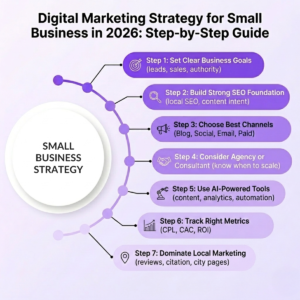
Step 5: Use AI-Powered Digital Marketing Tools
Artificial intelligence has fundamentally reshaped digital marketing, and that’s especially significant for small businesses that don’t have massive teams or budgets. AI tools can now help you:
- Generate content ideas, outlines, and first drafts in minutes
- Analyze keyword data and reverse-engineer competitor strategies
- Automate email sequences, social scheduling, and ad targeting
- Personalize customer experiences at a scale that was previously impossible
But here’s the critical nuance: AI is a powerful tool, not a complete strategy. The small businesses winning in 2026 are using AI to work faster and smarter while keeping their brand voice, personality, unique perspective, and human judgment front and center.
Customers increasingly can tell when they’re reading generic, machine-generated content. In a world flooded with AI output, authentic human expertise has become a real competitive advantage.
Step 6: Track the Right Metrics for Business Growth
You can’t improve what you don’t measure, but you also shouldn’t drown in vanity metrics that don’t connect to business outcomes. Pick a focused set of numbers that genuinely reflect whether your digital marketing strategy for a small business is working.
For most small businesses, these are the KPIs that matter:
- Website traffic and traffic source — are the right people finding you, and how?
- Conversion rate — what percentage of visitors take a meaningful action?
- Cost per lead (CPL) — how much are you paying to acquire each potential customer?
- Customer acquisition cost (CAC) — total marketing spend divided by new customers won
- Return on investment (ROI) — is your marketing actually making you more than it costs?
Set up Google Analytics 4, connect your Google Search Console, and build the discipline of reviewing your numbers at least monthly. Look for trends and patterns over time — not week-to-week perfection. Small, consistent improvements compound into significant results.
Step 7: Dominate Local Digital Marketing for Small Businesses Near You in 2026
If your business serves a specific geographic area, a city, a region, or a neighbourhood, local digital marketing deserves a serious slice of your attention and budget.
- Keep your Google Business Profile fully optimised, active, and regularly updated
- Build local citations consistent Name, Address, Phone number (NAP) across all major directories
- Actively earn genuine reviews from real customers, and respond to every single one publicly
- Create locally relevant content: city-specific service pages, local blog posts, and community involvement stories
Frequently Asked Questions:
What is the best digital marketing strategy for a small business in 2026?
The best digital marketing strategy for small businesses in 2026 combines a strong SEO foundation, consistent content marketing, an owned email list, and selective use of social media all aligned to clear business goals. Rather than chasing every platform, small businesses should focus on two to three high-impact channels and execute them consistently. Adding AI-powered tools for efficiency, while maintaining an authentic brand voice, gives small businesses a genuine competitive edge in 2026.
How much should a small business spend on digital marketing?
Most marketing experts recommend that small businesses allocate between 7% and 12% of gross revenue to marketing. For very early-stage businesses, the priority should be on low-cost, high-ROI activities like SEO, content creation, and email marketing before scaling into paid advertising. Businesses in competitive markets or with aggressive growth targets may need to invest closer to 15% to 20% of revenue during growth phases.
Why is digital marketing important for small businesses?
Digital marketing is important for small businesses because it levels the playing field against larger competitors. A well-optimised blog post, a strong Google Business Profile, or a targeted email campaign can reach exactly the right customer at exactly the right moment without requiring a massive budget. In 2026, customers research businesses online before making almost any purchase decision, which means businesses without a digital presence are effectively invisible to a huge portion of their potential market.
What services does a digital marketing agency provide?
A digital marketing agency typically offers services such as SEO, content creation, paid advertising, social media management, email marketing, and website optimization. Many agencies also provide analytics and reporting to track performance and improve results. The goal is to help businesses grow through measurable and scalable marketing strategies.
How do I choose the right digital marketing agency?
Start by researching agencies with strong online reviews and proven results. Look for clear case studies, transparent communication, and a strategic approach. A good agency will focus on understanding your business goals. Scheduling a consultation can help determine if they’re the right fit.
What is the difference between a marketing agency and a consultant?
A marketing consultant is usually an individual expert who provides strategy and guidance, while an agency offers a full team to execute campaigns. Consultants are ideal for businesses that need direction, while agencies are better suited for those looking to outsource complete marketing execution.
Which digital marketing channels are most important for small businesses?
The most important channels include local SEO, content marketing, email marketing, and social media. These help improve visibility, build relationships, and drive long-term growth. Paid advertising becomes more effective after establishing a strong organic foundation.
How long does digital marketing take to show results?
Results depend on the strategy used. SEO and content marketing typically take 3–6 months to generate consistent traffic, while paid advertising can produce immediate results. Email marketing often shows quicker engagement if there’s an existing audience. Long-term success usually comes from consistent effort over time.
Can small businesses manage digital marketing on their own?
Yes, many small businesses handle their own marketing using tools like Google Analytics, Google Search Console, Canva, and Mailchimp. While this approach saves money, it requires time and consistency. A hybrid approach handling some tasks internally while outsourcing specialized work, can be more efficient.
What is Generative Engine Optimization (GEO)?
Generative Engine Optimization (GEO) is the process of creating content that can be easily understood and referenced by AI-powered search tools. It focuses on clear structure, direct answers, and authoritative information. As AI platforms become a primary way users discover information, GEO helps businesses improve visibility beyond traditional search engines.
Final Thoughts:
Start with the fundamentals. Show up for your audience. Build trust long before you ask for the sale. Work with the best marketing agency or a consultant when you’re ready to scale. And remember: every successful business you admire started exactly where you are right now.
The tools are better than ever. The opportunity is real. Now it’s your move.
Ready to Grow? Get Expert Digital Marketing Services for Your Small Business — Contact Genbe
You don’t have to figure all of this out on your own. At Genbe, we specialize in delivering results-driven digital marketing services for small businesses, from SEO and content strategy to paid advertising, local search, and everything in between.
Whether you’re just getting started or ready to scale an existing presence, our team works as a true partner in your growth, transparent, strategic, and focused on outcomes that actually move the needle for your business.
Contact Genbe today to discuss your digital marketing strategy and get a free consultation tailored to your small business goals.
Want to Learn More? Read the Genbe Blog for Small Business Digital Marketing Tips
This guide is just the beginning. Our blog covers everything from local SEO tactics and content marketing frameworks to social media strategies and the latest AI marketing tools — all written specifically for small business owners like you.
Explore the Genbe Blog for practical, actionable digital marketing insights you can apply to your business today.
If you’re unsure whether your SEO foundation is strong, Genbe offers a free audit to identify quick wins.