
Let’s be honest, getting a consumer to buy from you today is harder than it’s ever been.
It’s not that people aren’t spending. They are. But they’re doing it on their own terms. They’re tuning out ads they don’t care about, skipping content that feels generic, and gravitating toward brands that genuinely understand them. The bar for what counts as “good marketing” has never been higher.
That’s why modern B2C marketing strategies need to go far beyond traditional advertising. Today’s consumers expect personalized experiences, authentic communication, and brands that deliver real value at every touchpoint.
If you’re a business selling directly to consumers, whether that’s through an eCommerce store, subscription service, retail brand, or consumer app, this guide is for you. We’re going to break down what B2C marketing actually means in 2026, which digital marketing strategies are driving real results, and where most brands are still getting it wrong.
What Is B2C Marketing, and Why Does It Work Differently?
B2C (Business-to-Consumer) marketing is exactly what it sounds like: brands marketing directly to individual people rather than to other businesses.
But here’s where it gets nuanced. B2C buying decisions are fundamentally different from B2B ones. There’s no procurement committee, no six-month sales cycle, no 40-page proposal. A consumer sees something, feels something, and either acts or doesn’t.
That emotional dimension is everything in B2C. People buy because a product makes them feel confident, excited, nostalgic, or understood. They buy because they trust the brand. They buy it because their favorite creator uses it. Logic matters, sure, but emotion closes the deal.
This means B2C marketing has to do something B2B rarely needs to do: connect fast, connect personally, and make someone care within seconds.
Why B2C Marketing Is Harder Than It Looks
The average consumer sees thousands of marketing messages every day. Most get filtered out before they’ve even registered consciously. Ad fatigue is real. Banner blindness is real. And brand loyalty — the kind that used to come automatically with a good product — now has to be actively earned and continuously maintained.
Here’s what makes the modern B2C environment particularly challenging:
Consumers expect personalization as a baseline, not a bonus. They expect your website to remember them, your emails to feel relevant, and your ads to reflect what they actually care about. Anything less feels lazy.
Trust is fragile and hard to rebuild. One bad experience, one tone-deaf campaign, or one broken checkout process can undo months of relationship-building.
Platforms change constantly. Algorithms shift. Formats that worked last year (hello, link-in-bio posts) get deprioritized. Brands that build their entire strategy around one channel find themselves scrambling every few months.
Succeeding in this environment requires a digital marketing strategy that’s adaptive, customer-centric, and built on a genuine understanding, not just clever copy.
The Core B2C Marketing Strategies That Drive Real Results
1. Know Your Customer Deeply Before Doing Anything Else
This sounds obvious, but most brands skip it or do it superficially. Demographics (age, location, income) are a starting point, not a destination. What you really need to understand is what your customer values, what frustrates them, what motivates them to open their wallet — and what makes them close it.
When your messaging reflects that depth of understanding, everything performs better. Your emails get opened. Your ads get clicked. Your product pages convert. There’s no shortcut to this — it requires real research, real listening, and a willingness to update your assumptions as your audience evolves.
2. Content Marketing That Helps, Not Just Sells
The brands building the most loyal consumer bases in 2026 aren’t the ones with the most aggressive sales content. They’re the ones that make people’s lives better or easier through content — and then happen to sell something useful at the end.
That means blog posts that answer real questions, videos that solve real problems, social content that genuinely entertains, and interactive content (quizzes, polls, tools) that creates value in exchange for attention. When your content is actually useful, people come back for it. And when they trust your content, they trust your products.
For brands with a larger footprint, an enterprise SEO strategy ensures this content reaches the right audiences at scale not just within your existing following.
3. Social Media as a Relationship Channel, Not a Broadcast Channel
The brands that treat social media as a megaphone for promotions are losing ground fast. The ones winning are the ones treating it like a conversation.
That means responding to comments — the real ones, not just the easy compliments. It means engaging with content in your niche, not just publishing your own. It means building a brand voice that sounds like an actual person, not a corporate press release. Consistent, authentic engagement builds the kind of emotional loyalty that no amount of ad spend can replicate.
4. Influencer and Creator Partnerships — But Choose Wisely
Consumers trust other people more than they trust brands. That’s not new information, but the implications are worth sitting with: a recommendation from a trusted creator in your niche can outperform your entire paid media spend for the week.
The keyword is trusted. Audience size matters far less than audience fit. A micro-influencer with 8,000 deeply engaged followers in your specific niche will consistently outperform a celebrity with 2 million passive ones. Look for creators whose audience already overlaps with your customer profile — and who genuinely align with what your brand stands for.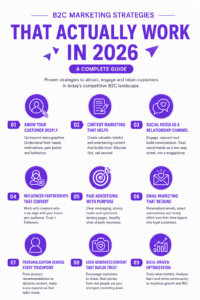
5. Paid Advertising With Purpose
Paid ads work — when they’re built around a clear value proposition, a strong emotional hook, and an optimized landing page. When they’re not, you’re just burning budget.
The biggest mistake B2C brands make with paid advertising is treating it as a shortcut rather than an amplifier. Ads work best when they’re amplifying something that already resonates organically. If your message isn’t connecting on social or in email, paid media won’t fix that — it’ll just spread it faster.
Local PPC campaigns can be particularly effective for B2C brands with a geographic presence, delivering high-intent consumers right to your door.
6. Email Marketing: Your Most Underrated Retention Tool
Email is consistently one of the highest-ROI channels in B2C marketing, and it’s chronically underused by brands that are too focused on acquisition to invest in retention.
The math is simple: keeping an existing customer costs far less than acquiring a new one, and loyal customers spend more over time. Welcome sequences, personalized product recommendations, abandoned cart follow-ups, loyalty rewards, seasonal campaigns — done thoughtfully, these feel like genuinely useful communication rather than spam.
The critical word is “personalized.” Generic blast emails have a dismal open rate. Emails that reference what someone actually browsed, bought, or showed interest in perform exponentially better.
7. Personalization Across Every Touchpoint
Consumers have been trained by Amazon, Netflix, and Spotify to expect experiences tailored to them. When they land on a brand’s website and get a completely generic experience, it creates a subconscious disconnect — this brand doesn’t know me.
Personalization in 2026 spans product recommendations based on browsing behavior, location-based offers, customized email content, and dynamic website experiences that adapt to returning visitors. The technology to do this is widely accessible. The brands not doing it are leaving conversions on the table.
8. User-Generated Content: Let Your Customers Sell for You
Nothing builds trust faster than real customers talking about their real experiences. Reviews, photos, unboxing videos, testimonials UGC is the modern word-of-mouth, and it’s more powerful than most branded content by a wide margin.
The brands that win at UGC don’t just passively collect it — they actively create the conditions for it. That means making the post-purchase experience worth sharing, encouraging customers to tag the brand, featuring real customer content prominently, and making people feel seen when they do share. If you’re planning a new product launch, building a UGC strategy into it from day one can generate organic momentum that no ad budget can buy.
9. Data-Driven Optimization: Track What Actually Matters
Modern B2C marketing produces a lot of data. The challenge isn’t accessing it — it’s focusing on the metrics that actually predict business outcomes, rather than vanity metrics that look good in reports.
Conversion rate, customer acquisition cost, customer lifetime value, retention rate, churn — these are the numbers that tell you whether your marketing is working. An integrated digital marketing services approach connects these dots across channels, giving you a complete picture instead of fragmented snapshots.
Combine your analytics with SEO insights, and you can identify exactly what your customers are searching for — and ensure you’re showing up at exactly the right moment in their journey.
Common Mistakes That Undermine B2C Marketing
Even brands with solid strategies stumble on execution. A few patterns worth watching out for:
Leading with features instead of benefits. Consumers don’t care how your product works — they care what it does for them. Frame everything through the lens of their life, not your engineering.
Going quiet after the sale. Post-purchase engagement is where loyalty is built. Brands that disappear after the checkout confirmation are missing the most important phase of the customer relationship.
Inconsistent messaging across channels. If your tone on Instagram sounds nothing like your email copy, which sounds nothing like your website, customers feel the dissonance — even if they can’t articulate it. Consistency builds trust.
Chasing trends without strategy. Not every viral format belongs in your marketing mix. Tactics should serve your brand, not the other way around.
Frequently Asked Questions
Q: What’s the biggest difference between B2C and B2B marketing? B2C is faster, more emotionally driven, and focused on individual consumers making personal decisions. B2B involves longer sales cycles, multiple stakeholders, and logic-heavy decision-making. If you’re curious how B2B decision-makers think, this breakdown on LinkedIn targeting is a useful contrast.
Q: How important is personalization in B2C marketing? It’s no longer optional — it’s expected. Consumers who feel like a brand understands them are significantly more likely to buy, stay loyal, and recommend the brand to others. Even basic personalization (relevant email content, behavioral product recommendations) dramatically outperforms generic messaging.
Q: Which B2C marketing channel delivers the best ROI? It depends on your business, but email consistently ranks near the top for ROI, especially for retention. Paid social is strong for acquisition but requires ongoing investment. Content and SEO take longer to build but deliver compounding returns. Most successful brands invest across several channels and track cross-channel performance.
Q: How do I build customer loyalty in a crowded market? Loyalty is built through consistent positive experiences — great products, responsive support, genuine engagement, and content that adds value beyond the sale. Loyalty programs help, but they’re not a substitute for the fundamentals. Customers stay loyal to brands that make them feel valued.
Q: Is influencer marketing worth it for small B2C brands? Yes — especially micro-influencers. You don’t need celebrity partnerships to benefit from influencer marketing. A well-chosen micro-influencer with a niche, engaged audience can deliver better conversion rates than larger influencers at a fraction of the cost.
Q: How do I get started if my B2C marketing is currently inconsistent? Start by auditing your current customer journey — where people find you, how they engage, and where they drop off. Then build a consistent strategy around your best-performing channels. A step-by-step digital marketing plan can help you prioritize where to focus first.
Ready to Build a B2C Marketing Strategy That Actually Converts?
The brands consumers love in 2026 share one thing in common: they put people first. Not products. Not promotions. People.
At Genbe, we help B2C brands build marketing systems that connect emotionally, perform analytically, and grow consistently — whether you’re launching something new or scaling what’s already working.
Let’s build your B2C growth strategy together → Contact Genbe Today