Search has always evolved. But rarely has it shifted this quietly — and this decisively.
For years, digital discovery followed a predictable pattern. A user typed a query into Google, scanned a list of blue links, and chose which site to explore. Rankings determined visibility. Visibility determined traffic. Traffic drove growth.
That model is no longer complete.
Today, millions of users are turning to AI systems like ChatGPT, Perplexity, Gemini, and Microsoft Copilot to ask questions directly. Instead of browsing links, they receive synthesized answers. Instead of comparing pages, they consume consolidated responses. Instead of clicking multiple websites, they often accept a single AI-generated explanation.
This shift changes everything.
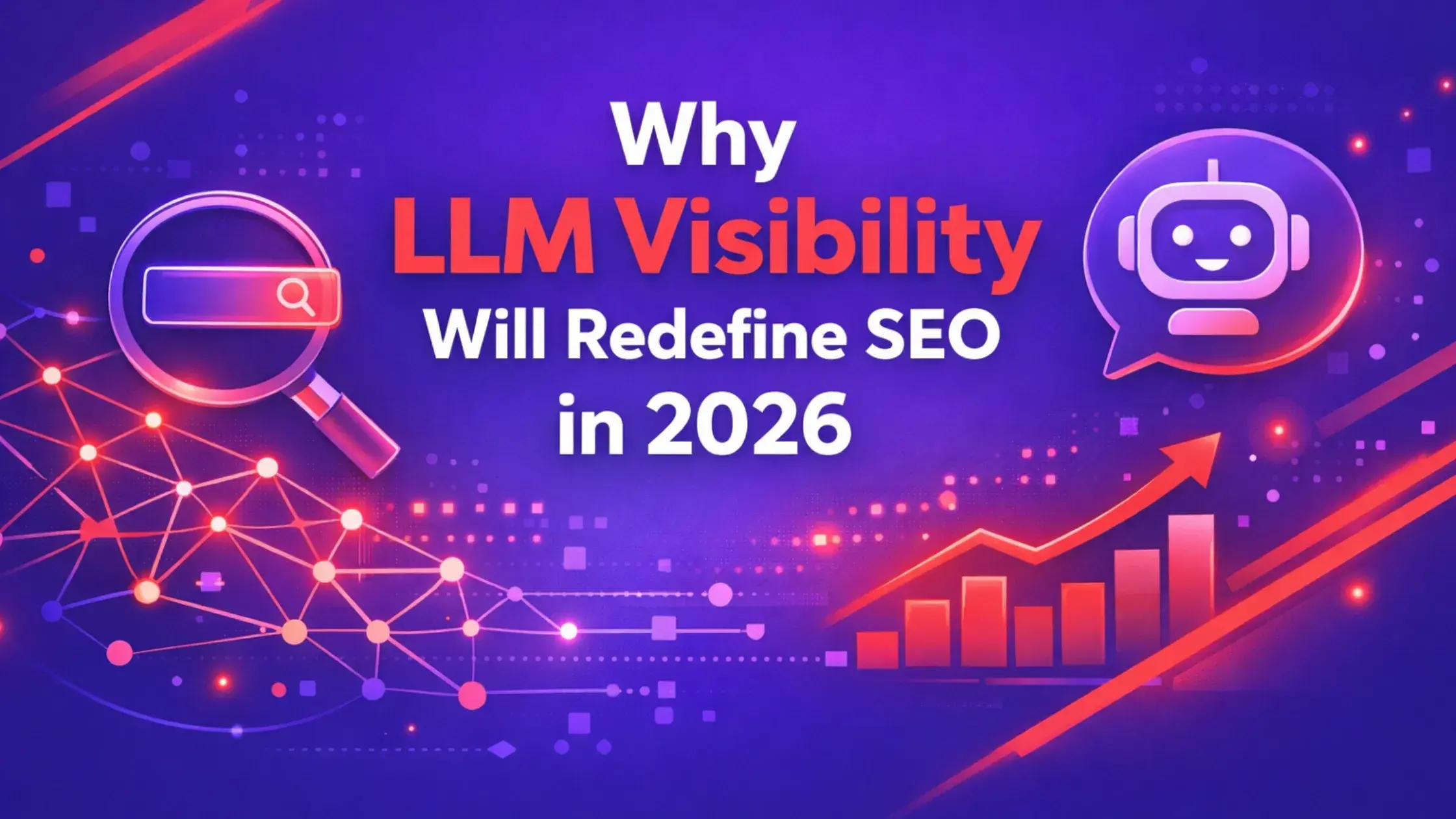
LLM Visibility is no longer defined solely by ranking positions. It is increasingly defined by whether your brand appears inside AI-generated answers at all.
Welcome to the era of LLM visibility.
What Is LLM Visibility?
LLM visibility refers to how a brand, product, service, or expertise area appears within responses generated by large language models (LLMs).
Unlike traditional search engines, AI systems do not present ten blue links. They interpret a question, synthesize information from multiple sources, and generate a consolidated answer.
Being Visible in This Context Means:
• Your brand is recognized as relevant to a specific topic
• Your expertise is reflected in AI explanations
• Your product or service is referenced when solutions are discussed
• Your positioning is clearly associated with a defined domain
This is fundamentally different from traditional SEO.
Conventional optimization focuses on keywords, backlinks, and rankings. LLM visibility focuses on contextual authority.
Large language models do not simply retrieve pages. They summarize patterns across trusted sources. They identify recurring associations between brands and topics. They surface what appears coherent, credible, and consistently positioned across the broader information ecosystem.
In practical terms, LLM visibility is not about chasing keywords. It is about shaping how AI systems understand your brand.
Why Traditional SEO Alone Won’t Be Enough in 2026
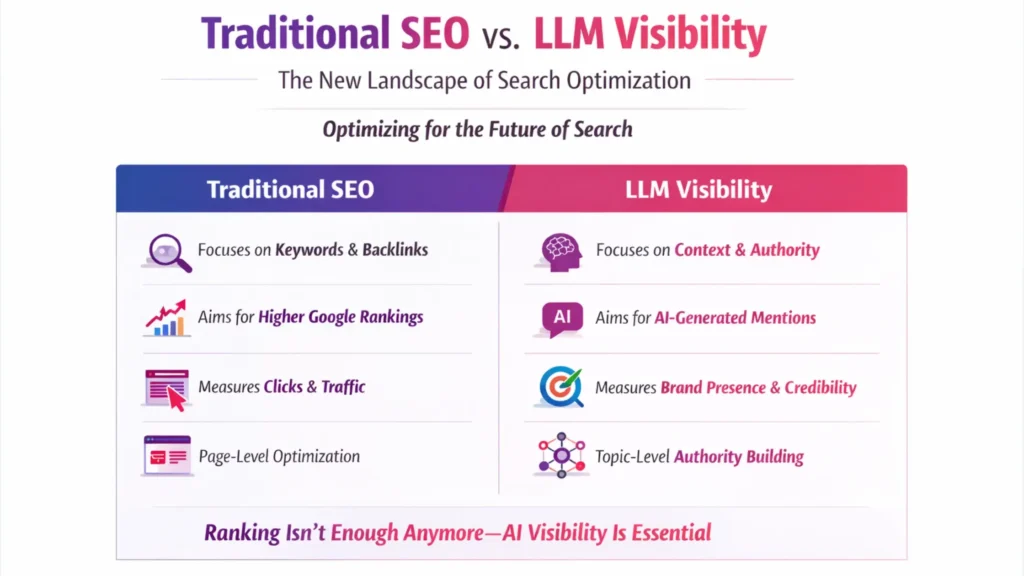
Traditional SEO was built on a simple assumption: higher rankings lead to more traffic.
That assumption is becoming less reliable.
Key Forces Reshaping Search Behavior:
• AI-generated answers increasingly resolve queries without requiring clicks
• Search platforms are prioritizing summaries over listings
• Users are trusting synthesized responses for faster decision-making
• Buying research is happening inside AI tools before visiting websites
Imagine a SaaS company ranking #1 for a high-value keyword.
Now imagine a potential buyer asking ChatGPT: “What are the best enterprise SEO agencies for AI visibility?”
If that SaaS company is not mentioned in the AI response, its ranking becomes irrelevant at the exact moment trust is formed.
The New Visibility Gap
Ranking without recognition is no longer enough.
SEO is not dying. It is evolving. Rankings still matter. Technical optimization still matters. Content still matters.
But ranking without contextual authority will not secure AI-era discovery.
How LLMs Decide What to Reference
LLM visibility is not driven by traditional ranking signals. These systems are not simply reordering search results.
AI Models Surface Information Based On:
• Consistency of a brand’s presence across authoritative sources
• Clarity of association between brand and topic
• Frequency of appearance in educational or thought leadership contexts
• Coherence of messaging across platforms
• Structured, well-explained content that is easy to interpret
In other words, AI systems favor brands that are easy to understand and easy to contextualize.
If your brand consistently appears alongside discussions of “AI search optimization” or “LLM visibility strategy,” it becomes more strongly associated with that domain.
If your positioning is scattered or unclear, AI systems struggle to confidently reference you.
This is why visibility in the AI era is less about page-level optimization and more about topic-level ownership.
What Marketers Need to Rethink Right Now
The rise of AI-driven discovery demands a strategic reset.
For years, content strategies emphasized scale, keyword coverage, and publishing frequency. While those tactics still support traditional SEO, they are not sufficient for LLM visibility.
Strategic Shifts Required:
1. Depth Now Outweighs Volume
LLMs are more likely to reference comprehensive, well-structured explanations than thin articles created purely for rankings.
2. Positioning Must Be Precise
Brands attempting to cover too many loosely connected topics risk being invisible in AI responses. Clear expertise boundaries strengthen contextual authority.
3. Authority Must Extend Beyond Owned Media
Mentions across credible publications, industry commentary, podcasts, research reports, and forums contribute to how AI systems perceive legitimacy.
4. Clarity Beats Cleverness
Structured content, direct definitions, logical narratives, and explicit topic framing make it easier for AI systems to interpret and summarize your expertise accurately.
The goal is not to manipulate AI systems. The goal is to remove ambiguity about what your brand stands for and what it solves.
Is Your Brand Showing Up in AI Answers — Or Being Replaced by Competitors?
AI systems are already influencing buying decisions. If your brand is not referenced inside AI-generated responses, you may be losing visibility at the moment prospects form trust.
Genbe helps growth-focused organizations transition from traditional SEO to AI-powered visibility frameworks built for 2026 and beyond.
With Genbe, You Gain:
• Authority-driven content architecture aligned with AI search behavior
• LLM visibility strategy across ChatGPT, Copilot, and emerging platforms
• Topic ownership positioning within your core expertise
• Cross-platform credibility reinforcement
• Measurement models that go beyond rankings and traffic
This is not about ranking higher. It is about becoming the referenced answer.
→ Book a strategic AI Visibility Consultation with Genbe to future-proof your SEO before LLM visibility becomes the baseline.
Budget Shifts and Strategy Changes Heading into 2026
As discovery patterns evolve, marketing budgets are adjusting.
Emerging Investment Areas:
• Authoritative, educational content assets
• Brand positioning clarity
• Cross-platform credibility building
• AI search visibility strategies
• Thought leadership amplification
This shift is closely tied to long-term ROI.
When discovery happens inside AI-generated answers, visibility becomes a durable asset. Instead of competing for fleeting clicks, brands compete for contextual recognition.
What Early Adopters Are Doing Differently
Organizations adapting early share several common traits.
These brands:
• Prioritize topic ownership over scattered keyword targeting
• Invest in research-backed, in-depth educational content
• Ensure messaging consistency across channels
• Measure visibility beyond rankings alone
• View AI recognition as a strategic KPI
Rather than asking, “How do we rank higher?” they are asking, “How do we become the most credible answer to this problem?”
How to Improve LLM Visibility: A Practical Framework
1. Define Your Topic Territory
Clarify the domain you want to be known for. Narrow focus increases recognition strength.
2. Build Comprehensive Pillar Content
Create structured, in-depth resources that explain concepts clearly and thoroughly.
3. Strengthen Cross-Platform Signals
Earn mentions in reputable publications. Participate in expert commentary. Publish thought leadership in recognized channels.
4. Maintain Messaging Consistency
Align website copy, social profiles, interviews, and articles around a unified positioning.
5. Monitor AI Mentions
Regularly evaluate whether your brand appears in AI-generated answers related to your core topics.
Visibility must be observed, not assumed.
The Future of SEO in an AI-Driven Landscape
As AI systems integrate more deeply into daily workflows, the definition of SEO will expand.
Key Implications:
• Brand clarity will function as a discoverability signal
• Authority will be measured contextually, not positionally
• Visibility will be earned through consistency, not isolated optimization
• Recognition inside AI answers will influence buying decisions
SEO is not being replaced. It is being elevated.
FAQ:
1. What is LLM visibility in SEO?
LLM visibility refers to how a brand appears inside responses generated by AI systems like ChatGPT, Perplexity, and Copilot. Instead of ranking in a list of links, brands must be contextually recognized and referenced within AI-generated answers.
2. How is LLM visibility different from traditional SEO?
Traditional SEO focuses on rankings, keywords, and backlinks. LLM visibility focuses on contextual authority, brand clarity, and consistent association with specific topics across the digital ecosystem.
3. Will traditional SEO become irrelevant by 2026?
No. Traditional SEO will remain important. However, ranking alone will not guarantee visibility inside AI-generated answers.
4. How can brands improve LLM visibility?
Brands can improve LLM visibility by publishing authoritative content, maintaining consistent positioning, earning credible mentions, and structuring content clearly for AI interpretation.
5. Why should businesses act now?
Because LLM visibility is rapidly moving toward becoming a baseline expectation rather than a competitive advantage.
Conclusion
LLM visibility is not an optional extension of SEO.
It represents the next stage in how visibility is defined, earned, and sustained.
By 2026, LLM visibility will not be an advantage. It will be the standard.
The brands that act now will shape how they are represented in the AI-driven future of search.
Want your brand to be discoverable inside AI answers, not invisible?
Genbe helps organizations build authority-driven SEO strategies designed for the AI era.
→ Talk to Genbe today and position your brand to lead in 2026 and beyond.